Dive Sites
Best Places to Dive in Tasmania
By ScubaDownUnder Team · Published 11 May 2026
Tasmania produces the most distinctive temperate diving in the country and arguably some of the best cool-water diving in the southern hemisphere. The state's geology is dolerite, the same Jurassic basalt that produced the Tasman Peninsula's three-hundred-metre sea cliffs and the offshore stacks that drop straight from the splash zone into the cold Tasman Sea. The marine life is the southern Australian temperate assemblage at its richest: weedy seadragons, giant Maori octopus, broadnose sevengill sharks, fur seals, draughtboard sharks, and the bright-coloured invertebrate life that thrives in cold, oxygen-rich water. Tasmania is the country of the palawa people of lutruwita, whose connection to this coast and its waters predates European arrival by tens of thousands of years.
What separates Tasmanian diving from the rest of southern Australia is the geometry. The dolerite columns produce vertical walls, sheer drop-offs, and cave-and-overhang structures unique on the Australian coast. Combined with the protected status of much of the coastline (Tasman National Park, Maria Island, Freycinet, Kent Group, plus a network of marine reserves), the result is some of the densest and most legible temperate diving anywhere.
## The Tasman Peninsula
The Tasman Peninsula southeast of Hobart holds the headline dives of Tasmanian recreational scuba and is the destination for most visiting divers. The peninsula's geology produces dramatic underwater terrain: dolerite walls dropping past 30 metres, cave systems carved by ocean swell into the cliff bases, and offshore pinnacles that rise from deep water into curious fur seal colonies.
[Hippolyte Rocks](https://www.scubadownunder.com/dive-sites/hippolyte-rocks) is the peninsula's flagship offshore site, a pair of weather-stained pinnacles 5 kilometres off Eaglehawk Neck with hundreds of resident Australian fur seals and broadnose sevengill sharks year-round. [Waterfall Bay](https://www.scubadownunder.com/dive-sites/waterfall-bay) sits below the peninsula's tallest cliffs and holds the entrance to a sea cave system carved into the cliff base. The [SS Nord wreck](https://www.scubadownunder.com/dive-sites/ss-nord-wreck), lying broadly intact at 35 to 42 metres near Hippolyte, is one of Australia's deepest and best-preserved wrecks and is reserved for technical divers. Cathedral Cave, [Sisters Rocks](https://www.scubadownunder.com/dive-sites/sisters-rocks-cape-surville) and [Fortescue Bay](https://www.scubadownunder.com/dive-sites/fortescue-bay) round out the peninsula's roster. Pirates Bay at Eaglehawk Neck is the main charter departure point, and Eaglehawk Dive Centre is the long-established operator.
## Bicheno and Governor Island
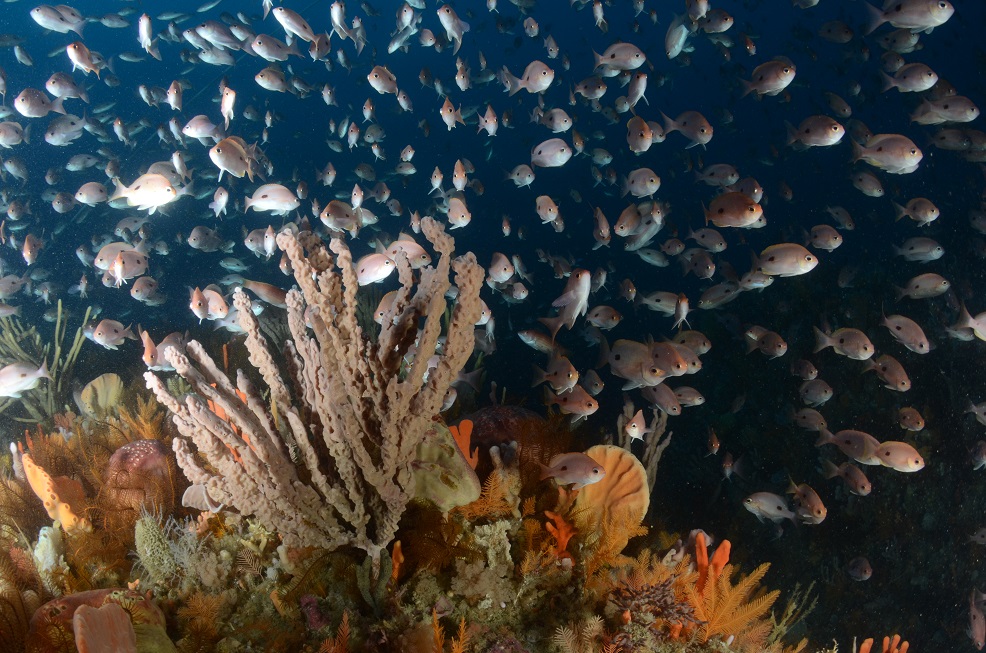
Bicheno on the east coast holds [Governor Island Marine Reserve](https://www.scubadownunder.com/dive-sites/governor-island-marine-reserve), regarded as Tasmania's premier shore-accessible dive area. The reserve packs over 35 named dive sites into a small protected zone, with granite walls, swim-throughs, caverns and sandy bommies between 5 and 40 metres of water. The marine life is dense after decades of full protection: weedy seadragons, eastern blue groper, banded morwong, butterfly perch, southern rock lobster, and sponge gardens that read as more diverse than tropical reef habitat. Winter visibility regularly hits 20 metres, exceptional for temperate water. Bicheno's sheltered geometry makes it the more accessible alternative to the Tasman Peninsula's open-ocean exposure.
## Freycinet and the East Coast
The Freycinet Peninsula north of Bicheno extends Tasmania's east coast diving into more remote granite country. The headline offshore site is [Ile des Phoques](https://www.scubadownunder.com/dive-sites/ile-des-phoques), a rugged granite island 18 kilometres off Little Swanport with a substantial Australian fur seal haul-out and a network of cave systems beginning at 20 metres. The island is reached by charter from Triabunna or Coles Bay and is dive-able only on calm days. The east coast more broadly holds reef diving from the protected bays around Coles Bay south to the Tasman Peninsula, much of it accessible from charter boats in calm summer windows.
## Hobart and the South
Hobart's local diving is concentrated around the Derwent Estuary and the immediate southern coast. [Tinderbox Marine Reserve](https://www.scubadownunder.com/dive-sites/tinderbox-marine-reserve), 23 kilometres south of Hobart, offers a sheltered shore dive with an underwater interpretive trail and is the standard training and refresher site for Hobart-based divers. Kelp gardens, sponge ledges and weedy seadragon habitat run along the sandstone reef close to shore. Bruny Island, accessible by ferry, holds further sheltered shore dives and offshore reef structures. The southern Tasmanian water is the coldest in mainland Tasmania (10 to 17°C across the year), and a 7mm wetsuit or drysuit is the comfortable choice.
## The North Coast and Kent Group
Tasmania's north coast and the Kent Group of islands in the eastern Bass Strait hold some of the most isolated diving in the state, accessible only by liveaboard or extended charter from Devonport, Launceston or Wilsons Promontory in Victoria. The Kent Group, a marine reserve of granite islands rising from deep water in the strait, supports fur seal colonies, dense sponge gardens, and seasonal weedy seadragon habitat. Trips are weather-window dependent and require multi-day commitment. Tasmania's far north and west coasts are diveable in calm windows but lack the dive operator infrastructure of the east and south.
## When to Dive Tasmania
Tasmanian diving runs year-round but peaks from December through April, the southern hemisphere summer and early autumn. Surface conditions are calmest, water temperature highest (16 to 18°C), and visibility windows largest (regularly 15 to 25 metres). Winter diving is technically possible and produces the cleanest water of the year on the days when weather allows, but Tasmania's southern winter is the limiting factor for surface access. The Tasman Peninsula's exposed sites lose more days to weather than the sheltered Bicheno reserve. Plan trips with weather buffer days built in.
Water temperature ranges from 10°C in the south winter to 18°C in the east summer. A drysuit is the most comfortable choice across the year, and most operators rent them. A 7mm semi-dry suit is the alternative for divers committed to wetsuit diving in summer.
## Trip Planning Notes
Hobart is the main air gateway, with direct flights from all mainland capitals. The Tasman Peninsula and Bicheno are 90 minutes and 2.5 hours from Hobart by road respectively. The Freycinet Peninsula is 3 hours. Eaglehawk Dive Centre at Pirates Bay is the dominant Tasman Peninsula operator and the standard booking point for Hippolyte, Waterfall Bay, the SS Nord and surrounding sites. Bicheno Dive Centre handles Governor Island. Bruny Island and Tinderbox have local operators in Hobart. Drysuit hire is widely available across the state.
Tasmania rewards divers who commit to the cold and the longer transits. The diving here is among the best in the southern hemisphere and the species list is unique to the latitude. For divers who have worked the warm-water sites in the north and want a different chapter of Australian diving, Tasmania is the next destination after the East Coast.