Tips
Best Time to Dive in Australia: Season Guide
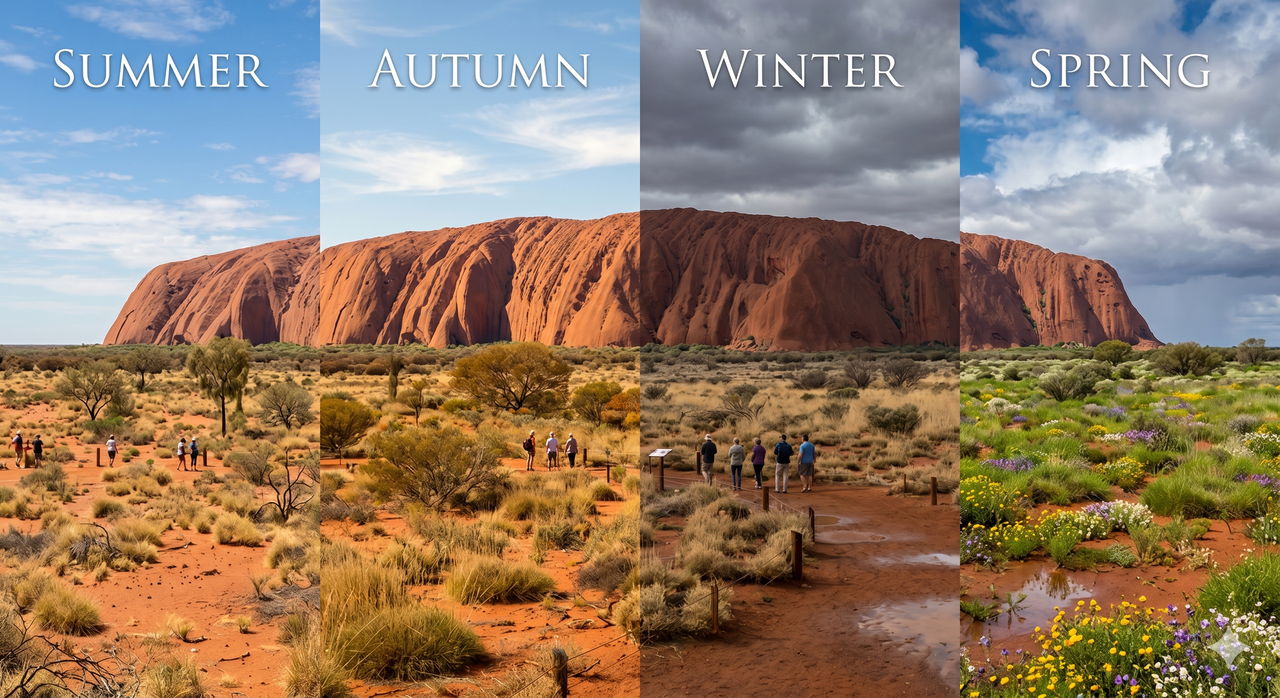
When to dive every Australian region: dry season up north, summer down south, whale shark and grey nurse seasons, month by month.
By ScubaDownUnder Team · Published 18 May 2026
Australia is the largest dive country in the world by coastline length, and the question of when to visit produces a different answer for every region. The tropical north peaks in the dry season; the southern temperate states peak in summer; the south-east coast holds dive seasons that switch between winter species and summer species inside a single year. This guide breaks the calendar into the four diving seasons that actually matter on Australian coasts and identifies the species, regions and operators that align with each window.
## The geography that drives the calendar
Three patterns shape Australian dive seasons:
**The East Australian Current** carries warm tropical water down the east coast through summer and autumn, pushing whale sharks south to Lady Elliot, leopard sharks into the [Gold Coast Seaway](https://www.scubadownunder.com/dive-sites/gold-coast-seaway), and tropical species into northern New South Wales. The same current weakens through winter, and cold-water species like grey nurse sharks aggregate in larger numbers along the NSW coast.
**The northern wet/dry season** dominates the tropical waters of Queensland, the Northern Territory and northern Western Australia. The dry season (May to October) brings calm seas, cleaner water, lower humidity and the absence of saltwater crocodile water-edge risk that wet-season runoff produces. Box jellyfish are present in northern coastal waters October through May.
**The southern summer** is the only window for most temperate diving in Tasmania, Victoria, South Australia and southern Western Australia. December through April delivers the warmest water (16 to 22°C depending on latitude), the calmest seas, and the best visibility of the year for most cold-water sites.
## Summer (December to February)
The headline season for most Australian diving. The east coast warms, the temperate states open up, and the marine life calendar peaks across the south.
**Best for:** Leopard sharks at the Gold Coast Seaway and [Julian Rocks](https://www.scubadownunder.com/dive-sites/julian-rocks) (peak November to May, summer is the heart of the season). Manta rays at [Julian Rocks](https://www.scubadownunder.com/dive-sites/julian-rocks-marine-sanctuary), [Wolf Rock](https://www.scubadownunder.com/dive-sites/wolf-rock) and along the east coast. Giant cuttlefish hatching at Whyalla (which spawned in winter). Shore-based diving at Sydney's east-coast sites with warmest water of the year. Tasmania's open-coast sites at their most accessible. Victoria's bay diving and offshore reefs at peak. Great white shark cage diving at Port Lincoln on the cusp of peak season.
**Avoid in summer:** Whyalla cuttlefish aggregation (it ends in August). Whale shark season at [Ningaloo](https://www.scubadownunder.com/dive-sites/ningaloo-reef) (it runs March to August). The far north tropics (wet season risks for crocodile and box jellyfish). Coral spawning windows on the GBR (one specific November-December full moon).
**Best regions to plan around:** the southern temperate states (TAS, VIC, SA), Sydney and the NSW coast, the southern Great Barrier Reef.
## Autumn (March to May)
The transition season and arguably the best all-round window for east-coast and northern diving. The water stays warm into May while the wet-season risks recede in the tropics.
**Best for:** Whale sharks at Ningaloo (season opens in March). Coral spawning on the Great Barrier Reef (specific November to early December full moon dates). The clearest water of the year on most NSW sites. Manta rays continue through autumn at most sites. Cuttlefish at Whyalla don't peak until later but the run-up begins. Macro photography across the temperate sites with stable water and reduced storm activity.
**Best regions:** Ningaloo and [Coral Bay](https://www.scubadownunder.com/dive-sites/coral-bay), the southern Great Barrier Reef, the NSW coast, South Australia's leafy seadragon sites at Rapid Bay and Edithburgh.
## Winter (June to August)
Australia's diving doesn't shut down in winter, it shifts. The northern tropics become the working dive water; the southern temperate sites become more weather-dependent but produce the clearest water of the year on calm days.
**Best for:** The Whyalla giant cuttlefish aggregation, the most distinctive single dive event in Australian waters (peak June and July, with hundreds of thousands of cuttlefish in less than 8 metres of water). Whale shark season at Ningaloo continues through August. Grey nurse shark aggregations at NSW sites (Fish Rock, Lighthouse Reef, [Bushrangers Bay](https://www.scubadownunder.com/dive-sites/bushrangers-bay), [Magic Point](https://www.scubadownunder.com/dive-sites/magic-point)) peak through winter, with counts of 20 to 40 sharks at Fish Rock common from May through September. Humpback whale migration along the east coast (June to October) provides surface-encounter opportunities. Great white shark cage diving at Port Lincoln peaks. Lady Elliot's manta numbers peak in winter when up to 50 mantas can be at a single cleaning station. Port Jackson sharks aggregate at southern NSW sites.
**Best regions:** Ningaloo (whale sharks), South Australia (cuttlefish, sharks), the NSW coast (grey nurse), [Lady Elliot Island](https://www.scubadownunder.com/dive-sites/lady-elliot-island) (mantas), the tropical north (now in dry season).
## Spring (September to November)
Transition again. Winter species begin to thin, summer species build, and the cuttlefish aggregation winds down. November is the start of the leopard shark season on the east coast and the early-summer window for Julian Rocks.
**Best for:** The end of grey nurse season on the NSW coast. Late whale shark visits at Ningaloo. The start of leopard shark season on the east coast (November). Coral spawning on the GBR (single full-moon event in November or December). Stable conditions across most regions before the wet season kicks in to the north. Spring is often the most pleasant temperate-state window: water warming, conditions calming, visibility excellent.
**Best regions:** the entire east coast, the southern GBR, Sydney's offshore sites.
## State-by-state quick guide
**New South Wales:** Year-round diving with seasonal headlines. Summer (December to May) for leopard sharks, mantas and warm water. Winter (May to October) for grey nurse aggregations at Fish Rock, Bushrangers and Magic Point. See [Best Places to Dive in NSW](https://www.scubadownunder.com/blog/best-places-to-dive-in-nsw).
**Queensland:** Tropical north (Cairns, Port Douglas, Whitsundays) peaks May to October dry season. Southern Great Barrier Reef (Lady Elliot, Lady Musgrave) good year-round. Southeast (Gold Coast, Sunshine Coast) summer for leopard sharks. See [Best Places to Dive in Queensland](https://www.scubadownunder.com/blog/best-places-to-dive-in-queensland).
**Victoria:** Summer (December to April) for the open-coast sites and the J-class submarine wrecks. Bay diving (Port Phillip, Mornington Peninsula) year-round.
**South Australia:** Year-round for Rapid Bay (leafy seadragons) and Edithburgh (macro). Whyalla cuttlefish strictly May to August. Port Lincoln great whites May to October.
**Western Australia:** Ningaloo's whale shark season March to August. Manta season at Coral Bay year-round, peaks autumn-winter. Perth and Rottnest year-round. Albany and the south coast December to April.
**Tasmania:** December to April for most diving. Tasman Peninsula and Bicheno year-round in calm windows. Drysuit-friendly gear all year.
**Northern Territory:** [Darwin Harbour wrecks](https://www.scubadownunder.com/dive-sites/darwin-harbour-wrecks) May to October dry season. Outside this window, wet-season runoff and crocodile risk dominate.
## Trip planning logic
Plan trips around a single signature experience and let the calendar pick the destination. Whale sharks dictate Ningaloo from March to August. Cuttlefish dictate Whyalla in June and July. Leopard sharks dictate the Gold Coast Seaway in summer. Grey nurses dictate the NSW coast in winter. Mantas can be planned in any month if you accept the regional shift.
For divers without a fixed target species, autumn and spring are the most reliable all-rounder windows: stable conditions, warm-enough water, and seasonal handover that leaves multiple species accessible across multiple regions. Late autumn (April to May) is arguably the best single month for east-coast multi-region trips and early spring (September to October) the equivalent for the southern temperate states.
Pick the species, pick the region, then book the operator. Australia's diving is too varied for a calendar-driven approach to work nationally. The seasonal pattern only makes sense one region at a time.