Marine Life
Box Jellyfish: Australian Diver's ID Guide
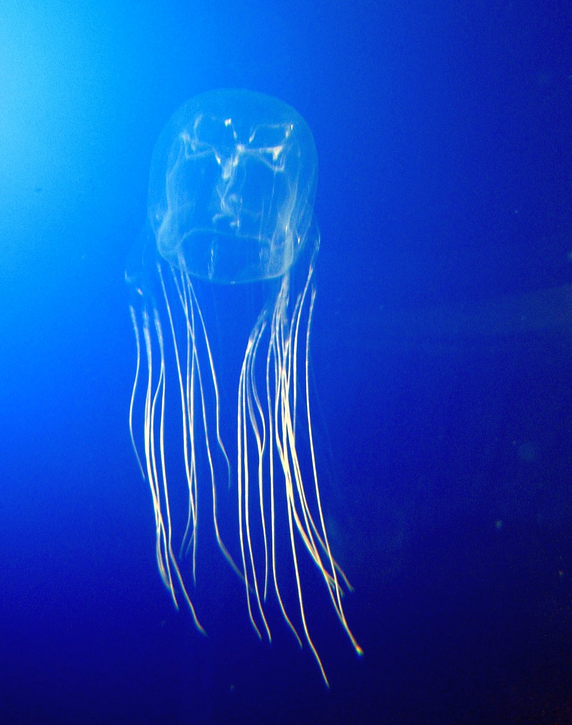
Australia's cubozoans up close: Chironex fleckeri, the Irukandji group, jimble, and the smaller species. Identification, biology, vision, seasonality, and what a stinger season actually means for divers.
By ScubaDownUnder Team · Published 29 May 2026
# Box Jellyfish: Australian Diver's ID Guide
Few marine animals have a public reputation as fearsome and as misunderstood as the box jellyfish. The Australian press tends to collapse the whole class into one creature, the sea wasp, and write off the entire tropical coast for half the year. The reality is more interesting. Box jellies are a distinct class of cnidarians with around fifty species worldwide, only a handful of which are dangerous, and Australia is the global hotspot for their diversity. They are also among the most biologically peculiar animals a diver is likely to share water with: active swimmers rather than drifters, equipped with twenty-four eyes including image-forming lenses, and managing complex behavioural feats with no centralised brain. This guide covers the Australian cubozoans a diver may encounter, how to tell them apart, how they live, and what their presence means for trip planning across the tropical north.
## A separate class from true jellyfish
Box jellyfish belong to the class Cubozoa, separate from the true jellyfish of the class Scyphozoa. The split matters because the two groups behave and look quite differently in the water. True jellies drift with the current, propel themselves by pulsing their bell, and trail tentacles in a loose mass. Cubozoans have a squared-off, cube-shaped bell with a thickened rim called the velarium, which they use to direct the jet of water expelled when the bell contracts. The result is an animal that can swim against current at speeds reaching four knots, change direction deliberately, and hold position around prey. Cubozoans also carry sensory organs called rhopalia at each of the four corners of the bell, each rhopalium holding a cluster of six eyes including two image-forming lens eyes. True jellies have nothing equivalent.
The class divides into two orders. Chirodropida holds the large, multi-tentacle species in which several tentacles trail from each of the four corner-mounted pedalia. Chironex fleckeri and its relatives sit here. Carybdeida holds the smaller species with a single tentacle at each pedalium, and includes the Irukandji jellies and the various jimbles. The distinction is useful in the water because the silhouette of a sea wasp, with a fringed quadruple-cluster of tentacles, is unmistakable next to the simpler four-corner trail of a carybdeid.
## Chironex fleckeri, the sea wasp
Chironex fleckeri is the largest cubozoan, the most venomous, and the one that closes Queensland and Northern Territory beaches each stinger season. A mature bell reaches around 30 centimetres across, transparent pale blue, with up to fifteen tentacles emerging from each of four corner pedalia. Stretched out, the tentacles can exceed three metres. The bell carries the typical four corner rhopalia and is held upright in the water column when the animal is swimming actively. Sea wasps move with purpose. They hunt small fish and shrimp in shallow inshore water and have been recorded covering ground at four knots in pursuit of prey.
The species occupies tropical coastal waters from Exmouth in Western Australia, across the Top End, and down the Queensland coast to roughly Gladstone, with the same distribution extending north through Papua New Guinea, Indonesia, and the broader Indo-Malay archipelago. Sea wasps favour sheltered inshore environments: estuaries, mangrove-fringed bays, shallow sandy beaches, and turbid water close to creek mouths. They are uncommon on open offshore reef, which is why diving on the outer Great Barrier Reef carries far less stinger risk than swimming at a mainland beach in the same week.
The venom is cardiotoxic and dermatonecrotic in roughly equal measure. A serious envenomation can cause cardiac arrest within minutes, which is why education campaigns target wet-season swimmers at inshore beaches rather than reef divers. Australian Institute of Marine Science records list around 70 fatalities attributable to Chironex fleckeri in northern Australia since records began, with the number trending down sharply over the last two decades thanks to stinger nets, first-aid education, and the widespread use of vinegar at swimming patrol stations.
## The Irukandji jellies
The Irukandji group covers a cluster of small carybdeid species responsible for Irukandji syndrome, a delayed envenomation effect distinct from a Chironex sting. Carukia barnesi was the first species identified as a cause, named after Jack Barnes, the Cairns physician who allowed himself, his son, and a lifeguard to be stung in 1964 in order to confirm the species' role. Two further species, Malo kingi and Malo maxima, have since been documented as Irukandji-syndrome agents, and ongoing work at James Cook University suggests several more candidates across the tropical Indo-Pacific.
Irukandji jellies are physically tiny. The bell of Carukia barnesi measures one to two centimetres across, with four single tentacles up to a metre long emerging from the corner pedalia. The bell is transparent to the point of invisibility in open water. Unlike Chironex, Irukandjis are bluewater animals. They move offshore in summer and are encountered through the outer reef and shoulder-season fringes in numbers that vary year to year with sea-surface temperature and onshore wind patterns. This is the species that occasionally closes Whitsundays operators for several days at a stretch when wind direction brings them inshore.
The sting itself is often mild and easily missed. The signature of Irukandji syndrome appears twenty to forty minutes later: severe lower-back pain, muscle cramping, hypertension, vomiting, profuse sweating, and a particular sensation of impending doom that survivors describe consistently across decades of case reports. The syndrome is driven by a catecholamine surge rather than direct toxicity at the sting site, and serious cases require hospital management. Fatalities are rare but documented, and pulmonary oedema has caused most of the recorded deaths. Recovery is typically complete within twenty-four to forty-eight hours.
## The smaller Australian cubozoans
Beyond the headline species, Australian waters carry a handful of smaller cubozoans that divers will encounter without much consequence. Carybdea xaymacana, the jimble, is the species most commonly seen in southern Australian water. It carries a small transparent bell three to four centimetres across with a single short tentacle at each corner, and turns up in coastal bays from Sydney down through Victoria and across to the Great Australian Bight. Stings are painful but minor, similar to a strong bluebottle hit, with no systemic effect.
Chiropsella bronzie, formerly grouped with Chiropsalmus, occupies the same tropical Queensland range as Chironex fleckeri and looks superficially similar with multiple tentacles per pedalium and a square bell. The species is much smaller than a sea wasp, with the bell around six to eight centimetres across, and the sting is locally painful but not life-threatening. Confident species identification in the water is difficult, which is one reason that lifeguard training in the tropical north defaults to vinegar treatment for any multi-tentacle cubozoan sighting until a clearer picture emerges.
Several further species occupy Australian range with limited diver interaction: Copula sivickisi in the Top End, Tripedalia binata across northern reefs, and a still-unresolved species complex around Carukia within the Irukandji-syndrome group. Taxonomic work is ongoing and most of these animals are known from a handful of records.
## Vision, swimming, and the question of intelligence
Cubozoans have the most complex eye structure in any animal lacking a centralised brain. Each of the four rhopalia at the corners of the bell carries six eyes: two image-forming lens eyes that operate on the same camera principle as a vertebrate eye, two slit-shaped pit eyes, and two simple pigment-cup ocelli. The two lens eyes are arranged so that one always points up and the other always points down, regardless of how the bell is oriented, because the rhopalium is weighted to maintain that orientation through any swimming attitude. The upward-facing lens eye is used for navigation around obstacles above the water column, and in mangrove-dwelling Caribbean species has been shown to fix on the tree canopy as a positioning reference.
The swimming behaviour is equally distinctive. A sea wasp does not drift. It cruises actively, holding a constant depth in the water column, turning to investigate moving silhouettes, and pursuing prey through directed jet propulsion. Researchers at the University of Copenhagen and James Cook University have demonstrated learned-avoidance behaviour in cubozoans, with individual animals modifying their response to obstacle patterns after repeated encounters. Whether this qualifies as cognition in any strict sense depends on how the question is framed, but the behavioural complexity is real and observable in the field.
Reproduction follows a polyp-medusa life cycle similar to other cnidarians. The free-swimming medusa stage that divers encounter is the sexually mature adult form, and after spawning, the larvae settle on hard substrate as polyps. The polyps overwinter through the dry season, then bud off juvenile medusae in response to environmental cues at the start of the wet season. Work at James Cook University has identified specific salinity and temperature triggers for the metamorphosis from polyp to medusa in Carukia barnesi, and the same approach is being applied to other species in the search for predictive tools for stinger-season forecasting.
## Range and seasonality
Box jellyfish appear in northern Australian inshore waters from roughly October to May, with regional variation. In Queensland north of Gladstone, the official stinger season runs from November to May. The Northern Territory and the Kimberley coast run a similar window. Western Australia north of Exmouth carries the same risk for the same period. South of Gladstone in Queensland, sea wasps are uncommon, and Sydney, Melbourne, Adelaide, and Perth metropolitan waters carry only the smaller, locally-painful jimble and carybdeid species year-round.
Irukandji jellies follow a similar tropical-wet-season pattern but with more year-to-year variability. They have been recorded as far south as [Fraser Island](https://www.scubadownunder.com/dive-sites/fraser-island) in Queensland and as far west as the Coral Coast in Western Australia. Onshore wind events through summer can bring offshore aggregations into reef-fringing water, and operators in Cairns, Port Douglas, and the Whitsundays monitor wind direction closely. Outer reef sites carry lower stinger risk than inshore bommies during onshore-wind events.
The Great Barrier Reef as a whole carries far lower Chironex risk than mainland beaches because the species favours turbid inshore water rather than clear reef water. Risk on outer reef trips is dominated by Irukandji species, which travel with bluewater. Liveaboards operating from Cairns to Lizard Island typically run full-body lycra stinger suits as the default exposure layer from November to May, regardless of water temperature.
## What this means for divers
Cubozoan risk on Australian dive sites is manageable with three habits. Wear a full-body lycra stinger suit or a 3mm wetsuit covering all skin from November to May on any northern-Australian dive, including warm-water sites where neoprene feels unnecessary. The covered-skin envelope is the single largest reduction in envenomation risk, particularly against Irukandjis whose small bell makes them effectively invisible in open water. Confirm operator first-aid arrangements before diving in tropical Queensland or the Top End: vinegar should be on board, and the deckhand should know the current protocol, which has shifted across the last decade as research has clarified what vinegar does and does not do.
For pre-dive planning, check Surf Life Saving Australia advisories for the dive day in question. Operators in stinger country brief reliably on current conditions and any beach or site closures, but solo or club divers planning shore entries into mainland tropical water need to verify the local stinger situation directly. The risk on outer-reef trips is real but lower, and the diver-facing protocols there focus on Irukandji recognition during the post-dive surface interval rather than Chironex avoidance on the bottom.
If a sting occurs, the standard sequence is to leave the water, douse the affected area with household vinegar for at least thirty seconds to neutralise undischarged nematocysts on the skin, do not rub or rinse with fresh water, and call for medical support. For suspected Irukandji syndrome, hospital transfer is the priority even if the initial sting felt minor, because the systemic effects develop on a delay and benefit from monitored management. The fatality rate for both species has fallen dramatically with modern first-aid practice and rapid retrieval.
The wider point is that the cubozoan presence in Australian waters is part of the seasonal pattern of tropical diving, not a reason to avoid it. The peak diving conditions on the Great Barrier Reef, the Coral Coast, and the Top End fall squarely inside stinger season, and the operators who run those sites have spent decades refining the protocols that keep divers safe. Understanding what a box jellyfish actually is, where it lives, and how it hunts removes most of the mystery from a class of animal that the public press has rendered cartoonish. They are remarkable animals worth knowing well.
## Sources
- [Australian Museum, Box Jellyfish](https://australian.museum/learn/animals/jellyfish/boxjellyfish/) - [Australian Museum, Jimble](https://australian.museum/learn/animals/jellyfish/jimble/) - [Australian Institute of Marine Science, Sea Wasp](https://www.aims.gov.au/docs/projectnet/sea-wasp.html) - [Professor Jamie Seymour, James Cook University, tropical Australian venom research](https://research.jcu.edu.au/portfolio/jamie.seymour/) - [Health Direct, Jellyfish stings](https://www.healthdirect.gov.au/jellyfish-stings) - [Surf Life Saving Australia](https://www.surflifesaving.com.au/) - [GBIF, *Chironex fleckeri*](https://www.gbif.org/species/2264689) - [GBIF, *Carukia barnesi*](https://www.gbif.org/species/2264716)