Safety
Decompression Sickness: Symptoms, Causes, and What to Do
By ScubaDownUnder Team · Published 13 May 2026
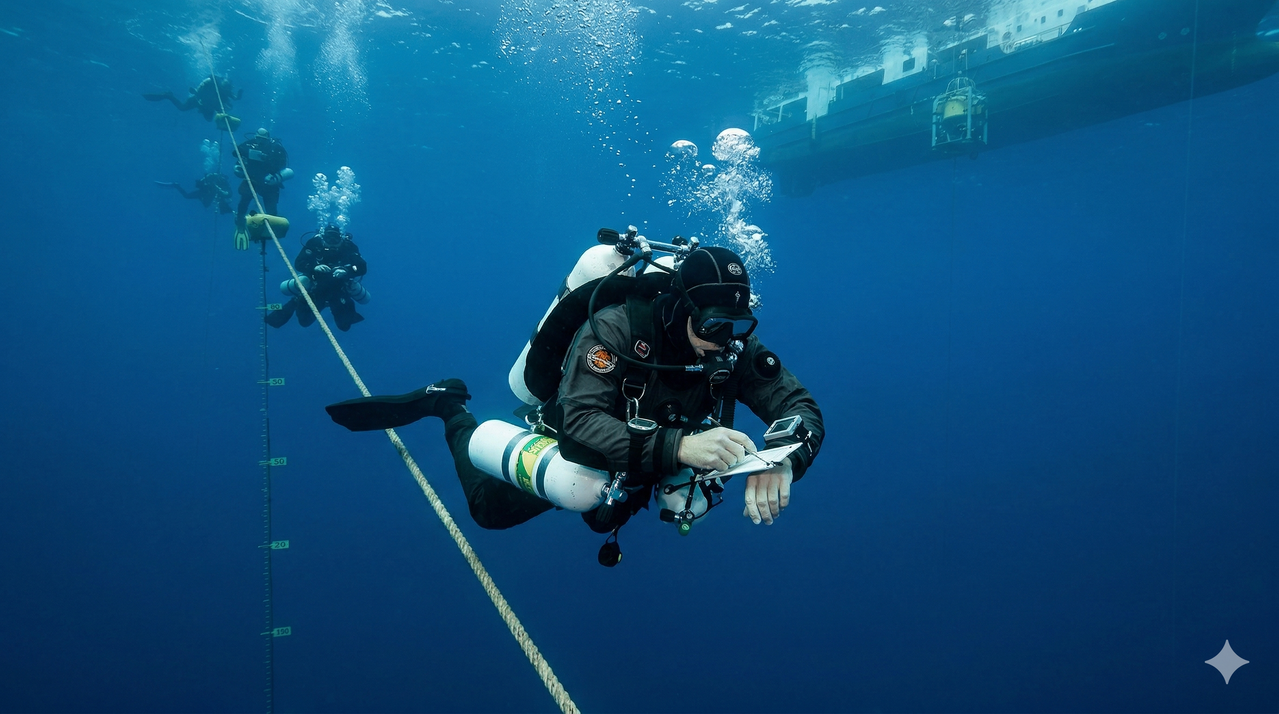
Decompression sickness, commonly called the bends, is the diving-specific medical condition every recreational diver should understand and very few experience. It happens when nitrogen absorbed into a diver's tissues during a dive comes out of solution as bubbles during ascent, lodges in joints, soft tissue or the central nervous system, and produces symptoms ranging from mild joint pain to life-threatening neurological damage. Modern dive computer use and adherence to no-decompression limits have reduced the incidence dramatically, but the condition remains the most serious recreational dive emergency, and recognition matters because outcomes depend almost entirely on how fast a diver gets to a hyperbaric chamber.
This article is for recognition and first response only. It is not medical advice. Any suspected case of decompression sickness requires immediate professional medical assessment and access to hyperbaric treatment.
## What it is
When a diver breathes compressed air at depth, the increased pressure forces additional nitrogen into the body's tissues at a rate that depends on depth and time underwater. On ascent, the pressure drops and that excess nitrogen has to come back out through the lungs. If ascent is slow enough and the no-decompression limits are observed, the nitrogen leaves the tissues gradually and harmlessly. If the ascent is too fast, the dive too long, or the depth profile too aggressive, the nitrogen comes out of solution as bubbles inside the body before it can reach the lungs to be exhaled. Those bubbles are decompression sickness.
Decompression sickness is divided into two clinical types. Type 1 (joint bends, skin bends) is the milder form: bubbles in the soft tissues and joints producing pain, rash and fatigue. Type 2 is the serious form: bubbles in the central nervous system, spinal cord or lungs, producing neurological symptoms, paralysis and respiratory distress. Type 2 cases require emergency evacuation to a hyperbaric chamber and untreated cases can be fatal or permanently disabling.
## Symptoms
Symptoms typically appear within 1 to 6 hours of surfacing, though onset can range from minutes after the dive to 24 hours or longer in atypical cases.
The most common Type 1 symptoms are joint pain, particularly in the shoulders, elbows and knees, often described as a deep aching that worsens with movement. The pain appears without recent trauma to explain it. Skin symptoms include itching, mottled rashes (cutis marmorata) and unusual fatigue disproportionate to the dive profile.
Type 2 symptoms are neurological and require immediate response. They include numbness or tingling in the limbs, weakness or paralysis, difficulty walking, vertigo, blurred vision, confusion, slurred speech, chest pain, or shortness of breath. Any combination of these symptoms after a dive must be treated as a Type 2 case until medical assessment proves otherwise.
A recognisable but easily missed pattern is the diver who feels generally unwell after a dive, dismisses it as fatigue or dehydration, and finds the symptoms worsening over the following hours. Time matters: Type 2 symptoms left untreated for hours produce significantly worse outcomes than the same symptoms treated within the first hour.
## What causes it
The clinical causes are well-documented:
- Ascent rate exceeding the recommended 9 metres per minute (or 18 metres per minute for older training) - Skipped or shortened safety stops at 5 metres for 3 minutes - Profiles that exceed the no-decompression limits for the depth and time - Repetitive dives without adequate surface interval - Multi-day, multi-dive trips that allow nitrogen to accumulate across days - Flying after diving inside the recommended waiting period (12 hours minimum after a single dive, 18 hours after multiple dives or any decompression-required dive) - Dehydration, fatigue and poor general fitness, all of which slow nitrogen elimination - Cold water and heavy work underwater, both of which alter circulation and tissue saturation - Patent foramen ovale (a small hole between the heart's atria, present in about 25% of the population), which allows nitrogen bubbles to bypass the lungs and enter arterial circulation
The most common cause in recreational diving is a combination of two or three of the above on the same dive. A dive that violates the no-decompression limit by a few minutes, in a diver who is dehydrated and fatigued from a long travel day, with a slightly fast ascent, produces a much higher risk than any single factor alone.
## Prevention
The standard prevention practices, all of which reduce risk substantially:
1. Use a dive computer and respect its limits. Modern computers track nitrogen loading dynamically and adjust as the dive profile changes. 2. Ascend slowly, no faster than 9 metres per minute (most computers warn at this rate). 3. Always do a safety stop: 3 to 5 minutes at 5 metres on every dive. 4. Stay well hydrated before and after diving. Dehydration is one of the most reliably documented contributing factors. 5. Avoid alcohol within 12 hours of diving. 6. Do not fly within 18 hours of multi-dive days or any decompression dive. The recommended minimum is 12 hours after a single recreational dive, but 18 hours is safer. 7. Manage repetitive dives carefully: deepest dive first, longer surface intervals, and conservative computer profiles when planning multiple dives across consecutive days. 8. Maintain general fitness. Cardiovascular health correlates with safer nitrogen elimination. 9. If you have a known patent foramen ovale or a history of unexplained DCS, consider conservative profiles and discuss with a diving medicine specialist.
## What to do if you suspect DCS
The response chain is straightforward and time-critical:
**Immediately**: Stop diving. Do not attempt to in-water recompress. Lay the diver flat (do not elevate the legs). Administer 100% oxygen if available; this is the single most effective first-aid intervention and most charter boats carry oxygen kits. Get the diver to professional medical assessment as fast as possible.
**Call DAN**: The Divers Alert Network (DAN) operates 24-hour emergency hotlines for diving medical emergencies. In Australia, the DAN AP (Asia Pacific) emergency line is +61-8-8212-9242. DAN handles case coordination, refers to local hyperbaric facilities, and arranges evacuation. DAN membership is highly recommended for all active divers and includes evacuation insurance and case coordination.
**Hyperbaric treatment**: The definitive treatment for DCS is hyperbaric oxygen therapy at a recompression chamber. Australia has chambers in Sydney (Royal Prince Alfred), Melbourne (The Alfred), Adelaide (Royal Adelaide), Perth (Fiona Stanley), Brisbane (Wesley Hospital), Cairns, Townsville and several other regional centres. DAN and emergency services coordinate transport.
**Document everything**: dive profiles, depths, times, surface intervals, ascent rates, and the timing and progression of symptoms. The hyperbaric specialist needs all of this for treatment planning.
## Insurance and DAN membership
Recreational dive insurance is genuinely not optional for active divers. A single chamber treatment costs tens of thousands of dollars, helicopter evacuation can cost over $100,000, and standard travel insurance often excludes diving. DAN membership includes diving-specific evacuation and treatment cover at a fraction of the cost. Most experienced divers consider DAN membership a basic equipment line item alongside the dive computer.
## When to seek medical advice
Any post-dive symptom that cannot be confidently explained by something else should be treated as possible DCS until ruled out. Joint pain, unusual fatigue, neurological symptoms, skin rashes or breathing problems within 24 hours of a dive all warrant medical assessment. The clinical pattern is well-recognised by emergency physicians at coastal hospitals and by hyperbaric specialists, and the cost of investigating a false alarm is much lower than the cost of missing a genuine case.
## Final notes
Decompression sickness is rare in recreational diving when standard practices are followed. The Australian recreational diving community sees only a small number of cases each year given the volume of diving, and the major causes are well-documented and largely preventable. Understanding the symptoms, the causes and the response chain protects you, your buddy and the divers around you. Carry oxygen on dive trips when possible, know the DAN emergency number, maintain DAN membership, and trust the standard rules: slow ascent, safety stop, hydration, conservative computer profiles, no flying inside the waiting window.
Sources for further reading: Divers Alert Network Asia-Pacific (dan.org.au), Royal Australian and New Zealand College of Anaesthetists hyperbaric medicine guidelines, and the medical advisory pages of PADI, SSI and SDI.