Learn to Dive
Discover Scuba Diving: Try Before You Commit
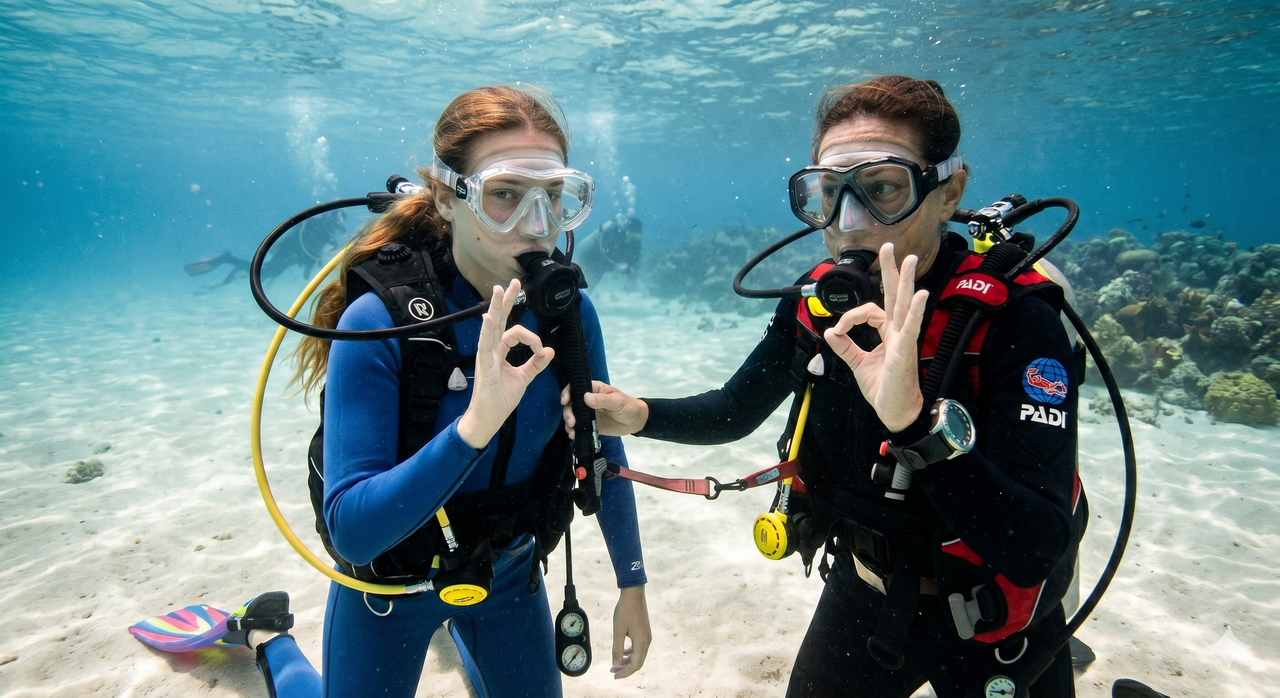
Breathe underwater for the first time without committing to a full Open Water course. What a Discover Scuba Diving session involves, costs, and how it credits toward later certification.
By ScubaDownUnder Team · Published 6 May 2026
# Discover Scuba Diving: Try Before You Commit
> Not ready to commit to a full Open Water course? You do not need to. A Discover Scuba Diving session lets you breathe underwater for the first time, with full instructor supervision, in 3 to 4 hours and for $150 to $300. Here is what is involved, where to do one in Australia, and how it credits toward a real certification later.
## Why try-dives are the smartest first step for the curious
Most people who think they want to learn to dive do not actually know whether they will like it. The standard Open Water course is a $1,300 commitment of money, a weekend or two of time, a medical, and the willingness to put your face under saltwater on dives 1 through 4 with no easy out. That is a lot to ask of someone who has not yet confirmed they enjoy breathing underwater.
A Discover Scuba Diving session (DSD in PADI terminology, "Try Scuba" or "Scuba Experience" elsewhere) is the answer. One short pool or shallow-ocean session, one instructor for every two to four students, and the actual experience of breathing compressed air at 6 metres on a regulator. By the end, you know whether scuba is for you.
This is also the article for someone who has never planned to be certified, just wants the experience once. It is a perfectly valid one-off, you do not have to do anything more after.
## Contents
1. [What a Discover Scuba Diving session actually is](#what-it-is) 2. [Pool DSD vs ocean DSD](#pool-vs-ocean) 3. [What it costs in 2026](#cost) 4. [The six things you will do on a typical DSD](#what-you-do) 5. [Eligibility, age limits, and the medical question](#eligibility) 6. [How DSDs credit against the full Open Water course](#credit) 7. [Where to do one in Australia](#where) 8. [What to expect emotionally on your first breath underwater](#emotion) 9. [Red flags to avoid when picking a DSD operator](#red-flags) 10. [After the DSD, deciding what is next](#after)
## What a Discover Scuba Diving session actually is {#what-it-is}
A DSD is a structured introductory dive run by a qualified instructor under agency standards (PADI, SSI, NAUI, RAID, SDI all run them). It is **not** a certification course. You do not earn a card, you cannot go diving on your own afterward, and you do not have to do any classroom or eLearning work. The program is deliberately scoped so that an instructor can take you from "never breathed underwater" to "did one supervised dive" in a single half-day.
What is included:
- Brief safety and equipment talk (15 to 30 minutes) - Equipment fitting (mask, fins, BCD, regulator) - Confined-water introduction in a pool or sheltered shallow bay (30 to 45 minutes) - One ocean or open-water dive to maximum 12 metres (in practice, often 6 to 8 metres) - Instructor supervision throughout, with student-to-instructor ratios of 2:1 or 4:1
The whole thing is 3 to 4 hours from start to finish.
## Pool DSD vs ocean DSD {#pool-vs-ocean}
Two flavours, broadly:
**Pool DSD ($80 to $180)**
- 1 to 2 hour pool session, no ocean dive - Common at urban dive shops with their own training pool - Lowest cost, easiest to fit into a workday - Good for testing whether you can handle breathing underwater, but you do not see fish
**Ocean DSD ($150 to $300)**
- 3 to 4 hour session, brief, gear, shallow-water orientation in a sheltered bay or pool, then one supervised ocean dive - The full "try diving" experience, gives you the sights and the feeling of weightlessness at depth - This is the one to book if you want to know whether you would enjoy real diving
For the purposes of "try before you commit," the ocean DSD is what most people mean.
## What it costs in 2026 {#cost}
Australian DSD prices vary by location and what is included:
- **Sydney shore-entry DSD** (e.g., [Shelly Beach](https://www.scubadownunder.com/dive-sites/shelly-beach), [Camp Cove](https://www.scubadownunder.com/dive-sites/camp-cove)): $179 to $249 - **Melbourne pier DSD** (Portsea or Blairgowrie): $189 to $259 - **Cairns reef DSD** (boat trip to outer reef): $239 to $320, often bundled with snorkellers' day-trip pricing - **Whitsundays day-boat DSD:** $279 to $359 - **Perth (Rottnest or coastal):** $219 to $289 - **Adelaide DSD:** $199 to $259
The Cairns and Whitsundays prices look higher because they include the boat trip itself. You are paying for a day at the reef whether you scuba or snorkel, and the scuba upgrade adds the cost of the instructor and gear hire.
## The six things you will do on a typical DSD {#what-you-do}
1. **Sign a brief medical statement.** A short questionnaire asking about the same conditions covered in the [scuba medicals article](https://www.scubadownunder.com/blog/scuba-diving-medicals-what-disqualifies-you). If you tick yes to anything, the instructor will ask you to see a doctor before continuing. You do not need a full pre-booked dive medical for a DSD in most cases, only if you flag a relevant condition. 2. **Get fitted with hire gear.** Mask, fins, wetsuit, BCD, regulator, weights, tank. Identical to the gear used on a full course. 3. **Listen to a 20-minute briefing.** How the regulator works, what to do if water gets in the mask, what hand signals mean, never hold your breath. Three rules, repeated until you can recite them. 4. **Practise three core skills in shallow water.** Regulator clearing, mask clearing, equalising your ears. The instructor demonstrates, you copy, you do it once more to confirm. 5. **Do the actual dive.** Holding the instructor's hand or fin strap if you are nervous, descending to 6 to 12 metres, swimming for 30 to 40 minutes around a reef, jetty, or sandy bottom. 6. **Debrief and decide what is next.** Most schools will ask if you would like to book the Open Water course at the DSD price as a discount.
## Eligibility, age limits, and the medical question {#eligibility}
Eligibility for a DSD is broader than for the full Open Water course but still has limits.
- **Minimum age:** 10 years (PADI Bubblemaker for ages 8 to 9, in pool only). - **Maximum age:** no upper limit, but over 45 to 50 some operators ask for a doctor's clearance even for a DSD. - **Medical:** a self-declaration form on the day. Common stoppers, asthma, recent surgery, pregnancy, heart conditions, severe ear problems, uncontrolled diabetes. If you tick any of these, the operator will ask you to obtain a GP's clearance before they will take you. The criteria are essentially the same as for a full course, see [what disqualifies you from diving](https://www.scubadownunder.com/blog/scuba-diving-medicals-what-disqualifies-you). - **Swimming ability:** most operators ask that you can swim 50 metres unaided and tread water for 1 minute. They rarely test it but they do ask. - **Comfort in water:** not formally measured, but if you panic at having water on your face, a DSD will not be enjoyable. Try a snorkel session in a calm bay first if you are unsure.
## How DSDs credit against the full Open Water course {#credit}
Most major agencies allow your DSD to credit against the corresponding skill in your full Open Water course:
- **PADI:** a DSD signed off by a PADI instructor can credit Open Water Dive 1 if completed within 12 months at the same operator (sometimes longer). You skip Dive 1 and go straight to Dive 2. - **SSI:** similar. The "Scuba Experience" credits the first open-water dive of the full course. - **NAUI / RAID / SDI:** vary by operator, ask before booking if this matters to you.
In practice this means a DSD plus a full Open Water course at the same shop is often the same price or $50 to $100 cheaper than just doing the full course outright. That sounds wrong, but it works out because the shop wants to capture you for the full course and discounts the DSD as the on-ramp.
> **Worth asking at booking:** "Does this DSD credit against your Open Water course, and if I sign up within 30 days, can I deduct what I have already paid?" Most reputable schools say yes.
## Where to do one in Australia {#where}
- **Sydney:** most operators run shore-entry DSDs at Shelly Beach (Manly), Gordons Bay, or Camp Cove. Half-day, $179 to $249. Boat-based DSDs at [Bare Island](https://www.scubadownunder.com/dive-sites/bare-island) or off Botany Bay run $250 to $320. - **Melbourne:** [Portsea Pier](https://www.scubadownunder.com/dive-sites/portsea-pier) and [Blairgowrie Pier](https://www.scubadownunder.com/dive-sites/blairgowrie-pier) are standard. Melbourne winter water is cold (12 to 13 C), expect a 7 mm wetsuit and a hood. - **Brisbane / Sunshine Coast:** Mooloolaba reefs and Tangalooma (Moreton Island) wrecks. Tangalooma DSDs are exceptional value and accessible by ferry. - **Cairns:** boat-based reef DSDs are the headline experience. Day-trip operators run them daily out of the Marlin Marina. - **Whitsundays:** most reef day-boats offer a DSD upgrade option. Heart Reef and Bait Reef are common DSD sites. - **Perth:** Rottnest Island, Mettams Pool, Coogee. - **Adelaide:** [Rapid Bay Jetty](https://www.scubadownunder.com/dive-sites/rapid-bay-jetty) (the iconic Adelaide site for new divers) and Edithburgh. - **Tasmania:** Tinderbox and Eaglehawk Neck operators run DSDs in summer (Dec to Mar). Cold water, but world-class kelp forests.
Browse the [SDU dive-shop directory](https://www.scubadownunder.com/dive-shops) to find DSD-running operators near you.
## What to expect emotionally on your first breath underwater {#emotion}
The first breath of compressed air through a regulator at 1 metre below the surface is, for most people, the strangest thing they have ever done. Your brain expects to inhale water and instead inhales perfectly normal dry air. The reflex resistance lasts about three breaths and then it feels routine.
What surprises people most:
- **How quiet it is.** No traffic, no voices, no music, only the sound of your own breathing. - **How buoyant a wetsuit makes you.** You float when relaxed, you sink only with weight. - **How indifferent the fish are.** They have seen thousands of bubbling humans and you are scenery. - **How fast the dive ends.** A 35-minute dive feels like 10.
A few people do not enjoy it. The most common reasons, trouble equalising the ears, claustrophobia in the mask, or dislike of the salt-water taste. All three are useful to discover before you have paid for a full course.
## Red flags to avoid when picking a DSD operator {#red-flags}
A reputable DSD operator will:
- Offer 2:1 or 4:1 student-to-instructor ratios (not 6:1 or 8:1) - Insist on the medical questionnaire and not wave it through - Spend at least 20 to 30 minutes in shallow water on skills before the dive - Have you wear a clearly-marked DSD vest or boot-wrap so the instructor can identify you - Not push you to descend deeper than 12 metres on the dive
Walk away if any of those are missing. A handful of low-quality operators in tourist-heavy markets run DSDs as a short, depth-pushing, ratio-violating box-tick. The diving accidents that involve DSDs almost all come from those operators.
## After the DSD, deciding what is next {#after}
At the debrief, three honest reactions:
**"That was great, when can I do my Open Water?"** Book the course at the DSD operator if you liked them. Take the credit or discount on offer.
**"That was fine but I am not sure."** Do a second DSD at a different site within a few weeks. The contrast between, say, a sheltered pool dive and a real reef dive often clarifies the decision.
**"I am relieved I tried it once and do not need to do it again."** That is a legitimate outcome, and the DSD just saved you $1,300.
For the full picture of the certification path, see [What is Scuba Diving, A Complete Beginners Overview](https://www.scubadownunder.com/blog/what-is-scuba-diving-a-complete-beginners-overview), and [Is Scuba Diving Right for Me](https://www.scubadownunder.com/blog/is-scuba-diving-right-for-me).
## Next steps
- Read [How Much Does It Cost to Get Scuba Certified](https://www.scubadownunder.com/blog/how-much-does-it-cost-to-get-scuba-certified) to weigh DSD vs full-course pricing. - Read [How Long Does It Take to Get Scuba Certified](https://www.scubadownunder.com/blog/how-long-does-it-take-to-get-scuba-certified) for the time commitment of the full course path. - Read [How Fit Do You Need to Be to Scuba Dive](https://www.scubadownunder.com/blog/how-fit-do-you-need-to-be-to-scuba-dive) if fitness is your concern.