Marine Life
Manta Rays in Australia: Where and When to Dive
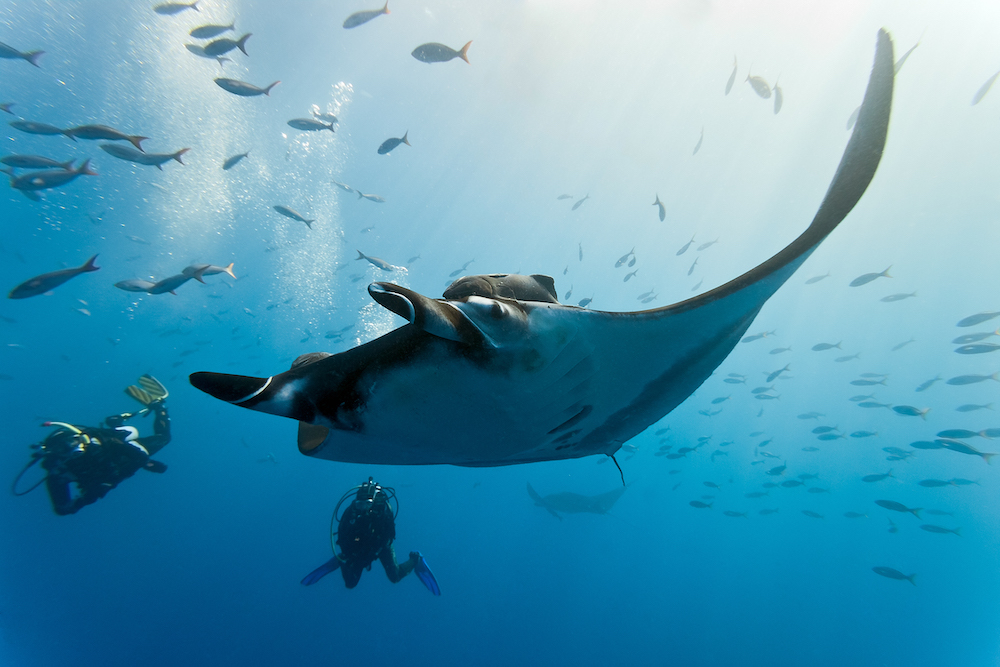
Where to dive with manta rays in Australia, from Lady Elliot Island and Ningaloo to Byron Bay's Julian Rocks, plus the best season and what to expect.
By ScubaDownUnder Team · Published 27 May 2026
Manta rays are the largest of the rays, with wingspans reaching seven metres in the giant oceanic manta and four metres in the reef manta, and Australian waters host both species across an exceptional spread of accessible sites. Encounters happen at established cleaning stations on the Great Barrier Reef, in the warm-water aggregation grounds of [Ningaloo](https://www.scubadownunder.com/dive-sites/ningaloo-reef), at [Lady Elliot Island](https://www.scubadownunder.com/dive-sites/lady-elliot-island) year-round, and along the east coast where seasonal manta visits bring world-class encounters within reach of a half-day boat trip. The diving is generally easy, the conditions reliable, and the experience consistently named by Australian divers as the single most memorable encounter of their diving career.
## The two species in Australian waters
The reef manta ray (*Mobula alfredi*) is the species most divers encounter. Smaller than its oceanic cousin, with a wingspan typically 3 to 4 metres, the reef manta is a coastal animal that frequents shallow reef cleaning stations, feeds in the upper water column on plankton, and forms long-term associations with specific reef systems. Lady Elliot Island, [Lady Musgrave](https://www.scubadownunder.com/dive-sites/lady-musgrave-island), and the Ningaloo coast are reef manta hotspots.
The giant oceanic manta ray (*Mobula birostris*) is larger, with a wingspan up to 7 metres, more pelagic in habit, and harder to predict. Encounters happen at sites where deep water meets reef structure, particularly along the outer Great Barrier Reef, at the Coral Sea seamounts, and on the southern east coast where occasional vagrants pass through warm-current windows.
Both species are protected in Australian waters. The reef manta is listed as Vulnerable on the IUCN Red List, the giant oceanic manta as Endangered. Touching, riding or pursuing mantas is prohibited at all sites and operators enforce respectful distance.
## Lady Elliot Island
Lady Elliot Island, a tiny coral cay at the southern end of the Great Barrier Reef, is the most reliable manta encounter destination in Australia. The island sits within a permanent reef manta aggregation, with documented populations of over 1,000 individuals using the surrounding waters. Encounters happen year-round at sites like the Lighthouse Bommie cleaning station and Lady Elliot's western drop-off, with peak numbers from May through August during the cooler-water months when up to 50 mantas have been recorded at a single cleaning station. The island is reached by light aircraft from Hervey Bay, Bundaberg or the Gold Coast, and the diving is generally easy: shallow depths (5 to 18 metres), calm sheltered conditions, and dive sites accessible from the resort jetty. Lady Elliot is the destination most often recommended to divers chasing a single guaranteed manta encounter.
## Lady Musgrave Island
40 kilometres north of Lady Elliot, Lady Musgrave is a larger coral cay with a substantial protected lagoon and a reef edge that drops into deeper Coral Sea water. Manta encounters here are seasonal rather than year-round, with peak activity through autumn and winter (May to September). Day-trip and liveaboard operators run from Bundaberg and 1770. The diving is more varied than Lady Elliot, with both shallow lagoon dives and outer-reef walls available on a single trip.
## The Northern Great Barrier Reef
The northern outer reef, accessed from Cairns and Port Douglas, holds reef manta cleaning stations on sites like Norman Reef, Hastings Reef and Saxon Reef. Liveaboard trips into the Coral Sea ([Osprey Reef](https://www.scubadownunder.com/dive-sites/osprey-reef), Bougainville Reef, Holmes Reef) deliver giant oceanic manta encounters at the seamounts, with peak activity through autumn. Liveaboard departures are concentrated through the Cairns and Port Douglas operators and run multi-day trips.
## Ningaloo Reef and Coral Bay
Ningaloo's reef manta population is concentrated around [Coral Bay](https://www.scubadownunder.com/dive-sites/coral-bay) and the southern end of the Cape, with well-established cleaning stations at sites like [Bateman Bay](https://www.scubadownunder.com/dive-sites/bateman-bay-ningaloo). Trips run from Coral Bay year-round and from Exmouth in the cooler months. Manta encounters at Ningaloo overlap with [whale shark season](https://www.scubadownunder.com/blog/whale-sharks-in-australia) (March to August) and divers commonly encounter both on the same trip. Conditions are warmer than the Queensland coast (22 to 28°C) and the diving is consistently good with visibility 15 to 25 metres.
## [Julian Rocks](https://www.scubadownunder.com/dive-sites/julian-rocks) and the Northern NSW Coast
Manta rays appear at [Julian Rocks Marine Sanctuary](https://www.scubadownunder.com/dive-sites/julian-rocks-marine-sanctuary) off Byron Bay between November and May, with peak sightings through summer when the East Australian Current pushes warm tropical water down the coast. Encounters are unpredictable but produce some of the most photogenic manta diving on the Australian east coast, with mantas feeding head-on into the current at the bay's entrance and cruising the western face of the rocks. The site is reached by short boat charter from Byron Bay and is dived as a paired site with the rocks' resident leopard sharks and [grey nurse sharks](https://www.scubadownunder.com/blog/the-grey-nurse-shark-the-gentle-giant-of-australias-reefs). Tweed Heads and the Gold Coast see occasional manta sightings during the same warm-water season.
## Hervey Bay and the Sunshine Coast
The [Wolf Rock](https://www.scubadownunder.com/dive-sites/wolf-rock) dive site off Rainbow Beach on the Sunshine Coast holds resident grey nurse sharks and seasonal manta encounters between October and May. The site sits on the migratory path of east-coast manta movements and produces reliable summer encounters when conditions allow. Charter operators run from Rainbow Beach and Mooloolaba. Hervey Bay itself is the gateway to Lady Elliot for manta divers continuing south to the southern Great Barrier Reef.
## Behaviour to expect
Mantas at cleaning stations hover in mid-water above the reef while small wrasse and butterflyfish remove parasites from their gills, mouth and underside. The interaction is slow and deliberate, with the manta returning to the same station repeatedly over weeks or months. Divers settle on the bottom adjacent to the station and observe without approaching closer than the operator brief allows.
Feeding mantas display a different behaviour: head-on into the current with cephalic fins unfurled, mouth wide, swimming slowly upward to filter zooplankton from the water column. Feeding aggregations of 20 or more animals occur when current and plankton conditions align, particularly at Ningaloo and Lady Elliot during the productive seasons.
Mating trains are the third recognised behaviour: a female pursued by multiple males in a slow line over reef structure, lasting from minutes to hours. Mating trains are most often observed in the warm-water months and are documented year-round at Lady Elliot.
## Trip planning
The simplest manta trip in Australia is a Lady Elliot Island package: light aircraft from Hervey Bay or the Gold Coast, 2 to 4 nights at the resort, dives included. The more ambitious option is a Coral Sea liveaboard from Cairns chasing the giant oceanic manta. The east-coast options ([Julian Rocks](https://www.scubadownunder.com/dive-sites/julian-rocks), Wolf Rock) suit divers based on the mainland who want a day-trip encounter without the island commitment. Ningaloo combines manta and whale shark seasons in a single Western Australia trip. Mantas in Australia are accessible in a way they are not in most of the world, and the variety of species, sites and operators means most divers can find an encounter that fits a Sydney-based, Melbourne-based or interstate trip plan.
For divers who have not yet logged a manta dive, Lady Elliot is the strongest recommendation: year-round resident population, easy diving, and the highest probability of a single-trip success.