Marine Life
Diving with the Old Wives Fish: Australia’s Striped Reef Guardians
This seven minute read will take you through everything you need to know about the old wives fish, where to find them, how to approach them, and why they are such a favourite for divers and photographers.
By ScubaDownUnder Team · Published 2 October 2025
Diving with the Old Wives Fish: Australia’s Striped Reef Guardians
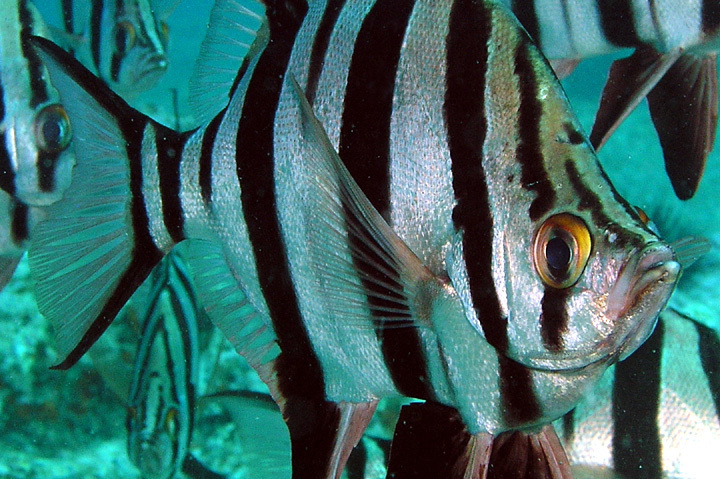
The first time you encounter an old wives fish under the water, it is hard not to pause. Their bold silver and black stripes gleam in the filtered sunlight, while their tall fins rise like sails on a breeze. They do not dart away like many reef fish. Instead, they hover calmly, as if they own the patch of reef you have entered. It is this quiet authority, combined with their unusual name, that makes them one of the most memorable fish to spot on a dive in southern Australia.
What is an Old Wives Fish?
The old wives fish (Enoplosus armatus) is a striking marine species found exclusively in Australian waters. With their bold vertical stripes and elegant elongated dorsal fins, they look almost tropical in appearance despite being a temperate water species.
They generally grow to around 30 to 40 centimetres in length, although larger individuals can be found. The distinctive striping runs in sharp black bands across a silver body, making them easy to identify even from a distance.
Their unusual name has a story of its own. When lifted out of the water, these fish make a rasping grating noise with their jaws. Early sailors and fishers likened this sound to the nagging voice of an “old wife”, and the name stuck.
Interesting Facts about Old Wives
* Ancient lineage: Fossils of old wives relatives have been found dating back over 50 million years, making them one of Australia’s oldest fish families. * Venomous spines: The long spines of the second dorsal fin can deliver a sting. It is not deadly but can cause sharp pain, much like a sting from a catfish or stonefish, though far less severe. * Endemic treasure: Old wives are found only in Australia. Their limited range makes them an important part of the nation’s marine identity. * Monogamous pairs: Divers often see them in pairs, which has led some to believe they form long term bonds. While not fully proven, their behaviour supports the theory. * Easily spooked by spearfishers: While divers find them calm and approachable, they are much warier around spearfishers, suggesting they learn to distinguish threats. * Sound makers: The rasping noise that earned them their name is created by grinding their teeth and jaw bones together, a rare behaviour among reef fish.
Habitat and Distribution
Old wives are endemic to Australia. They inhabit the temperate waters of the southern half of the continent, from southern Queensland, down the east coast, across Tasmania, and up along Western Australia.
Their preferred habitats include:
* Rocky reefs * Kelp forests * Seagrass beds * Estuaries and sheltered bays
Divers often spot them between 5 and 30 metres depth, sometimes deeper. They are particularly common around Sydney, Jervis Bay, Port Phillip Bay, and the Great Southern Reef.
Behaviour and Characteristics
One of the delights of encountering old wives is their behaviour. Unlike some fish that bolt at the first sign of a diver, these reef guardians seem almost nonchalant. They often cruise in pairs, though small schools of up to a dozen can be found hovering near rocky outcrops.
Their movement is deliberate and slow, giving them an air of calmness that contrasts with the bustling activity of many reef environments. This makes them ideal subjects for photography. If you approach slowly, they often let you drift quite close.
Their spines, while elegant, conceal a defence mechanism. The venom is not lethal but is a strong deterrent for predators. This may help explain why they move with such composure, as they are well defended.
Why Divers Love Them
For many Australian divers, the old wives fish is almost a rite of passage. It is often one of the first distinctive species you will learn to identify as a beginner diver. Their bold stripes stand out against the muted blues and greens of temperate reefs, and their steady behaviour makes them easy to observe.
Photographers love them because they stay still long enough to frame beautifully in a shot. Their vertical stripes also create high contrast images, particularly when paired against kelp or sponges.
There is also something quietly reassuring about them. Hovering in pairs, they appear like guardians of the reef, watching as the underwater world carries on around them.
Best Dive Sites to Spot Old Wives
If you are keen to see old wives, here are some of the best regions to explore:
* Bare Island, Sydney: A classic training site where old wives are often seen in shallow water. * Cabbage Tree Island, Port Stephens: Known for its diversity of temperate species, including large schools of old wives. * Jervis Bay, NSW: Protected waters with reefs and kelp beds full of them. * Port Phillip Bay, Victoria: Jetty dives here frequently turn up old wives cruising among pylons. * Tasmania’s East Coast: Clear waters and kelp forests provide a dramatic backdrop for these striped fish.
Conservation and Importance
Old wives are not a threatened species, but like many reef fish, they depend on healthy reef ecosystems. Pollution, overfishing of associated species, and climate change can all indirectly affect their habitats.
Their presence reminds us of the unique beauty of Australia’s southern reefs, which are often overshadowed by the Great Barrier Reef. The Great Southern Reef, stretching from New South Wales to Western Australia, is a biodiversity hotspot where old wives are just one of many endemic treasures.
Tips for Divers
If you want to maximise your chance of seeing and photographing old wives fish:
* Move slowly. They will usually let you approach if you are calm and unhurried. * Look for pairs. They are rarely solitary and are often found in twos or small schools. * Check kelp edges. They like hovering near the transition from kelp forest to open sand. * Mind the spines. Appreciate them visually, but do not attempt to touch. * Bring a camera. Their stripes and stillness make for brilliant underwater portraits.
Final Thoughts
The old wives fish may not have the glamour of a shark or the colour of a nudibranch, but they hold their own as one of the most recognisable and endearing residents of Australia’s southern reefs. For many divers, they are a symbol of the calm quiet beauty of temperate diving.
So next time you descend onto a rocky reef in New South Wales, Victoria, or Tasmania, keep an eye out for those vertical stripes hovering in the blue. Chances are, you will find a pair of old wives gently cruising by, as if keeping a watchful eye on the reef below.
Sources
* Wiki Old Wife * Australian Museum Fishes of Australia * Great Southern Reef