Learn to Dive
Your First 10 Dives After Certification
How to bridge the gap after certification: easy conditions, shop dives versus buddy dives, logging, gear familiarity and when to move on to AOW.
By ScubaDownUnder Team · Published 28 June 2026
# Your First 10 Dives After Certification
The card arrives, the course group chat goes quiet, and suddenly you are a certified diver with nobody telling you where to be on Saturday morning. This is the gap nobody warns you about: the stretch between finishing your course and becoming a comfortable, self-sufficient diver. The divers who cross it share one habit, and it is not talent. They simply got back in the water quickly and kept going. Here is how to make your first ten post-course dives count.
## Why Skills Fade Fast
Fresh skills are shallow-rooted. Mask clearing, regulator recovery and weighting felt automatic on the last day of your course because you had just drilled them; leave a three month gap and they will feel foreign again. The agencies formally recommend a refresher after 6 to 12 months out of the water, but the decay starts within weeks. The single best thing you can do for your diving is book dive number five (your first as a certified diver) within a month of certification. Momentum is a skill multiplier, and it is free.
## Keep the First Few Boring
Your course dives happened under supervision at sites your instructor chose. For your first independent dives, choose conditions that ask nothing extra of you:
- 12 metres or shallower - Good visibility and small or no swell - Minimal current, easy entry and exit - Daylight, simple navigation, and a site dived regularly by others
Australia is gloriously rich in exactly these sites. Think [Shelly Beach at Manly](https://scubadownunder.com/blog/diving-at-shelly-beach-manly-a-guide-for-every-diver) or [Clovelly](https://scubadownunder.com/blog/the-colours-of-clovelly-beach-nsw) in Sydney, [Bare Island](https://scubadownunder.com/blog/bare-island-dive-guide-sydneys-shore-diving-gem-in-botany-bay) in Botany Bay, [Rapid Bay Jetty](https://scubadownunder.com/blog/rapid-bay-jetty) in South Australia, [Flinders Pier](https://scubadownunder.com/blog/flinders-pier) on the Mornington Peninsula, [Edithburgh Jetty](https://scubadownunder.com/blog/edithburgh-jetty) on the Yorke Peninsula, or the [Exmouth Navy Jetty](https://scubadownunder.com/blog/exmouth-navy-jetty-a-macro-wonderland-for-beginners) in the west. Browse the full [dive sites index](https://scubadownunder.com/dive-sites) and look for jetty and shore dives flagged as beginner friendly. Boring conditions do not mean boring diving; some of those sites are among the best macro dives in the country.
## Diving With a Shop vs Diving With a Buddy
Your certification entitles you to dive independently with a buddy, but the practical question is how to mix two modes.
**Guided shop dives** give you logistics, local knowledge, gear hire, a professional safety net and, crucially, other divers to meet. You pay for it (a guided double boat dive typically runs $150 to $250 with gear), but for new divers it buys a lot of learning per dollar. Find operators near you in the [dive shops directory](https://scubadownunder.com/dive-shops).
**Independent buddy dives** are cheaper, build real self-sufficiency, and are where the lessons of your course become yours. The catch is the buddy: early on, try to dive with someone more experienced rather than pairing two brand-new divers on an unfamiliar site. If you do dive with a fellow novice, pick the easiest site you know and plan conservatively. Understand what the buddy system is and is not, and why [diving alone is not on the menu yet](https://scubadownunder.com/blog/solo-or-buddy-should-you-ever-scuba-diving-alone).
The ideal first ten dives mix both: a few guided dives to learn sites and habits, and a few buddy dives to own them.
## A Simple Plan for Dives One to Ten
If you like structure, here is a sensible default:
- **Dives 1 and 2**: guided shore dives at an easy local site, within a month of certification. Goal: shake the rust off with a professional nearby. - **Dives 3 and 4**: return to the same site with a buddy. Familiar terrain frees you to focus on weighting and buoyancy rather than navigation. - **Dives 5 and 6**: a new easy site, still shallow. Practise planning the dive yourselves: entry, route, turn pressure, exit. - **Dives 7 and 8**: your first post-course boat dives, guided. Learn the rhythms of a dive deck, gearing up in a queue and back-rolling without drama. - **Dives 9 and 10**: consolidate at whichever site you enjoyed most, with one skill focus each dive.
Treat it as a default, not a rule. Weather will reshuffle it, and that is its own lesson: checking conditions, swell and [likely visibility](https://scubadownunder.com/blog/crystal-clear-how-to-predict-visibility-at-your-next-dive-site-like-a-pro) before committing to a site is a skill the course never had time to teach.
## Log Every Dive
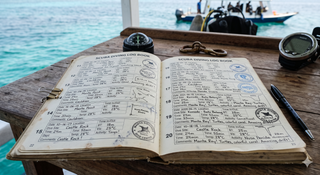
Logging feels administrative until you realise it is your personal training data. For each dive record the date, site, depth, time, start and end pressure, weights carried, exposure suit worn, and a line about conditions and what went well or badly. Within ten dives the log starts paying off: you will know exactly how much weight you need in a 5 mm suit, watch your air consumption improve dive by dive, and have evidence of recency when an operator asks. Paper or app, it does not matter. What matters is the habit.
The notes column earns its keep most. "Anchor line descent much calmer than free descent" or "cold by minute 35 in the 5 mm" are the observations that quietly turn dives into progress, and in five years the entries become a diary you will be glad you kept.
## Make Friends With Your Gear
Task loading is the enemy of early dives, and unfamiliar gear is the biggest source of it. Either rent the same setup repeatedly or start buying your own, beginning with the contact points: mask, fins and a dive computer, the order our [buy versus rent guide](https://scubadownunder.com/blog/scuba-equipment-buy-vs-rent-2025-guide-for-aussie-divers) recommends. If you are unsure what everything does, revisit [the gear you used in your course](https://scubadownunder.com/blog/gear-youll-use-in-your-course). A diver who set up their own kit, in the same configuration as last time, descends with brain space to spare.
## One Skill Per Dive
Do not try to fix everything at once. Pick one focus per dive:
- **Buoyancy**: hover for a minute without sculling, then hold your safety stop without a line. Our [buoyancy guide](https://scubadownunder.com/blog/perfect-buoyancy-the-key-to-effortless-diving) has drills. - **Weighting**: re-check every time your suit, tank or water changes. The [weights guide](https://scubadownunder.com/blog/wait-how-many-weights) explains how. - **Descents and ears**: slow, controlled, feet first, equalising early. See [equalisation made easy](https://scubadownunder.com/blog/equalisation-made-easy-a-divers-guide-to-stress-free-descents). - **Air consumption**: note your pressure every ten minutes and watch the trend across dives. - **Navigation**: run a simple out-and-back compass line on a site you know.
## When Something Feels Off
Nerves are normal and so is the occasional dive that just does not feel right. Calling a dive, before or during, is a skill the best divers exercise without apology; our guide on [when to say no to a dive](https://scubadownunder.com/blog/when-to-say-no-to-a-dive-the-smart-divers-guide) is worth reading before you need it. Tell guides and buddies you are newly certified. Nobody rolls their eyes; every diver on the boat was there once, and most will go out of their way to help. The [core safety habits](https://scubadownunder.com/blog/essential-safety-tips-new-divers) matter most exactly now, while they are still forming.
## When to Start Thinking About Advanced Open Water
Somewhere around dive ten the question arrives on its own. If you keep looking at boat trips marked "AOW minimum", if the wrecks are calling, or if navigation still feels like guesswork, the Advanced course after 10 to 20 dives is the classic sweet spot: enough experience to absorb it, soon enough to keep momentum. Some divers take it immediately after Open Water and that works too, especially in the tropics. Either way, the goal of your first ten dives is not the next card. It is to make diving a normal thing you do, not a thing you did once.