Marine Life
Are Moray Eels Dangerous? A Diver's Guide
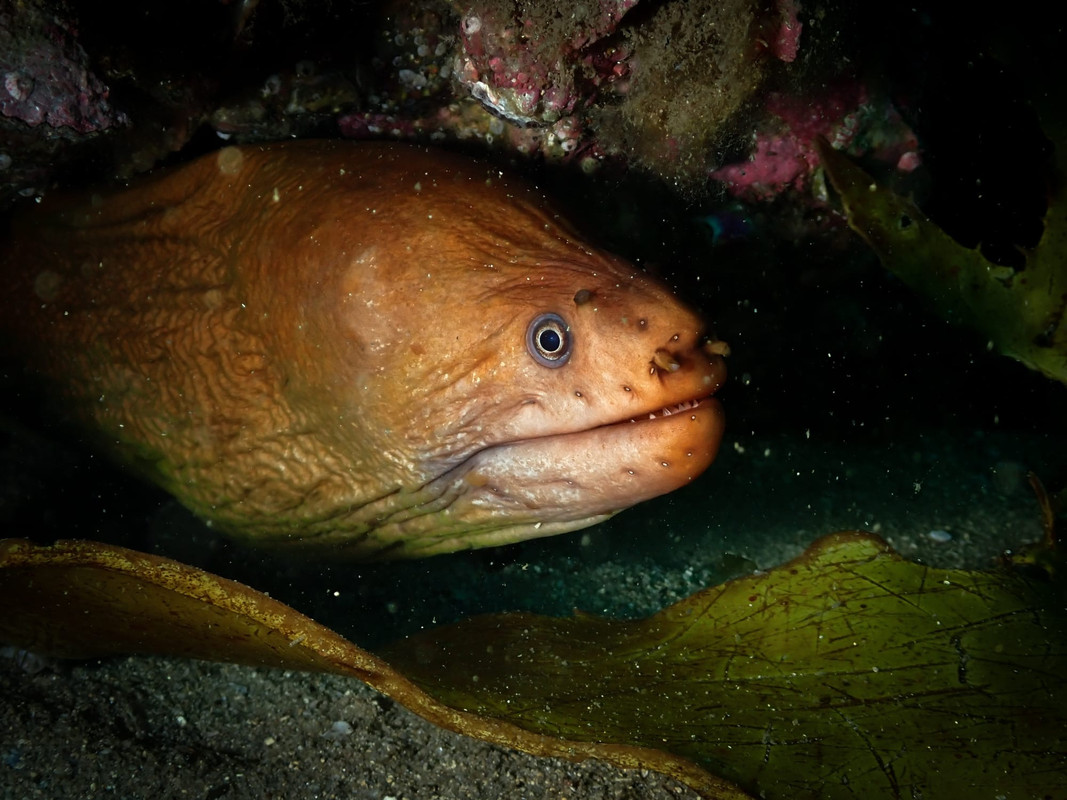
Are moray eels dangerous to divers? How they hunt, where they hide, why they gape their mouths, and how to share a reef with them safely.
By ScubaDownUnder Team · Published 10 September 2025
## The Ambush Masters of the Reef
Imagine diving through a coral canyon and sensing something watching you. Tucked into a crevice, barely visible, is a ribbon of muscle, jaws slightly agape, sharp teeth flashing with the sway of the surge. You’ve just met the moray eel, one of the reef’s most misunderstood predators.
With over 200 species distributed worldwide, moray eels are a fascinating blend of beauty and menace. Their flattened, snake-like bodies, reticulated patterns, and haunting green or yellow hues make them unforgettable. But it’s not just their looks that capture attention. It’s how they hunt, breathe, reproduce and bite.
## Physical Features and Hunting Technique
Moray eels belong to the Muraenidae family. They vary wildly in size, from the modestly sized ribbon eel (up to 1 metre), to the giant moray (Gymnothorax javanicus), which can grow to over 3 metres in length and weigh more than 30 kilograms.
Their skin is scaleless and often covered in a protective mucus layer that wards off infection and reduces drag when slithering through tight reef spaces. Some species even secrete toxins from this mucous coating.
They lack pectoral fins, giving them their characteristic serpentine movement. But what truly sets morays apart from other fish is their jaw, or more specifically, their two jaws. Moray eels possess a **second set of jaws** called **pharyngeal jaws**, hidden in their throat. When prey is captured in the outer jaws, the inner set shoots forward like a creature from *Alien*, gripping and dragging the prey backwards into the digestive tract.
Morays are ambush predators. They typically hide within coral or rock crevices, waiting motionless with jaws agape, a posture often mistaken for aggression, but actually a form of breathing (more on that shortly). When a fish, octopus or crustacean comes too close, the eel launches forward in a blur and clamps down with needle-like teeth.
## Why They Always Look Angry
Many divers assume a moray’s open mouth is a warning or a sign of aggression. In truth, it’s just breathing. Unlike most fish that use gill covers (opercula) to draw water over their gills, morays lack this mechanism. Instead, they pump water through their mouths to keep oxygen flowing across their gills. The result is that signature gaped teeth bared, eyes wide, and head rhythmically pulsing.
## Diet and Predation
Moray eels are strictly carnivorous and opportunistic. Their diet includes:
* Fish (often sleeping reef fish) * Octopuses and squid * Crustaceans like crabs and lobsters * Occasionally other eels
Their poor eyesight is balanced by an exceptional sense of smell. This helps them locate prey hidden under rocks or buried in the sand.
Interestingly, some morays have formed **hunting partnerships** with other predators, most notably the roving coral grouper. In a behaviour called **cooperative hunting**, the grouper will signal the moray with a head shake, encouraging it to follow into the reef. The moray flushes prey from crevices, while the grouper patrols the open spaces. Both benefit.
## Reproduction and Lifecycle Moray eels are **oviparous**, meaning they lay eggs. During mating, a male and female entwine their bodies, releasing sperm and eggs simultaneously into the water column. Fertilisation occurs externally.
The resulting larvae, known as **leptocephali**, look nothing like eels. They’re transparent, leaf-shaped, and drift with plankton for up to a year before settling into reef habitats and morphing into their adult form. This long larval stage helps morays spread across vast ocean distances, even between isolated island chains.
Moray eels can live for up to 30 years in the wild, with some species reaching maturity only after 5–6 years.
## Are Morays Dangerous to Humans? Moray eels have a bad reputation, but most of it is unfair. They’re not aggressive unless provoked, cornered, or accidentally hand-fed by divers. When they do bite, it’s serious. Their jaws are strong, their teeth are razor sharp, and their bites are often infected thanks to bacteria from rotting prey.
Some key notes:
* **Don’t hand-feed morays.** They often can’t distinguish fingers from food. * **Don’t put your hands into holes.** This is the most common way divers get bitten. * **Don’t assume they’re tame.** Even well-known morays can lash out if startled.
One notorious incident involved a diver in Hawaii who lost a thumb while hand-feeding a moray sausage. The eel likely thought the thumb was just another treat.
## Symbiosis and Odd Companions
Some morays are frequently seen with **cleaner shrimp** or **cleaner wrasses**, which remove parasites from their skin and inside their mouths. The shrimp literally climb inside the eel’s gaping maw and nibble away debris while the eel stays eerily still.
Morays also share space with certain fish species, especially juveniles of species like the cardinalfish, which may shelter in the same crevices, taking advantage of the moray’s fearsome presence for protection.
## Habitat and Distribution
Moray eels are found in warm and temperate waters across the globe. Their habitats include:
* Coral reefs (especially Indo-Pacific) * Rocky shorelines * Lagoons and seagrass beds * Some temperate zones (e.g. Mediterranean)
They prefer environments with plenty of hidey-holes, as morays are **solitary** and **territorial**, often defending the same crevice for years. At night, many species emerge to hunt, slithering across the reef like ghosts.
Some species are even known to **hunt on land**. The snowflake moray eel (*Echidna nebulosa*) has been observed briefly leaving tide pools to snatch prey exposed during low tide.
## Notable Species
* Giant Moray (Gymnothorax javanicus), Largest species, widespread in Indo-Pacific reefs * Green Moray (Gymnothorax funebris), Found in the western Atlantic, infamous for its vivid green colour and size * Snowflake Moray (Echidna nebulosa), Small, beautifully patterned, popular in home aquariums * Ribbon Eel (Rhinomuraena quaesita), Bright blue or yellow, with a flared nose and delicate body * Chain Moray (Echidna catenata), Striking black and yellow pattern, found in the Caribbean
## Interesting Facts
* **Their skin contains no scales** and often has a toxic coating. * **They can swim backwards** with ease, making them formidable in close quarters. * **Some morays are venomous.** While rare, certain species produce toxins that affect blood clotting. * **They don’t blink** morays lack eyelids, so their eyes always seem wide and alert. * **Their bite force is among the strongest for their size** enough to crush crab shells. * **They can live in captivity for decades**, although their secretive nature means they’re rarely seen in action.
## Final Thoughts
The moray eel is one of the reef’s most enigmatic residents. Shy yet bold, repellent yet beautiful, feared yet misunderstood. As divers, respecting their space and observing their behaviour from a safe distance reveals a creature of astonishing complexity an ambush predator, a cooperative hunter, and a vital player in the reef ecosystem.
So next time you’re drifting through coral pinnacles and catch that flicker of movement from a crevice, look closely. That’s not a snake. That’s a moray.
### Sources:
* [Australian Museum, Moray Eels](https://australian.museum/learn/animals/fishes/muraenidae-moray-eels/) * [Ocean Conservancy, Moray Eels](https://oceanconservancy.org/blog/2021/01/12/moray-eel/) * [Smithsonian Ocean, Moray Eel Facts](https://ocean.si.edu/ocean-life/fish/revealing-nature-eel-faces) * [Wikipedia Moray Eel](https://en.wikipedia.org/wiki/Moray_eel) * [Nickos Photography](https://www.instagram.com/nickos_adventures/) * [Macunderwater Photography](https://www.instagram.com/macunderwater/)