Learn to Dive
PADI Course Levels Explained
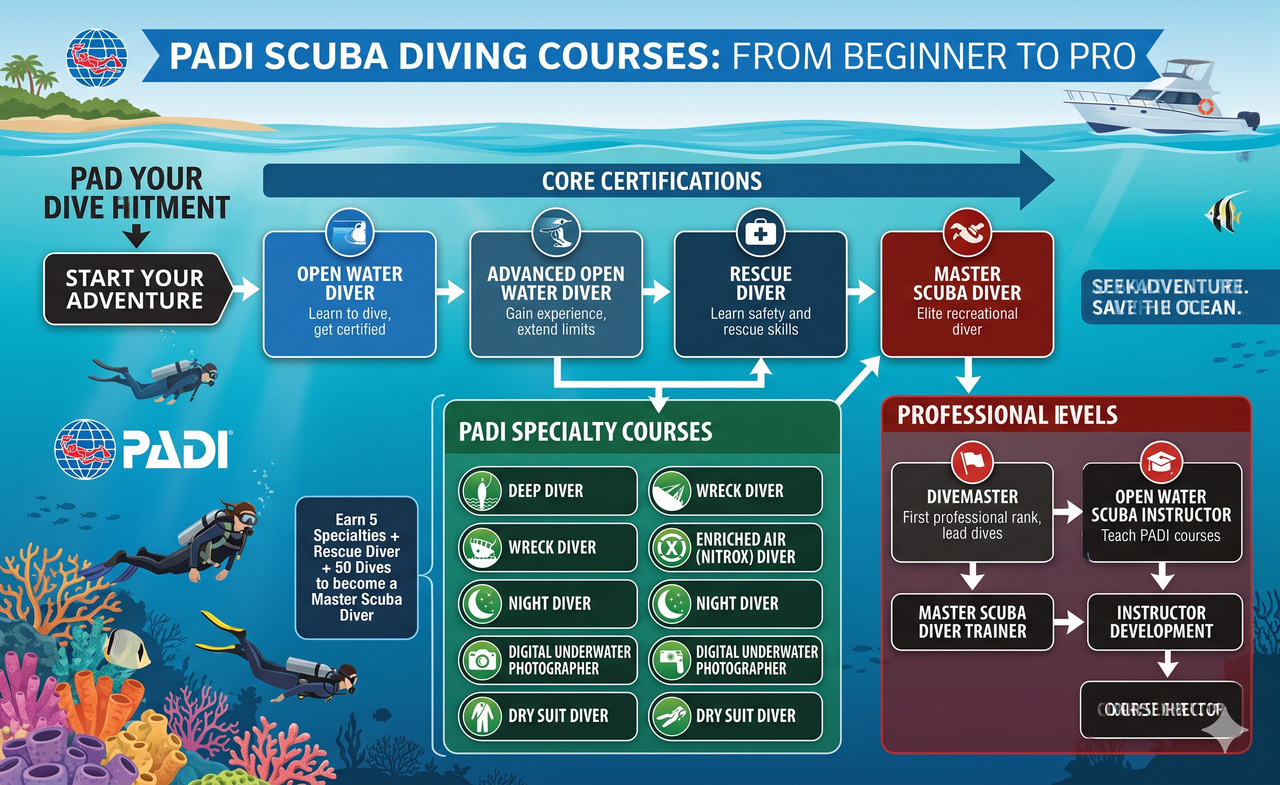
From Open Water to Instructor: what each PADI level costs in Australia, how long it takes, what it unlocks, and how the ladder maps to SSI courses.
By ScubaDownUnder Team · Published 21 June 2026
# PADI Course Levels Explained
Walk into any dive shop and the wall of course posters can look like a pyramid scheme: Open Water, Advanced, Rescue, Divemaster, Instructor, plus a couple of dozen specialty courses orbiting around them. The good news is that the structure underneath is simple, and most divers only ever need the first two or three rungs. This guide walks through the whole PADI ladder: what each level teaches, roughly what it costs in Australia, how long it takes, what it unlocks, and how it maps to the equivalent SSI ratings.
A quick note on prices. Course costs vary a lot between capital cities, regional shops and tourist hubs like Cairns, so treat every figure below as a rough band rather than a quote. Our [guide to certification costs](https://scubadownunder.com/blog/how-much-does-it-cost-to-get-scuba-certified) digs into the detail, and [where in Australia you choose to learn](https://scubadownunder.com/blog/where-to-get-scuba-certified-in-australia) makes a real difference to both price and experience.
## The Ladder at a Glance
- **Open Water Diver**: your entry certification, qualified to 18 metres - **Advanced Open Water**: five adventure dives that extend you to 30 metres - **Rescue Diver**: preventing and managing problems, yours and other people's - **Divemaster**: the first professional rating, qualified to lead certified divers - **Instructor**: qualified to teach and certify new divers
Specialty courses (deep, wreck, nitrox, night and many more) sit alongside the ladder rather than on it. You can take most of them at any point after Open Water, and five of them combine with Rescue Diver and 50 logged dives to earn Master Scuba Diver, the highest non-professional rating PADI issues.
## Open Water Diver: The Card That Matters Most
Open Water is the certification that actually makes you a diver. Everything above it refines, extends or professionalises what you learn here, so it is worth choosing a good shop and taking the course seriously.
The course has three parts: [knowledge development, the theory module](https://scubadownunder.com/blog/what-to-expect-in-your-theory-module-knowledge-development), [confined water sessions in a pool](https://scubadownunder.com/blog/what-to-expect-in-your-pool-sessions-confined-water-training), and [four open water certification dives](https://scubadownunder.com/blog/what-to-expect-in-your-open-water-training-dives). Most Australian shops run the full course over three to four days, either as a continuous block or spread across two weekends, and e-learning lets you finish the theory at home before you ever get wet.
The key numbers:
- **Depth limit**: 18 metres - **Minimum age**: 10 in Australia for Junior Open Water (divers under 12 are limited to 12 metres and must dive with a parent, guardian or PADI professional) - **Typical cost**: roughly $450 to $900 depending on city, season and inclusions - **Time**: three to four days, or two weekends
What it unlocks is the whole sport. You can rent tanks and gear, get air fills, and dive independently with a buddy anywhere in the world without a guide. The certification never expires, although if you spend more than 6 to 12 months out of the water, a short refresher session is strongly recommended before you dive again.
If you are still deciding whether diving is for you at all, a [Discover Scuba Diving experience](https://scubadownunder.com/blog/discover-scuba-diving-try-before-you-commit) lets you breathe underwater with an instructor in a single session, with no course commitment and usually with credit toward Open Water if you continue.
## Advanced Open Water: Deeper, Sooner Than You Think
Despite the name, Advanced Open Water (AOW) is not an experts' course, and there is no minimum number of dives required after Open Water. The course consists of five adventure dives, each effectively the first dive of a specialty course. Deep and Underwater Navigation are compulsory; you choose the other three, with wreck, night, drift and peak performance buoyancy the popular picks in Australia. There is no exam, just a short knowledge review for each dive.
- **Depth limit**: 30 metres - **Prerequisite**: Open Water Diver - **Typical cost**: roughly $350 to $600 - **Time**: two days, usually a weekend
The 30 metre limit is the practical reason most Australian divers do it. A large share of the country's marquee dives, particularly the big wrecks, sit between 18 and 30 metres, and operators check cards before they let you near them. AOW is also where many divers first experience [nitrogen narcosis](https://scubadownunder.com/blog/nitrogen-narcosis-what-it-is-and-how-to-recognise-it) under controlled conditions, which is exactly where you want to meet it.
## Rescue Diver: The Turning Point
Rescue is where your focus turns outward. Instead of managing only yourself, you learn to spot stress in other divers before it becomes a problem, to respond to panicked and tired divers at the surface and underwater, to run search patterns, and to manage an unresponsive diver. The final scenarios are famously demanding and famously fun.
- **Prerequisites**: Advanced Open Water (or Adventure Diver with the navigation dive), plus Emergency First Response or equivalent CPR and first aid training completed within 24 months - **Minimum age**: 12 - **Typical cost**: roughly $500 to $900, or $600 to $1,000 with the EFR course bundled in - **Time**: two to three days
Ask a room full of experienced divers which course changed their diving the most and Rescue wins nearly every time. It pairs naturally with a solid grounding in [everyday dive safety habits](https://scubadownunder.com/blog/essential-safety-tips-new-divers).
## Specialty Courses: Where They Slot In
Specialties are short courses, usually two to four dives, that you can take at almost any point after Open Water. The four most useful for Australian diving:
- **Enriched Air (Nitrox)**: the most popular specialty in the world, and theory-only at most shops. Nitrox gives you longer no-decompression limits on repetitive dives, which matters enormously on liveaboards and multi-dive days. Roughly $200 to $350. - **Deep Diver**: extends your qualified depth to 40 metres over four training dives, with proper attention to gas planning and narcosis management. Requires AOW first. Roughly $400 to $600. - **Wreck Diver**: lines, reels, mapping and the judgement to know when not to go inside. Our [PADI Wreck Diver course guide](https://scubadownunder.com/blog/padi-wreck-diver-course-australia) covers the Australian options in full. Roughly $450 to $650. - **Night Diver**: three dives covering torches, signalling and navigation in the dark. [Night diving in Australia](https://scubadownunder.com/blog/the-enchantment-of-night-diving-in-australia) is special enough to justify the course on its own. Roughly $350 to $500.
Complete Rescue Diver, any five specialties and 50 logged dives and you can apply for **Master Scuba Diver**, which is a recognition rating rather than a course: there is nothing extra to study, it simply acknowledges the miles.
## Divemaster: The First Professional Step
Divemaster is where diving stops being a hobby and becomes a vocation. The course is part academic (dive physics, physiology and decompression theory), part skills polish, and part supervised real-world work: guiding certified divers, assisting on courses, mapping sites and managing groups.
- **Prerequisites**: Rescue Diver, 40 logged dives to start (60 to certify), current EFR, and a dive medical - **Typical cost**: roughly $1,000 to $2,000, plus your own full gear set and annual professional membership fees - **Time**: from a few intensive weeks to several months part time
A certified Divemaster can lead dives and work in the industry, in Australia usually under workplace rules that also require an occupational dive medical, which is stricter than the recreational questionnaire. If you are eyeing this rung, read up on [dive medicals in Australia](https://scubadownunder.com/blog/scuba-diving-medicals-what-disqualifies-you) early so there are no surprises.
## Instructor and Beyond
The Instructor Development Course (IDC), followed by a two-day Instructor Examination, turns a Divemaster into an Open Water Scuba Instructor, qualified to teach and certify new divers. Budget roughly $2,500 to $5,000 for the IDC, materials and examination fees, plus a couple of weeks full time. Beyond that sit Specialty Instructor, Master Scuba Diver Trainer, IDC Staff Instructor and Course Director ratings, which only matter if you are building a career in dive education. Australia's dive industry hubs (Cairns, the Whitsundays, Byron Bay, Perth) run IDCs year round, and instructing remains a well-worn working holiday path for Australians heading overseas.
## How PADI Maps to SSI
SSI runs a parallel ladder, and crossing between agencies at any level is routine:
- **Open Water Diver** = SSI Open Water Diver (same 18 metre limit) - **Advanced Open Water** = SSI Advanced Adventurer (note that SSI also has a rating called Advanced Open Water Diver, which is a recognition award for four specialties plus 24 logged dives, not a course) - **Rescue Diver** = SSI Diver Stress and Rescue - **Divemaster** = SSI Divemaster - **Open Water Scuba Instructor** = SSI Open Water Instructor
Depth limits and prerequisites line up almost exactly, certification cards from either agency are accepted at dive operations worldwide, and you can switch agencies between levels without penalty. If you are weighing up agencies before you start, our [PADI vs SSI vs NAUI comparison](https://scubadownunder.com/blog/padi-vs-ssi-vs-naui-which-scuba-certification-agency-is-right-for-you) covers the differences that actually matter. Spoiler: the instructor in front of you matters far more than the logo on the card.
## Which Levels Do You Actually Need?
For most recreational divers in Australia the honest answer is: Open Water, Advanced Open Water and Nitrox. That combination covers nearly every recreational dive site in the country, including the famous wrecks. Add Rescue if you dive regularly, dive with family, or simply want to be a genuinely useful buddy. Divemaster and Instructor are career decisions, not collection items, and nobody should feel pressured up the ladder by a sales pitch.
However far you climb, remember that the cards are scaffolding, not the building. The diving is the point, and Australia has [a lifetime of it](https://scubadownunder.com/dive-sites) waiting at every level. When you are ready to start, our guides to [how long certification takes](https://scubadownunder.com/blog/how-long-does-it-take-to-get-scuba-certified) and [what it costs](https://scubadownunder.com/blog/how-much-does-it-cost-to-get-scuba-certified) will help you plan the first rung.