Learn to Dive
PADI Wreck Diver Course: Australia Guide
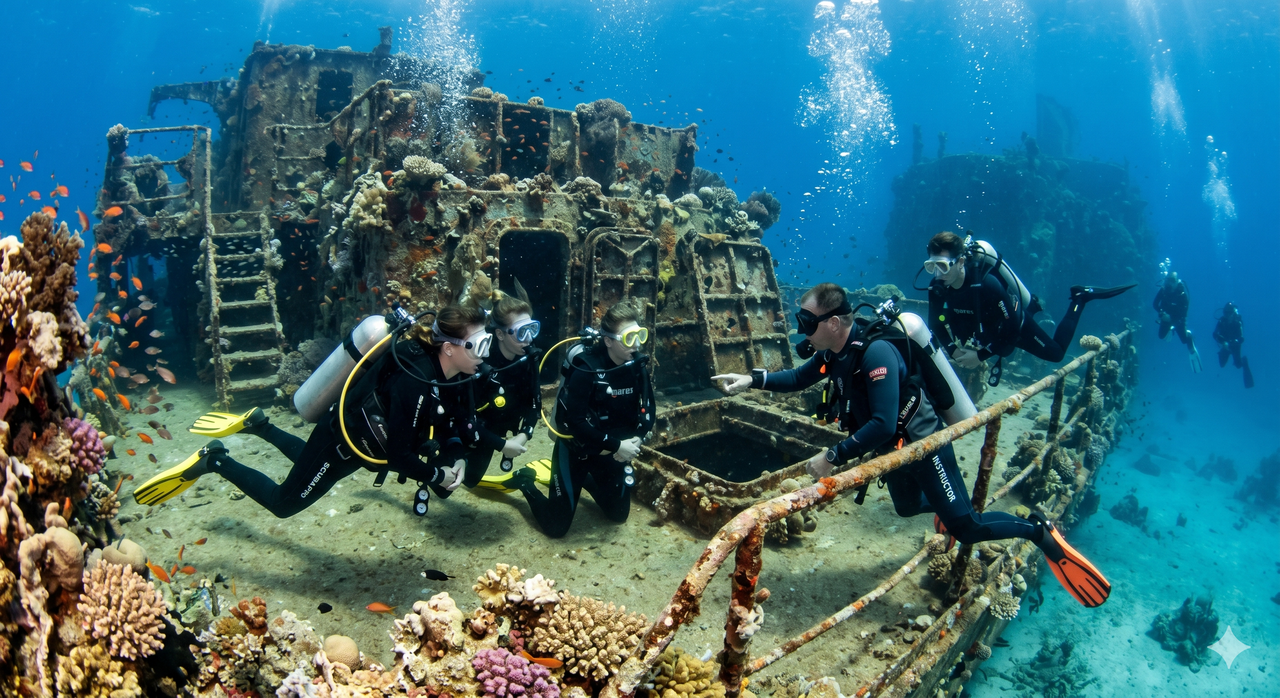
How to qualify as a PADI Wreck Diver in Australia: prerequisites, course structure, where to train, kit needed, and what comes next.
By ScubaDownUnder Team · Published 22 May 2026
Wreck diving is the specialty that bridges recreational scuba and the rest of the diving world. Most divers remember their first wreck dive as a defining moment: the steel architecture, the slow encrustation, the marine life that has built itself around the hull. The PADI Wreck Diver specialty turns that interest into competence. The four training dives teach how to assess, navigate, and (under specific conditions) penetrate wrecks safely. Australia is one of the world's strongest countries for wreck-diver training, with a national portfolio of purpose-sunk warships and historical wrecks covering the full range of difficulty.
This guide covers what the course actually involves, where to do it in Australia, what it costs, and what comes next.
## What the PADI Wreck Diver specialty is
The PADI Wreck Diver specialty is a four-dive, two-day course that teaches the foundational skills for safe recreational wreck diving. It is one of the most popular PADI specialties globally and is recognised by every major dive insurer and operator. The course does not certify you to dive technical or deep penetration; it covers the recreational wreck envelope, defined by PADI as wreck exterior diving plus limited penetration where natural light from the entry point remains visible.
The specialty is structured around three knowledge development sections and four open-water training dives. The training dives can be combined with the dives needed for other certifications, including Advanced Open Water, Deep Diver, and Master Scuba Diver, which saves cost and time for divers building toward broader qualifications.
## Prerequisites
You can enrol in the PADI Wreck Diver specialty if you hold:
- PADI Adventure Diver certification (with the Wreck Adventure Dive completed) or higher, or - An equivalent rating from another agency such as SSI, NAUI, or BSAC, and - Are at least 15 years of age.
In practice most candidates hold Advanced Open Water (which itself requires a Wreck Adventure Dive on some pathways) and use the specialty to formalise their wreck-diving skills. Operators routinely run the Wreck Diver specialty as the logical second specialty after Advanced Open Water, often paired with Deep Diver since most worthwhile Australian wreck dives sit at 18 to 30 metres.
You will also need a reasonable level of buoyancy control. Wrecks reward divers with stable horizontal trim and slow, deliberate finning. Operators may require a refresher dive before the specialty if your last recreational dive was more than 12 months ago.
## Course structure
PADI Wreck Diver knowledge development covers three sections, typically completed via PADI's e-learning platform before you arrive at the dive shop:
- **Wreck diving overview** covers the history and typology of wrecks, the difference between intentional (purpose-sunk) and unintentional wrecks, legal and conservation considerations, and the environmental hazards that distinguish wreck diving from open-water recreational diving. - **Wreck diving procedures** covers pre-dive planning, navigation around the wreck exterior, surveying and mapping techniques, surface marker buoy use, and team-diving protocols at depth. - **Wreck penetration procedures** covers the conditions under which limited penetration is permitted, line-laying technique, primary and backup light protocols, and the rules of thumb that distinguish recreational penetration from overhead-environment diving.
The four open-water training dives apply these progressively. The first dive is typically a survey and exterior orientation, the second covers mapping and navigation, the third introduces line-laying technique at the exterior of a wreck, and the fourth is a limited-penetration dive (in a wreck where it is safe and permitted) that puts the full skill set together. Some operators integrate a Deep Diver training dive in parallel if the candidate is pursuing both certifications.
## Equipment you will need
Wreck diving requires kit additions beyond standard recreational equipment:
- A **primary torch** with at least 500 to 1000 lumens output, suitable for the depth and turbidity of the wreck. - A **backup torch** stored on the harness, redundant in case the primary fails inside the wreck. - A **wreck reel or spool** for line laying during penetration practice and for surface marker buoy deployment. - A **cutting tool** (line cutter or low-profile knife) accessible to either hand, for cutting through old fishing line or your own reel line in the event of entanglement. - A **slate or wet notes** for mapping exercises during the training dives. - A **surface marker buoy with finger spool**, for ascent in current and for surface signalling.
Some operators include hire of these items in the course fee; others expect candidates to bring their own. Confirm before booking. If you are buying for the first time, the wreck-specific kit also crosses over to cave diving and other specialty work, so it pays back across multiple certifications.
## Where to do the course in Australia
Australia offers the best range of recreational wreck training environments of any country, with purpose-sunk warships in multiple states and dozens of historical wrecks in shallow water. The shortlist of hubs:
- **Sunshine Coast, Queensland** is the most popular wreck-training destination, anchored by the [ex-HMAS Brisbane](https://www.scubadownunder.com/dive-sites/ex-hmas-brisbane). The wreck is 133 metres long, sits broadly upright in 27 metres of water with the bridge at 12 metres, and is purpose-cleared for recreational training penetration. Operators in Mooloolaba run the Wreck Diver specialty multiple times a month and the conditions are reliable year-round. - **Sydney and Central Coast, New South Wales** hosts the [Terrigal HMAS Adelaide](https://www.scubadownunder.com/dive-sites/terrigal-hmas-adelaide) at a more advanced 32-metre depth. Sydney itself offers a range of historical wrecks across the Harbour and Botany Bay that operators use on a case-by-case basis for specialty training. - **Albany, Western Australia** is the home of the [ex-HMAS Perth](https://www.scubadownunder.com/dive-sites/hmas-perth-wreck-albany), the country's marquee purpose-sunk wreck dive at 25 to 35 metres. Cold-water temperatures (14 to 21°C) mean the WA wreck specialty runs predominantly through summer. - **Dunsborough, Western Australia** offers the [ex-HMAS Swan](https://www.scubadownunder.com/dive-sites/hmas-swan-wreck) at a more forgiving 22 to 30 metres in sheltered Geographe Bay. The Swan is the standard south-west WA wreck-training site. - **Cairns and Townsville, Queensland** is the technical end of the spectrum. The [SS Yongala](https://www.scubadownunder.com/dive-sites/ss-yongala-wreck) at 16 to 28 metres is one of the world's top wreck dives but is not used for entry-level specialty training due to its current and protected status. Most Cairns operators run wreck-specialty courses on the inner-reef historic wrecks before introducing students to the Yongala as a post-specialty experience.
For most beginners, **the Sunshine Coast is the obvious starting point**. The Brisbane is purpose-prepared for recreational training, conditions are reliable, and the trip stacks well with other Queensland diving on the same weekend.
## Cost expectations
PADI Wreck Diver specialty courses in Australia typically run between AUD 600 and AUD 1,000 depending on:
- The operator and region. Sydney and Queensland coastal operators sit at the upper end; Adelaide and Tasmania are typically lower. - Whether equipment hire is included. - Whether the course is run as a stand-alone specialty or bundled with Deep Diver and Advanced Open Water training. - Whether you are using your own torch and reel or hiring through the operator.
PADI e-learning materials are an additional AUD 200 to 300 if your operator does not bundle them into the course fee. Some operators offer a discount if you book multiple specialties together. The Master Scuba Diver rating, which requires five specialties plus Rescue Diver, is the natural progression for divers committed to building a serious portfolio.
## Beyond the recreational Wreck Diver
The PADI Wreck Diver specialty teaches recreational wreck diving with limited light-zone penetration. Three pathways extend from it:
- The **PADI Deep Diver specialty** delivers the depth qualification that opens up most worthwhile Australian wrecks. Many divers complete Deep Diver and Wreck Diver in the same trip. - The **PADI Master Scuba Diver** rating, the highest non-instructor recreational PADI certification, requires five specialties plus Rescue Diver. Wreck Diver counts toward it. - **Technical wreck diving** is a separate qualification tree. PADI TecRec, SDI/TDI and IANTD all offer extended-range and wreck-penetration courses that go beyond the recreational light-zone limit. These are the qualifications required to dive the deeper Australian wrecks (the [SS Nord](https://www.scubadownunder.com/dive-sites/ss-nord-wreck) in Tasmania, the deeper Darwin Harbour war wrecks, the Yongala interior).
Most divers do not need the technical extension. The PADI Wreck Diver specialty plus Deep Diver opens up the great majority of Australian recreational wreck diving, including the ex-HMAS Perth, the ex-[HMAS Brisbane](https://www.scubadownunder.com/dive-sites/hmas-brisbane), the [Tangalooma Wrecks](https://www.scubadownunder.com/dive-sites/tangalooma-wrecks), the [Scottish Prince](https://www.scubadownunder.com/dive-sites/scottish-prince-shipwreck), and the externally-dived portion of the Yongala.
## A safety note before you book
**The PADI Wreck Diver specialty teaches recreational wreck diving with limited light-zone penetration. It does not certify you to enter overhead environments, navigate beyond visible natural light, or dive depths beyond your other qualifications.** Wreck-penetration accidents are nearly always the result of divers exceeding their training rather than gear failure. Treat the certification as the start of a discipline rather than the end of one, and respect the boundary between recreational and technical wreck diving until you have the qualifications and experience for the next step.
## Ready to start?
The PADI Wreck Diver specialty is the most rewarding next step after Advanced Open Water for any diver drawn to the historical and structural side of the underwater world. Australia's wreck portfolio is one of the world's strongest, and the certification pays back over a lifetime of diving.
[Find a PADI Wreck Diver course near you →](https://padi.pxf.io/k44Ld0?u=https%3A%2F%2Fwww.padi.com%2Fcourses%2Fwreck-diver)
For broader context on Australia's wreck-diving destinations, see our [Best Wreck Dives in Australia](https://www.scubadownunder.com/blog/best-wreck-dives-in-australia) guide.