Learn to Dive
Rescue Diver: The Course Worth Doing
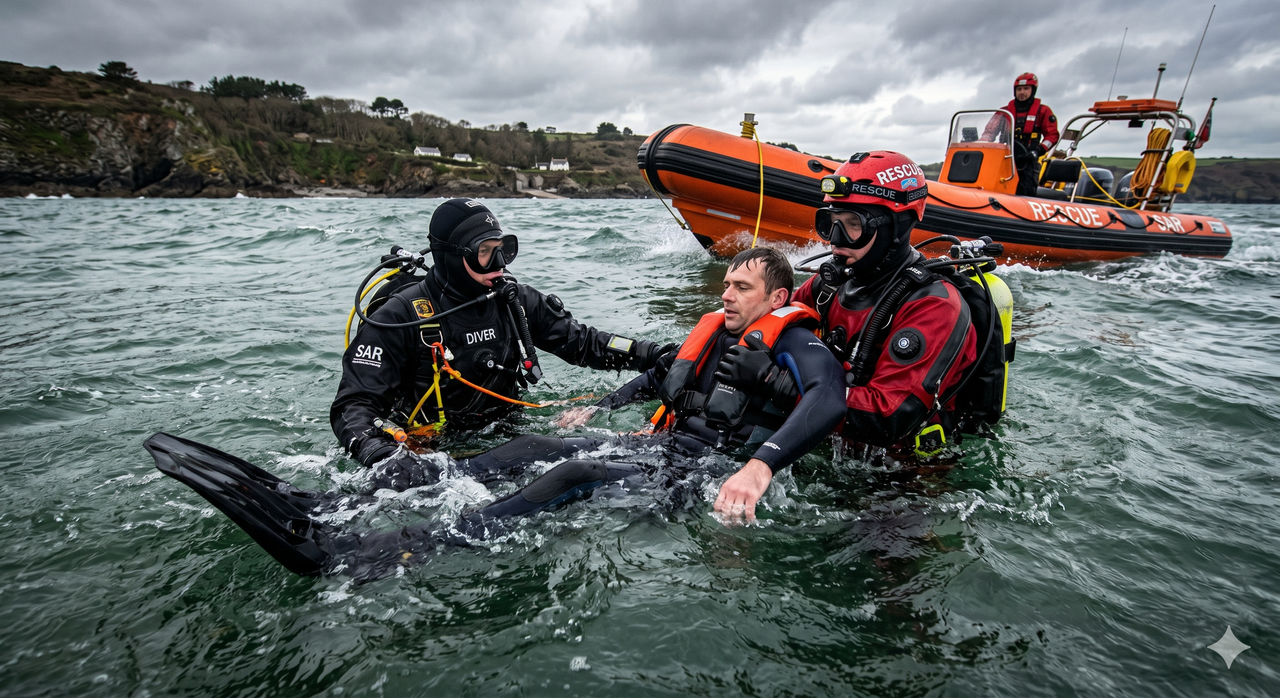
Why divers call Rescue the best course they ever did: self-rescue skills, buddy assists, scenario training, prerequisites and costs in Australia.
By ScubaDownUnder Team · Published 25 June 2026
# Rescue Diver: The Course Worth Doing
Ask a room full of divers which course they rate the highest and the answer is strangely consistent. Not Open Water, which made them divers. Not Divemaster, which made some of them professionals. The answer, over and over, is Rescue. It is a course about problems, taught mostly through games, and it changes how people dive more than any other card in the wallet. Here is why, and what it takes to do it in Australia.
## Why Divers Rate It So Highly
Every course before Rescue is about you: your buoyancy, your gas, your skills. Rescue is the first course about judgement. It teaches you to read a dive site, a situation and another diver, and to act early enough that nothing dramatic ever needs to happen. That shift, from consumer of supervision to contributor to safety, is why so many divers describe it as the moment diving clicked. The confidence it builds is not bravado; it is the quiet kind that comes from knowing what you would actually do.
There is also a simple truth the marketing does not mention: the most likely person you will ever rescue is yourself. The course front-loads self-rescue for that reason, and most graduates report that what changed was not their ability to haul someone from the water but their ability to notice, early, when a dive was drifting toward trouble, and to fix it while it was still a small thing.
## What You Will Actually Learn
The syllabus covers an escalating chain, and every link gets practised in the water:
- **Self-rescue first**: cramp release, regulator recovery under stress, managing your own gas, and recognising the early signs of trouble in yourself before anyone else has to. - **Reading other divers**: the pre-dive signals of stress, the diver fiddling endlessly with gear, the overly quiet buddy, the bravado that masks nerves. - **Surface assists**: tired diver tows, approaching a panicked diver (and when not to approach), using flotation, and keeping yourself safe while you help. - **Underwater responses**: search patterns for a missing diver and a controlled lift of an unresponsive diver from depth. - **Surface management**: in-water rescue breaths, towing while stripping gear, exits onto boats and shorelines, oxygen provision, and handing over to emergency services. - **Scenarios**: the famous final-day exercises where instructors stage surprises and you respond as a team. Expect to laugh, swallow seawater and learn more per hour than in any other course.
You will also revisit the theory that underpins it all, including [decompression sickness and how to respond to it](https://scubadownunder.com/blog/decompression-sickness-symptoms-causes-and-what-to-do), oxygen administration, and how dive emergencies are actually coordinated in Australia, from the boat radio to the Divers Alert Network and hyperbaric chambers.
## How the Course Typically Runs
Formats vary by shop, but the standard Australian shape is two to three days. Day one mixes classroom theory with confined water work: self-rescue drills, the panicked diver grips and releases, and the first tows. Day two moves to open water, where you cycle through stations: surfacing an unresponsive diver, in-water rescue breaths while towing and stripping gear, search patterns with a compass and a buddy line, and exits onto whatever the site offers, sand, rocks or a boat ladder. The final session is scenario day. Your instructors, and frequently some gleeful divemasters recruited as victims, stage incidents without warning: a missing diver, a panicked snorkeller, an unresponsive diver on the bottom. You and your fellow students manage each one end to end, including the decision-making, the delegation and the debrief. The debriefs are where the course really lives; you will replay every scenario over post-dive chips and disagree happily about what you should have done sooner.
## Getting the Most Out of It
A few things graduates consistently recommend. Do the course with people you actually dive with, because a buddy pair or family who have both done Rescue is safer than the sum of its parts. Arrive rested and fed; it is a physical few days. Ask your instructor to vary the scenarios rather than telegraphing them, since surprise is the point. And afterwards, keep the skills alive: run a tired diver tow for fun on an easy dive every few months, and revisit your oxygen and CPR skills when the EFR certificate comes up for renewal. Rescue skills decay like any others, and the course is the beginning of the habit, not the end of it.
## The EFR Prerequisite
Rescue requires current training in CPR and first aid, which PADI delivers as Emergency First Response (EFR) primary and secondary care, completed within 24 months of the course. Most Australian shops run EFR as a one-day or one-evening add-on immediately before the Rescue weekend, and many accept an equivalent current workplace first aid certificate that includes CPR; check with your shop before paying twice. Standalone EFR typically costs $120 to $200, and the skills transfer straight into the rest of your life, which is more than most hobbies can claim.
## How It Changes Your Diving
Graduates describe the same after-effects. Buddy checks stop being a ritual and become a habit you would not skip. You start noticing things on the boat: who is nervous, who is unfamiliar with their gear, where the current is running, where the exit is. You plan gas properly instead of glancing at the gauge when reminded. None of it makes diving feel more dangerous; the effect is the opposite. Awareness is calming, because vague worry gets replaced by specific competence. It is the natural next step once [the basic safety habits](https://scubadownunder.com/blog/essential-safety-tips-new-divers) are second nature, and it sharpens the most underrated skill in diving: [knowing when to call a dive](https://scubadownunder.com/blog/when-to-say-no-to-a-dive-the-smart-divers-guide).
## Prerequisites, Cost and Time in Australia
- **Certification**: Advanced Open Water, or Adventure Diver with the underwater navigation dive completed - **Age**: 12 or older (junior version for under 15s) - **First aid**: EFR or equivalent CPR and first aid within 24 months - **Medical**: the standard recreational screening questionnaire; if anything flags, see our [guide to dive medicals](https://scubadownunder.com/blog/scuba-diving-medicals-what-disqualifies-you) - **Cost**: roughly $500 to $900 for the course, or $600 to $1,000 with EFR bundled - **Time**: two to three days of training, plus the EFR day if you need it
## Is It Hard?
It is the most physically active course in recreational diving, and that is part of the appeal. Expect towing, lifting, wetsuit wrestling and a lot of surface swimming. But technique beats muscle at every station: smaller divers pass Rescue constantly because leverage, buoyancy and positioning do the work that brute strength cannot. If you can handle [the general fitness expectations of diving](https://scubadownunder.com/blog/how-fit-do-you-need-to-be-to-scuba-dive), you can handle Rescue. Performance requirements are about responding effectively, not perfectly, and instructors want you to succeed. Pass rates are high; the tired grin at the end is nearly universal.
## What It Unlocks
Practically, Rescue is the gateway to everything professional: Divemaster requires it, and the Master Scuba Diver rating builds on it. If you trained with SSI, the equivalent course is Diver Stress and Rescue, and the two are recognised interchangeably; our [agency comparison](https://scubadownunder.com/blog/padi-vs-ssi-vs-naui-which-scuba-certification-agency-is-right-for-you) covers how the systems line up. It also reframes the buddy system itself: after Rescue you understand why [diving alone is a specialist discipline](https://scubadownunder.com/blog/solo-or-buddy-should-you-ever-scuba-diving-alone) and what a buddy is actually for.
The real unlock is less tangible. Rescue makes you the diver other people want on their boat: calm, observant and useful. If you only ever take one course beyond Advanced, make it this one.