Marine Life
Sea Hares
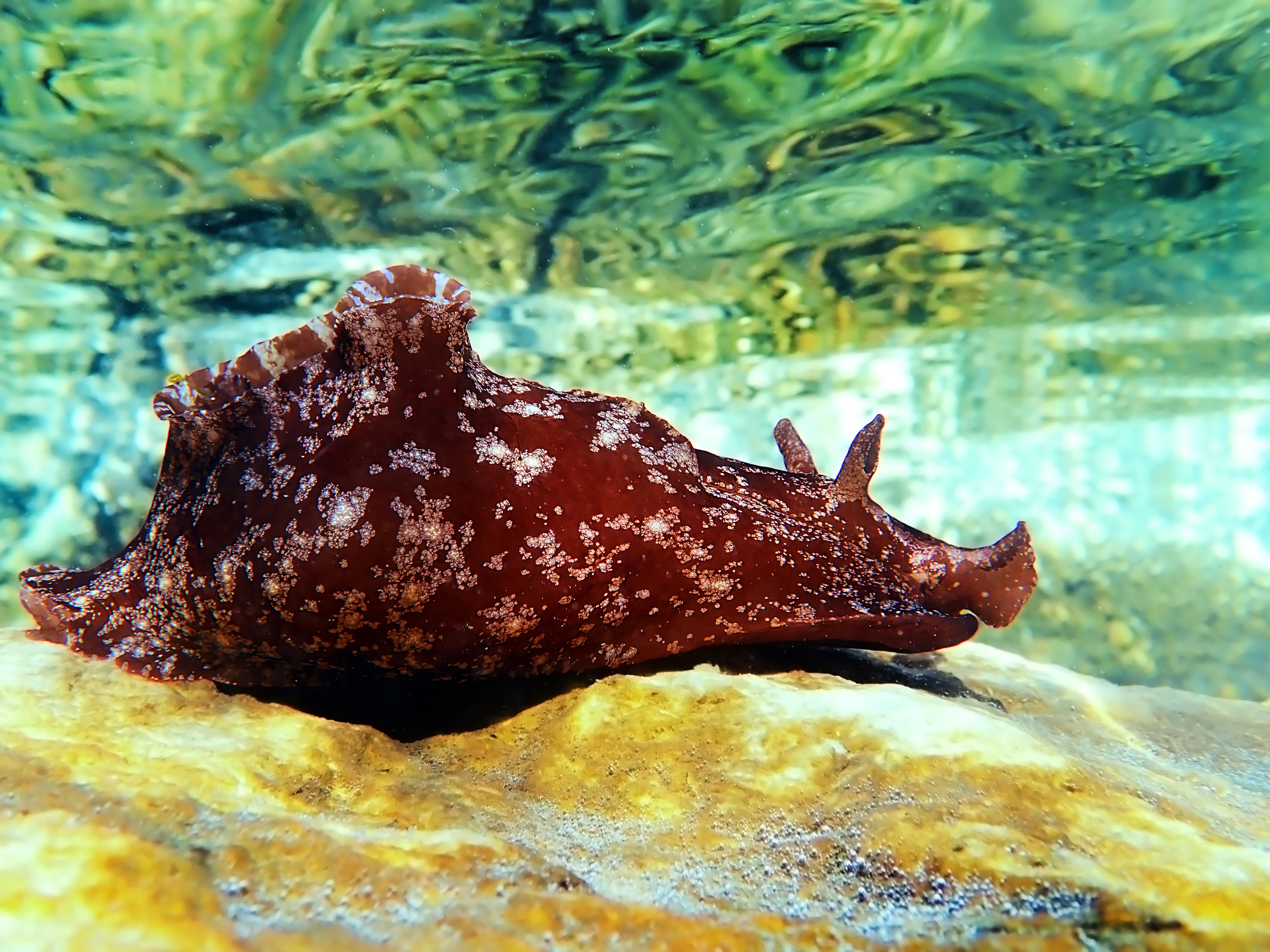
They are not the most glamorous inhabitants of the reef lacking the neon flamboyance of their nudibranch cousins
By ScubaDownUnder Team · Published 27 November 2025
Sea Hares
If you have ever drifted over a seagrass bed in Port Phillip Bay, skirted the rocky reefs of Rottnest Island, or explored the shallows of Sydney Harbour, you have likely encountered a creature that resembles a sentient blob of mottled velvet. They are not the most glamorous inhabitants of the reef, lacking the neon flamboyance of their nudibranch cousins, but the Australian Sea Hare is a biological marvel that deserves far more than a passing glance. To the uninitiated diver, they are "big ugly slugs." To the marine biologist, they are Anaspidea: masters of chemical warfare, giants of the gastropod world, and unlikely heroes of modern neuroscience. Grab a coffee (or a deco beer), settle in, and let’s explore why these hulking molluscs are some of the most fascinating critters down under.
What Exactly is a Sea Hare?
First, let’s clear up a common taxonomic misconception. While often lumped in with nudibranchs by casual observers, Sea Hares belong to the order Anaspidea. The primary difference lies in the shell. Nudibranchs have ditched their shells entirely during their evolutionary journey. Sea Hares, however, are evolutionary hoarders; they have kept a vestigial, protein-based shell, but they’ve tucked it inside their mantle cavity to protect their gills and organs. If you were to gently feel the back of a large sea hare (though I don’t recommend pestering them), you might feel a firm, internal plate. They get their common name, "Sea Hare," from the Romans, who thought their large rhinophores (sensory tentacles) looked like the ears of a hare. Combined with their rounded backs and grazing habits, the comparison to a rabbit is actually spot on, if rabbits were hermaphroditic, aquatic, and toxic.
The Australian Heavyweights
Australia boasts a rich diversity of Anaspidea, ranging from the tropics to the temperate south. - The Black Sea Hare (Aplysia gigantea) This is the beast of the southern coasts. Found from Western Australia to New South Wales, this species can reach a staggering 60 centimetres in length and weigh over 2 kilograms. Seeing one of these underwater is startling; they look like a dark, erratic storm cloud rolling over the sand. They are incredibly strong swimmers, using their large parapodia (wing like flaps) to glide through the water column.
- The Spotted Sea Hare (Aplysia argus) For years, diving guidebooks referred to the spotted sea hares in the Indo-Pacific as Aplysia dactylomela. However, genetic sequencing has recently told us that A. dactylomela is an Atlantic species, while our local spotted friend is actually Aplysia argus. These are the photographers' favourites, featuring beautiful ringed patterns that act as camouflage against the sun-dappled reef floor.
- The Wedge Sea Hare (Dolabella auricularia) If Aplysia are the rabbits, Dolabella is the rock. Shaped like a truncated wedge and covered in warty protrusions, they are experts at looking exactly like a dirty rock covered in algae. They are strictly nocturnal and often bury themselves in the sand during the day.
The Lifecycle: Live Fast, Die Young, Leave a Giant Corpse
The life of a sea hare is a sprint, not a marathon. Most Australian species have a lifespan of only about one year. This short existence is driven by a singular purpose: to turn algae into mass, and mass into offspring.
The "Roman Orgy" Phenomenon
Sea hares are simultaneous hermaphrodites, meaning every single individual possesses fully functional male and female reproductive organs. However, they cannot self-fertilise. This leads to one of the most amusing sights in the marine world: the mating chain. During the breeding season (often late summer in temperate Australia), sea hares aggregate in massive numbers. One individual will act as a female, another will mount it acting as a male. A third will then mount the second, acting as a male to the second hare's female side. This can continue until you have a conga line of ten or more sea hares, with the ones in the middle acting as both male and female simultaneously.
The Spaghetti Factory
Following this frenzy, the sea hares lay their eggs. And when I say "lay," I mean they mass produce. A single sea hare can produce millions of eggs in a gelatinous, stringy mass that looks remarkably like instant noodles or silly string. You will often find these bright yellow, pink, or green masses tangled in algae or attached to jetty pylons. The eggs hatch into microscopic veliger larvae, which drift in the plankton before settling and metamorphosing into crawling slugs.
The Mass Die-Off:
If you frequent Australian beaches, you may have seen hundreds of dead sea hares washed up on the shore. While alarmist headlines often scream "Pollution!", this is usually a natural, post-spawning event. having fulfilled their biological imperative to breed, the adults die en masse. Chemical Warfare: Why You Shouldn't Eat (or Poke) Them Sea hares are slow, soft, and protein-rich. In the ocean, this usually spells "lunch." Yet, very few predators touch them. Why? Because the sea hare is a master of chemistry.
- You Are What You Eat Sea hares are herbivorous grazers, feeding voraciously on red and green algae (and seagrasses). Many of these algae contain toxic compounds (terpenes and acetates). Rather than excreting these toxins, the sea hare bio-accumulates them in its skin and organs, making them foul tasting and potentially poisonous to fish.
- The Inking Response If you annoy a sea hare enough, it will deploy its ultimate weapon: a cloud of ink. But this isn't just a visual smoke screen like an octopus uses. The ink of Aplysia is a complex mixture of two secretions: - Purple Ink: Derived from the pigments in red algae (phycoerythrin) produced by the ink gland. - White Opaline: A thick, sticky secretion produced by the opaline gland. When mixed, they form a purple cloud that contains high concentrations of amino acids. Here is the science bit for the experts: The amino acids (specifically taurine and lysine) in the ink are so concentrated that they stimulate the feeding receptors of predators (like spiny lobsters). Essentially, the ink causes "phagomimicry", it tricks the predator’s chemical senses into thinking the ink is food. The lobster gets confused, trying to eat the cloud and clean its chemically overloaded antennae, giving the sea hare time to make a slow getaway.
A Nobel Prize in a Slug?
This is my favourite "pub trivia" fact to drop on surface intervals. The sea hare is responsible for a significant portion of what we know about human memory. The species Aplysia californica (a close relative of our Aussie species) was the subject of research by neuroscientist Eric Kandel. Why? Because sea hares have massive neurons some of the largest in the animal kingdom, which can be seen with the naked eye.
Kandel used these giant neurons to map out exactly how chemical signals change at the synapse during learning and habituation. His work with these humble slugs won him the Nobel Prize in Physiology or Medicine in 2000. So, the next time you see a sea hare, show some respect you are looking at a creature that helped us understand the human mind. Diving with Sea Hares: Habitat and Conditions If you want to find these fascinating anaspideans in Australian waters, you need to look in the "boring" bits. Where to Look:
- Seagrass Beds: This is prime real estate. Look for Aplysia grazing on the blades or burying into the sand at the roots. - Sheltered Bays & Estuaries: They prefer calm water. Places like Chowder Bay in Sydney, the Mornington Peninsula piers in Victoria, or the calm side of Heron Island are hotspots. - Intertidal Rock Pools: During low tide, you can often find smaller species trapped (safely) in pools. Topology & Cover: They love "muck diving" environments. You typically won't find them on the high energy, current swept outer walls. They prefer silty bottoms, rubble zones, and dense macro algae forests where their camouflage is most effective.
Best Time:
While some species are year round, late summer to early autumn is usually the peak time for observing the giants and their mating aggregations.
Summary
The Australian Sea Hare is a testament to the fact that you don’t need a backbone to be a badass. They are chemically defended, reproductively efficient, and neurologically significant. They transform the algae of our temperate and tropical reefs into a spectacle of life (and sticky purple ink). So, on your next dive, when you spot a shapeless blob rolling in the surge, take a moment to appreciate it. It’s not just a slug; it’s a toxic, swimming, memory teaching marvel of evolution. Safe diving, and don't harass the locals!