Marine Life
Stonefish: The Ocean’s Master of Disguise
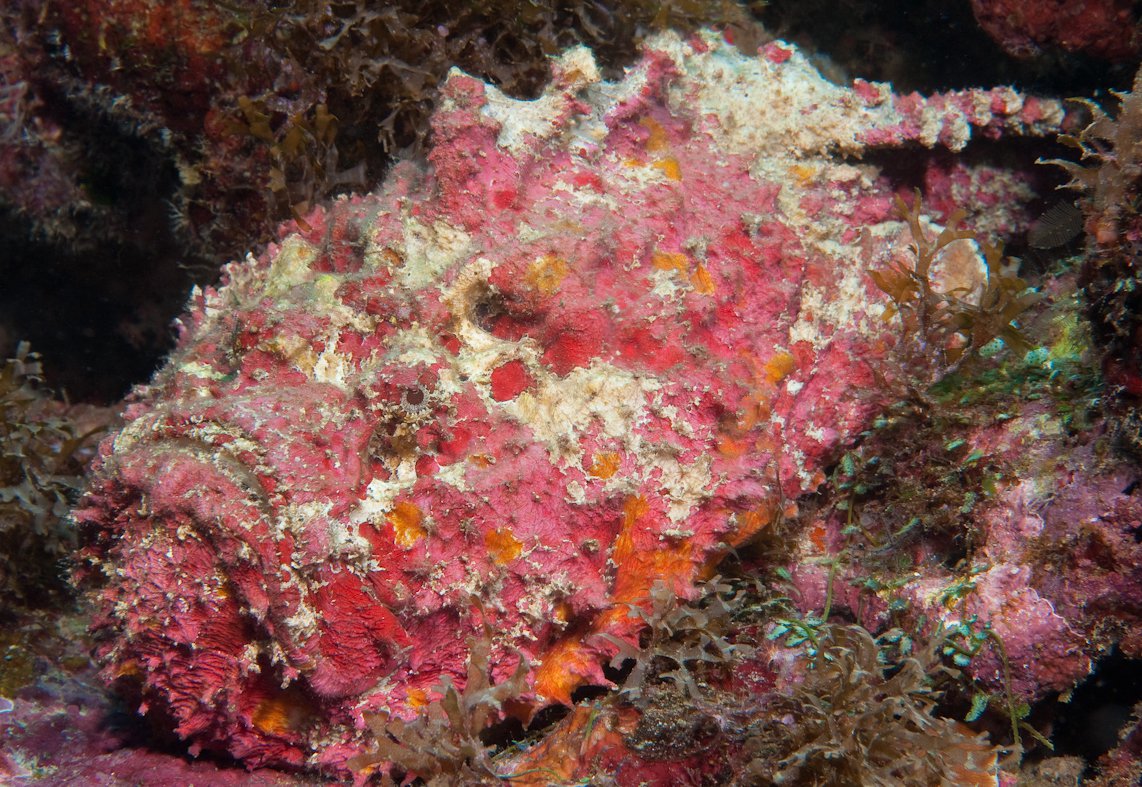
The world’s most venomous fish lurking in plain sight
By ScubaDownUnder Team · Published 16 August 2025
Few marine creatures inspire as much awe and caution as the stonefish.
This unassuming master of camouflage blends seamlessly into coral rubble and rocky seabeds, biding its time until prey wanders close enough for a lightning fast strike. Despite its sedentary appearance, the stonefish is a formidable predator armed with one of the most potent venoms in the animal kingdom. For divers, snorkellers, and coastal wanderers, understanding the stonefish’s nature is essential for both safety and appreciation of its role in marine ecosystems.
Appearance and Camouflage
The stonefish’s genius lies in its invisibility. With mottled skin in shades of brown, grey, and rusty red, it resembles an encrusted rock or coral head. Its warty texture is often enhanced by algae growth, further blurring the line between animal and inanimate object. Fully grown, stonefish can reach 30–40 cm in length, with a stout, broad head and an upturned mouth ready to engulf prey.
What makes them so challenging to spot is not just colour but behaviour: stonefish remain perfectly still for hours, sometimes days, positioning themselves where passing small fish or crustaceans are likely to come within striking range.
Habitat and Distribution
Stonefish thrive in shallow tropical and subtropical waters, often in sandy or muddy bottoms near reefs, mangroves, estuaries, and even tidal pools. They are widespread throughout the Indo-Pacific region, including much of northern Australia. Unfortunately, their preferred habitats often overlap with areas frequented by swimmers and waders, increasing the risk of accidental encounters.
Diet and Hunting
Despite their sluggish appearance, stonefish are ambush predators of remarkable efficiency. Using their camouflage as cover, they lie in wait until prey is within centimetres. Then, with a rapid expansion of their jaws an action completed in as little as 0.015 seconds they create a vacuum that sucks in their target whole.
Their diet consists mainly of small fish and crustaceans. They do not pursue prey actively, conserving energy for sudden, decisive strikes.
Venom and Defence
Stonefish are infamous for their venomous dorsal spines, up to thirteen sharp, stout spikes along their back, each connected to venom glands. The venom is a complex cocktail of proteins that can cause extreme pain, tissue damage, paralysis, and, in rare cases, death.
Envenomation usually occurs when an unsuspecting person steps on a stonefish, driving the spines into their foot or leg. The pressure triggers venom injection, and the pain is often described as excruciating, radiating quickly from the wound. Without rapid medical treatment, including the administration of antivenom, severe complications can follow.
Human Interactions and First Aid
Stonefish stings are a medical emergency. If stung:
- Seek urgent medical help antivenom is available in Australia and is highly effective if administered quickly. - Immerse the affected area in hot (but not scalding) water: heat helps break down venom proteins and can reduce pain. - Avoid tight bandages: these can restrict blood flow and worsen tissue damage. - Stay calm and still: movement can speed venom spread.
Prevention is the best defence: wear protective footwear when wading in shallow reef or rocky areas, and never place hands or feet into crevices without looking first.
Role in the Ecosystem
Stonefish play a vital role in maintaining reef balance by controlling populations of smaller reef fish and crustaceans. Their position as an apex ambush predator helps sustain a diverse and stable food web.
For Divers and Snorkellers
While the threat of a sting is real, stonefish sightings can be thrilling for experienced divers. They often remain perfectly still for photographs, provided you maintain a safe distance and avoid sudden movements near the seabed. Spotting one is a true test of a diver’s observational skills, many swim past without realising they have been watched the whole time.
Fascinating Facts - Speed of strike: Among the fastest known in the fish world, at around 15 milliseconds. - Long survival out of water: Stonefish can survive for up to 24 hours out of water, making them dangerous even when stranded on shore. - Ancient design: Fossil evidence suggests their ambush hunting strategy has changed little over millions of years. - Defensive over offensive: Venom is primarily for defence, not hunting prey are swallowed whole without being envenomated.
Conclusion
The stonefish is a marvel of evolutionary adaptation, a living booby trap in the shallows. Its beauty lies in its deception, and its danger lies in our ignorance. For those who respect the reef and tread carefully, it is a fascinating, if formidable, creature to encounter. By learning to recognise and appreciate it from a safe distance, divers and ocean lovers can admire this stealthy predator without becoming its next accidental victim.