Tips
The Breath of Life: A Deep Dive into Diving Gases
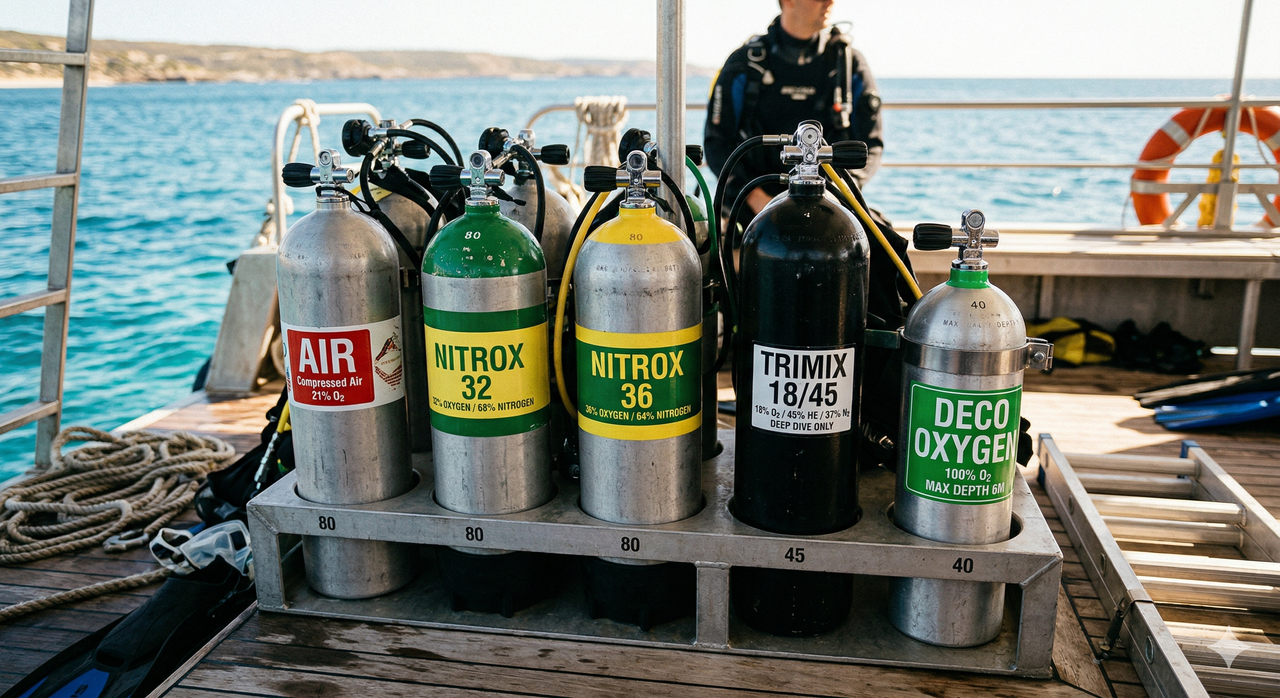
Choosing the right gas is about matching the tool to the task. From standard air to clear-headed Trimix, each mix offers a specific physiological key to the deep. Understanding partial pressures and gas density ensures that every diver, from recreational enthusiast to marine biologist, remains safe, sharp, and submerged for longer.
By ScubaDownUnder Team · Published 2 April 2026
The Breath of Life: A Deep Dive into Diving Gases
In the early days of the "Manfish," the choice was simple: you breathed what was in the atmosphere, just compressed. Today, we treat gas as a tool, a specific wrench for a specific depth. For the seasoned diver and marine professional, understanding the chemistry of your cylinder is the difference between a 20-minute bottom time and an hour-long masterpiece.
On the reefs of Australia and beyond, your gas choice dictates your safety margin, your clarity of mind, and how you feel when you finally climb back onto the duckboard.
The Physics of the Breath: Dalton’s Law
Before we look at the mixes, we have to understand why they change as we descend. John Dalton, an English chemist, gave us the foundation for everything we do in a drysuit or wetsuit. His law states that the total pressure of a gas mixture is the sum of the partial pressures of each individual gas.
As we dive deeper, the ambient pressure increases. At 10 metres, we are at 2 bar (or atmospheres). This means the 21% oxygen we breathe on the surface is now exerting a partial pressure of 0.42. By the time we hit 30 metres (4 bar), that same oxygen is hitting our system at 0.84.
For a marine biologist, this isn't just maths; it is a physiological ticking clock. Every gas has a "goldilocks zone." Too little oxygen and we become hypoxic; too much and it becomes a neurotoxin. Our job as divers is to keep these partial pressures within a window that allows our brains to function at peak performance while we document the wonders of the deep.
Compressed Atmospheric Air (21% Oxygen, 78% Nitrogen)
The "old faithful" of the diving world. It is simply filtered, dried, and compressed air from the world around us.
* The Usage: Standard recreational diving within "no-decompression" limits. * The Benefits: Universal availability and low cost. No special "O2-cleaning" of your regulators or cylinders is required. It is the baseline gas for every diver starting their journey. * The Risks: * Nitrogen Narcosis: Nitrogen becomes narcotic under pressure. By the time you hit 30 metres, most divers feel a slowing of cognitive function, the "narks." For a scientist trying to record complex fish behaviours, this "tipsiness" can lead to flawed data and poor safety choices. - Decompression Sickness (DCS): Because air is mostly nitrogen, our tissues saturate quickly. This creates a "hard ceiling" on our bottom time. - The Density Trap: This is the most overlooked risk. At 40 metres, air is five times denser than at the surface. It’s like trying to breathe honey through a straw. This increased density makes it harder for your lungs to "flush" o2. High co2 levels are the primary trigger for panic and a massive intensifier of nitrogen narcosis. * Licencing & Training: Requires Open Water Diver certification for shallow depths (18m) and Deep Diver training to reach the 40m recreational limit.
Enriched Air Nitrox (EANx)
Nitrox is air that has been "enriched" with extra oxygen, typically to 32% or 36%, thereby reducing the nitrogen content.
* The Usage: Multi-dive days, photography, and reef exploration in the 15m to 30m range. * The Benefits: * Extended No-Stop Time: Less nitrogen means slower saturation. At 20 metres, your bottom time can nearly double compared to air. This is a game-changer for photographers waiting for that one perfect shot of a Weedy Seadragon. - The "Nitrox Glow": While researchers debate the "placebo effect," many divers swear they feel less exhausted. The prevailing theory is that by reducing the "silent bubble" load (micro-bubbles that don't cause DCS but trigger an immune response), the body spends less energy on repair after the dive. * The Risks: * Oxygen Toxicity: This is the primary danger. When o2 exceeds 1.4, it can cause Central Nervous System (CNS) toxicity. If you take a 36% mix to 35 metres, you risk a grand mal seizure. Underwater, this almost inevitably leads to drowning as the regulator falls out of the mouth. * Licencing & Training: Requires an Enriched Air (Nitrox) Specialty. You must learn to use an oxygen analyser and calculate your Maximum Operating Depth (MOD).
Trimix (Helium, Nitrogen, Oxygen)
When we want to go deeper than 40 metres without the "martini effect," we turn to Trimix. By adding Helium, we displace some of the nitrogen and oxygen.
* The Usage: Technical diving, deep wall exploration, and wreck penetration. * The Benefits: Cognitive Clarity: Helium is non-narcotic. Diving to 60 metres on Trimix feels as clear-headed as standing on the beach. It allows you to actually remember the dive you just did. - Work of Breathing (WOB): Helium is incredibly "thin." It moves effortlessly through your regulator even at high pressures, drastically reducing co2 buildup and making the physical act of breathing much less taxing on your cardiovascular system. * The Risks: Complexity: Helium leaves the body much faster than nitrogen. This requires "staged" ascents and complex decompression algorithms. - Isobaric Counter-Diffusion (ICD): If you switch from a high-nitrogen gas to a high-helium gas at depth, the different speeds at which these gases move in and out of your inner ear can actually cause the "bends" while you are still deep. * Licencing & Training: Requires Technical Diver (Tec 40/45/50 or Trimix) certification. This involves rigorous training in gas management, twin-set or sidemount configurations, and emergency protocols.
The Decompression Specialist: Pure Oxygen (100% o2)
Pure oxygen is the "turbo-boost" for getting out of the water. We never breathe it deep; it is used strictly in the shallows.
* The Usage: Accelerated decompression and emergency first aid. * The Benefits: The Oxygen Window: By breathing 100% o2 at 6 metres, you create a massive partial pressure gap. Since there is zero nitrogen in your lungs, the nitrogen trapped in your tissues rushes out to fill the void. This can cut decompression times by 50% or more. * The Risks: Fatal Toxicity: Switching to your o2 bottle by mistake at 20 or 30 metres is an immediate life-threatening error. * Licencing & Training: Covered within Decompression Procedures or Tec Diver courses. It requires strict "gas switching" protocols, usually involving a "MOD" (Maximum Operating Depth) sticker on the tank that the diver must physically touch and read before putting the regulator in their mouth.
Behind the Scenes: How the Gas is Made
For the gear-heads among us, how that gas gets into the tank is just as important as how we breathe it.
* Partial Pressure Blending: The dive shop puts pure oxygen into a clean cylinder first, then tops it up with hyper-filtered air. It requires "O2 Clean" tanks because pure oxygen can cause oil or dust to spontaneously combust. * Nitrox Membranes: High-end shops use a "stick" or membrane that strips nitrogen out of the air before it even reaches the compressor. This is the safest way to make Nitrox as no pure oxygen is ever handled. * Trimix Blending: This is an art form. It involves precisely injecting helium, then oxygen, then air. Because helium is so "slippery," it takes a skilled blender to ensure the mix is accurate to within 1%.
Heliox (Helium and Oxygen)
Heliox removes nitrogen entirely, leaving only Helium and Oxygen.
* The Usage: Commercial saturation diving (living in a pressurized chamber for weeks) or world-record-breaking exploration. * The Benefits: Zero nitrogen narcosis. * The Risks: High-Pressure Nervous Syndrome (HPNS): At extreme depths (usually beyond 150m), the lack of nitrogen’s "calming" effect can cause the nervous system to misfire, leading to tremors. - The Cold Truth: Helium conducts heat six times faster than air. Breathing it chills your core from the inside out. In these environments, divers often need heated suits and gas heaters just to survive. * Licencing & Training: Generally reserved for Commercial Divers or Elite Expeditionary levels.
The Verdict for the Modern Diver
Choosing your gas is about matching the tool to the task. If you’re a recreational diver enjoying the shallows of Byron Bay, air is perfect. If you’re a professional looking to push the boundaries of what we know about the ocean, Nitrox and Trimix are your best friends.
As marine biologists, we respect the "Partial Pressure" gods to ensure we come back to the surface with our data and our health intact. The more you know about what’s in your tank, the more you can focus on what’s in front of your mask.