Marine Life
Green Sea Turtles: Facts and Where to See Them
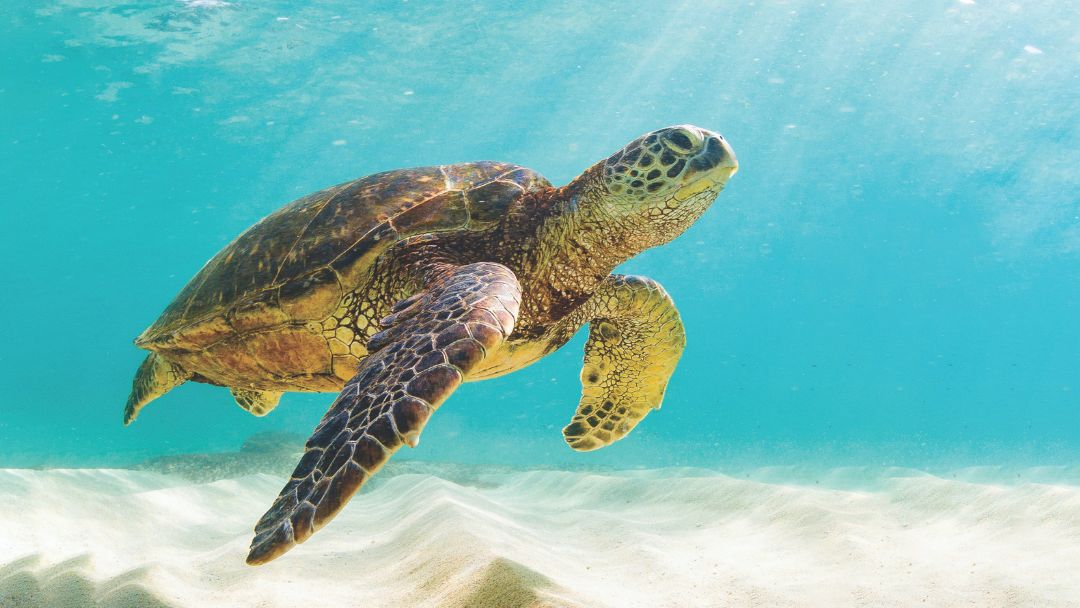
Green sea turtle facts for divers: diet, migration, nesting, and the best Australian dive sites to swim alongside one.
By ScubaDownUnder Team · Published 26 August 2025
Green Turtles and Their Remarkable Adaptations
Ancient ocean navigators with extraordinary survival skills
The green turtle (Chelonia mydas) is one of the most iconic and widespread sea turtles in the world’s oceans. With ancestors stretching back more than 100 million years, green turtles have survived thanks to a suite of extraordinary adaptations that allow them to navigate vast oceans, feed on seagrass meadows, and endure the challenges of both land and sea. Their lives are marked by epic migrations, complex physiology and unique reproductive strategies that make them one of nature’s most remarkable survivors.
The most visible adaptation is the green turtle’s streamlined shell. Unlike bulky tortoise shells, the carapace of a green turtle is flattened and hydrodynamic, reducing drag and enabling them to glide effortlessly through the water. Their front limbs have evolved into powerful flippers, perfectly suited for long distance swimming. With each sweep of their flippers, they can travel thousands of kilometres across open ocean, a feat few marine reptiles can match.
Respiration is another area of impressive adaptation. Although green turtles are air breathers, they can remain submerged for several hours at rest, slowing their heart rate to conserve oxygen. During dives, blood flow is redirected from non essential organs to the brain and heart, ensuring survival in oxygen limited conditions. This physiological control allows them to forage on the seafloor or undertake long migrations without constant resurfacing.
Diet has shaped some of the green turtle’s most distinctive features. While juveniles are omnivorous, feeding on jellyfish and small invertebrates, adults shift almost exclusively to herbivory, grazing on seagrass and algae. Their finely serrated jaws act like shears, trimming seagrass with efficiency. This diet not only sustains the turtle but also benefits marine ecosystems by maintaining healthy seagrass beds, which in turn support countless other marine species.
Perhaps the most astonishing adaptation is their navigational ability. Female green turtles return to the very beaches where they hatched decades earlier to lay their eggs. They are guided by an internal compass attuned to Earth’s magnetic fields, allowing them to cross entire oceans with precision. This natal homing behaviour ensures the continuation of nesting traditions, but it also highlights their vulnerability when beaches are disturbed by human activity or climate change.
Reproduction brings further remarkable strategies. A female green turtle may lay more than 100 eggs in a single clutch, burying them in the sand where they are incubated by the sun’s warmth. The sex of hatchlings is determined by nest temperature, a trait known as temperature dependent sex determination. Cooler nests tend to produce males, while warmer nests produce females. This adaptation has endured for millennia, but with modern warming trends, it risks creating skewed sex ratios that threaten population stability.
Hatchlings themselves are marvels of adaptation. Upon emerging, they instinctively sprint towards the ocean, guided by the natural light horizon over the sea. Their survival strategy is based on speed and numbers: while many are lost to predators, sheer numbers ensure that at least a few reach the water. Those that survive undertake what is known as the “lost years,” drifting with ocean currents for several seasons, often thousands of kilometres from their birth site, before returning to coastal feeding grounds.
Camouflage is another vital adaptation. The green turtle’s carapace displays mottled shades of brown, green and black, blending with seagrass beds and coral reefs. This reduces their visibility to predators such as sharks, especially during their vulnerable juvenile years. In adulthood, their sheer size provides further protection, with adults growing up to 1.5 metres in length and weighing as much as 200 kilograms. Few predators, apart from humans, dare challenge a fully grown green turtle.
Their longevity is equally impressive. Green turtles can live for more than 70 years, a slow and steady life history that balances their late maturity with decades of reproductive opportunity. Combined with their ability to store fat reserves and survive long periods without food, this longevity has been key to their evolutionary success.
Culturally and ecologically, green turtles are keystone species. They maintain seagrass ecosystems, support reef productivity, and have been revered in many human societies as symbols of wisdom and endurance. Their survival, however, is now increasingly tied to conservation. Habitat destruction, plastic pollution, rising temperatures and illegal hunting all place pressure on a species that has survived since the age of dinosaurs.
The story of the green turtle is one of endurance, adaptation and interconnection. From their magnetic compass that guides them across oceans to their role as gardeners of the sea, green turtles are living reminders of the resilience of nature. Yet they also remind us of fragility, as their future depends on our efforts to protect the beaches, seagrass meadows and oceans that sustain them.
Sources
* WWF, Green turtles * NOAA Fisheries, Green turtle * Smithsonian Ocean, Sea turtles