Best Scubapro Regulators 2026: Buying Guide
Australian buying guide to Scubapro's 2026 regulator lineup. Picks for tropical, cold-water, technical and travel diving.
Where to Buy
Affiliate links — we may earn from qualified purchases
# Best Scubapro Regulators 2026: Buying Guide
Scubapro has been the most-serviced regulator brand in Australian dive shops for the better part of forty years. The reason is practical, not romantic. Walk into a major dive shop in Sydney, Melbourne, Cairns, Adelaide or Perth and the technicians on the bench have the parts, the tools and the factory training to service a Scubapro first stage on the spot. That matters when you are three days into a Coral Sea liveaboard and a high-pressure hose lets go, and it matters when you are an hour into a Saturday morning and your regulator needs to be ready for the afternoon shore dive.
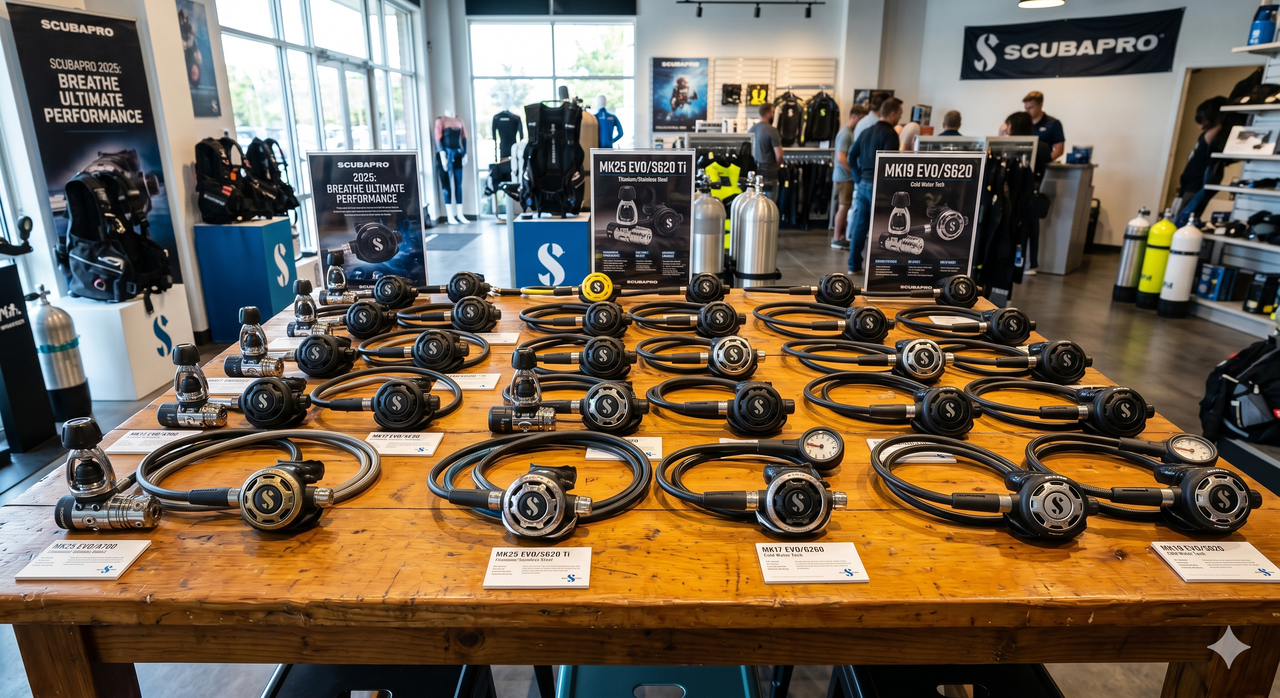
This guide covers Scubapro's 2026 regulator lineup, the technology choices that separate the models, and which set is right for which type of Australian diving. The picks below are framed for diving in Australian conditions. Tropical Queensland and Western Australia for the warm-water sets. Temperate Victoria, Tasmania and South Australia for the cold-water capable models. Travel and recreational sets for the divers who do both.
## Quick comparison: Scubapro 2026 regulator picks at a glance
| First stage / second stage | Cold-rated | Best for | Approx weight | Why pick it | |---|---|---|---|---| | **MK19 EVO / G260 Carbon BT** | Yes | Cold water, technical | 1,180 g | Premium sealed diaphragm, swivel turret, carbon faceplate | | **MK25 EVO / S620Ti** | Conditional | Tropical performance | 1,090 g | Flagship balanced piston, exceptional flow at depth | | **MK17 EVO / G260** | Yes | All-conditions value | 1,180 g | The sweet spot, sealed diaphragm at mid-tier price | | **MK25 EVO / A700** | Conditional | Deep / photographic | 1,210 g | Highest-flow second stage Scubapro makes | | **MK11 / C370** | Yes | First-time buyer | 950 g | Entry-level sealed diaphragm, light, reliable | | **MK11 / R195** | No | Travel / backup | 870 g | Lightest set, fits in carry-on |
## Why Scubapro dominates Australian dive shops
The two practical reasons most Australian divers end up on Scubapro after enough years in the sport are:
**1. The service network.** Scubapro's parts and service training has been embedded in Australian dive shops since the 1980s. The current generation of senior service technicians at Sydney, Melbourne, Brisbane, Adelaide, Hobart and Perth dive centres came through factory courses on Scubapro first stages. Service kits for the MK11, MK17, MK19 and MK25 are stocked as standard inventory at any Scubapro dealer. The competing premium brands (Atomic, Apeks, Mares) all have good service networks, but none are as dense across regional Australia.
**2. The model continuity.** A 2008 MK17 and a 2026 MK17 EVO are still the same regulator at the structural level. Service kits cross-fit, parts are interchangeable for the major components, and a regulator bought new in 2010 can still be serviced at any Scubapro dealer in 2026 without parts hassle. Few brands in any equipment category have this kind of multi-decade continuity, and it shows in the resale market: Scubapro sets hold their value better than almost any other regulator brand in the Australian secondhand market.
These are not the most exciting reasons to buy a regulator. They are the reasons that matter when you need the regulator to work for ten years.
## The two technologies you need to understand
Every Scubapro first stage is either a **balanced piston** or a **balanced/sealed diaphragm**. Both deliver constant intermediate pressure regardless of tank pressure, but the geometry behind that delivery is different and the difference matters in cold water.
### Balanced piston (MK25 EVO, MK11 in some configurations)
A single moving piston seats and unseats against a rubber seat, controlled by a spring. The water-side internals are exposed to ambient water through bleed holes, which keeps the piston shaft lubricated and the regulator responsive.
Performance is exceptional in clean tropical water, where there is nothing in the water that can lodge in the piston throat. Flow rate is typically the highest you can get in a recreational regulator: at 30 metres breathing hard, a balanced piston will out-deliver a sealed diaphragm under most conditions.
The trade-off is cold water. In water below approximately 10 degrees Celsius, condensing humidity inside the first stage can freeze on the piston shaft and lock the regulator open in a free-flow. Scubapro sells a cold-water service kit for the MK25 EVO that mitigates the risk, but the kit must be installed and confirmed at the most recent service. Without it, do not take an MK25 below 10 degrees.
### Sealed diaphragm (MK19 EVO, MK17 EVO, MK11 in sealed configurations)
An oil-filled or air-filled chamber separates the regulator internals from ambient water. The diaphragm flexes in response to ambient pressure, but ambient water does not enter the regulator body.
Performance is fractionally less aggressive than a balanced piston in warm water, but the regulator is fully sealed against silt, sand or freezing water. CE EN250 cold-water rated to 4 degrees Celsius (and the MK19 EVO carries the colder EN250-A "supplementary requirements for cold water" rating).
For Australian divers the rule of thumb is straightforward:
- **Tropical-only diving (QLD, NSW north of Sydney, WA Ningaloo, NT)**: a balanced piston is the better performer. - **Any dive below 14 degrees**: choose a sealed diaphragm. That includes Tasmania year-round, Victoria year-round, South Australia in winter, NSW south of Sydney in winter and any cold-water expedition diving. - **Both?** A sealed diaphragm covers both use cases. A balanced piston requires the cold-water kit to safely cross over.
## Top 6 Scubapro regulator picks for 2026
### 1. Scubapro MK19 EVO / G260 Carbon BT
The flagship cold-water set. The MK19 EVO is Scubapro's premium sealed-diaphragm first stage, with five low-pressure ports rotating on a swivel turret and two high-pressure ports. The G260 Carbon BT second stage uses a carbon-fibre faceplate (lighter than the standard chrome face) and a dive-side venturi/inhalation adjustment that lets you tune the breathing effort on the fly.
Tested below 4 degrees Celsius in CE EN250-A certification. The combination is the most expensive in the Scubapro recreational lineup and consistently the highest-rated for cold-water performance. Inhalation effort is among the lowest of any regulator on the market.
**Best for:** cold-water Australian diving (Tasmania, Victoria, South Australia), technical/twin-tank diving where the swivel turret matters for hose routing, anyone wanting the quietest possible breathing in low-temperature water.
**Watch out for:** more expensive than the MK17 sealed-diaphragm option and heavier than the MK11. The G260's adjustment knobs can confuse new divers who fiddle with them mid-dive instead of leaving them in the default position.
### 2. Scubapro MK25 EVO / S620Ti
The flagship warm-water performer. The MK25 EVO is the long-running balanced-piston first stage with the "antifreeze cap" upgrade and Scubapro's high-airflow design. Five LP ports on a turret, two HP ports. The S620Ti second stage is a metal-bodied lightweight (titanium-coloured housing, hence the "Ti" name, though the body is brass not pure titanium) with venturi and inhalation effort adjustment.
Effortless breathing at depth in warm water, very high airflow and the lowest Scubapro work-of-breathing numbers of any model in the lineup. The combination feels almost effortless under load at 30 metres in warm water.
**Best for:** tropical reef and wreck diving in Queensland, NSW north of Sydney, WA Ningaloo and Rowley Shoals, the Northern Territory and the Coral Sea liveaboard fleet.
**Watch out for:** not cold-rated. Do not use below 10 degrees without the cold-water service kit installed and confirmed.
### 3. Scubapro MK17 EVO / G260
The sweet spot for Australian diving. The MK17 EVO is the mid-tier sealed-diaphragm first stage, with the same sealed-chamber design as the MK19 EVO but with a fixed turret rather than swivel and a slightly less aggressive flow profile. Paired with the standard G260 second stage (without the carbon faceplate) it is the most cost-effective cold-water capable Scubapro set.
Reliable. Fully sealed. Dive-shop technicians know it inside out. The MK17 has been in continuous production for nearly two decades and the EVO upgrade modernised the internals without changing the structural design.
**Best for:** divers buying their first all-Australian-conditions regulator. The Tasmania or Victoria recreational diver who will not push beyond 30 metres. Anyone who wants the sealed-diaphragm reliability without the flagship price.
**Watch out for:** the fixed turret means hose routing is less flexible than the MK19 EVO's swivel, especially on a sidemount or twin-tank rig. Single-tank back-mount divers will not notice the difference.
### 4. Scubapro MK25 EVO / A700
The premium-second-stage option. Pair the MK25 EVO with the all-metal A700 second stage instead of the S620Ti, and you get one of the highest-flow recreational regulator sets ever made. The A700 is a heavier, more durable, all-chrome-brass second stage with a slightly older design that is still considered the benchmark for breathing resistance at depth.
The A700 is the regulator photographers and underwater videographers reach for when they want the absolute minimum effort under sustained hard breathing. The trade-off is weight: at around 360 grams the A700 is the heaviest second stage in the Scubapro recreational lineup.
**Best for:** deep recreational diving (40+ metres on Trimix or Nitrox). Photographers and videographers who need minimum breathing resistance at depth. Divers who prefer the heft of an all-metal second stage in their mouth.
**Watch out for:** travel weight is heavier than the S620Ti pairing. Cold-water service kit required for any dive below 10 degrees, same as the MK25/S620Ti pairing.
### 5. Scubapro MK11 / C370
The entry-level pick. The MK11 is a sealed-diaphragm first stage at a sub-flagship price point, paired with the C370 polymer-bodied second stage. Lighter and less expensive than the MK17 EVO/G260 set, with the same sealed-against-water reliability.
Travel weight is around 950 grams for the complete set, including hose, which is competitive with travel-specific regulators from other brands. The polymer body of the C370 is lighter and more comfortable in the mouth than an all-metal second stage, although it lacks the heft some divers prefer.
**Best for:** new divers buying their first regulator who want sealed-diaphragm reliability without flagship pricing. Travel divers who want a lightweight set. Anyone on a budget who still wants the option to dive Tasmania or Victoria.
**Watch out for:** lower flow rate than the higher-end sets, noticeable when working hard at 30 metres or under significant exertion. Fine for most recreational diving inside 30 metres on a single tank.
### 6. Scubapro MK11 / R195
The budget travel set. MK11 first stage paired with the polymer R195 second stage. Lightest regulator set Scubapro makes (under 870 grams without hose). Less aggressive breathing than the C370 but perfectly capable for recreational warm-water diving and travels well in carry-on luggage.
The R195 is a downgrade from the C370 in second-stage performance: simpler internals, no fine-tune adjustment, and slightly higher inhalation effort under load. For shallow tropical reef diving and Open Water training it is more than adequate.
**Best for:** travel divers heading to Indonesia, Fiji, the Maldives or North Queensland for a week of warm-water reef diving. Backup regulator on a primary set. Students completing Open Water training.
**Watch out for:** not cold-rated. Not the regulator for technical or deep diving. The R195 will breathe noticeably harder than the C370 at depth or under sustained exertion.
## How to choose the right Scubapro set for you
The decision tree that works for most Australian divers:
**Step 1: will you dive water below 14 degrees?**
- Yes, regularly → MK17 EVO/G260 minimum, MK19 EVO/G260 Carbon BT if budget allows. - Yes, occasionally → MK17 EVO/G260 covers you for both cold and warm water. - No, never → continue to step 2.
**Step 2: how often will you dive below 30 metres?**
- Frequently (deep recreational, photographic, Trimix) → MK25 EVO/A700 for the highest flow. - Sometimes → MK25 EVO/S620Ti is a strong all-rounder. - Rarely → MK11/C370 is sufficient and saves significant money.
**Step 3: how often will you fly with the regulator?**
- Frequently (multi-trip overseas, weekend QLD trips) → MK11/C370 for sealed-diaphragm reliability at travel weight, or MK11/R195 for the lightest possible carry-on. - Sometimes → MK25 EVO/S620Ti is a reasonable travel weight at 1,090 grams. - Rarely (drives to local sites only) → weight is irrelevant, choose on performance.
**Step 4: first regulator and you want one set that does everything?**
→ MK17 EVO/G260. The most versatile single buy. Sealed diaphragm so it handles cold water, mid-tier flow so it performs well at recreational depth, and the long production history means you will never struggle to get it serviced.
## Service and ownership in Australia
Every Scubapro regulator is on a 12-month service interval, which is consistent with industry practice. Australian dive shops carry MK11, MK17, MK19 and MK25 service kits as standard inventory. The lower-volume A700 and S620Ti kits are usually 24 to 48 hours by special order from the Scubapro Australia distribution centre.
Service typically runs in the range of $180 to $260 for a full first-stage and second-stage rebuild at most major dive centres in 2026, depending on parts and any cold-water kit upgrades. Octopus and console rebuilds add to the total. Most dive shops bundle the first 12-month service into the purchase price as part of the new-set sale.
Resale value of a serviced Scubapro set holds well in the Australian secondhand market, particularly the MK17 EVO and MK25 EVO, which are still considered current-tech rather than legacy. Plan to keep a Scubapro regulator on a 12-month service cycle for at least 6 to 8 years before replacement is economically necessary, and longer if you are diligent about maintenance.
A note on service history: when buying secondhand, insist on a continuous Scubapro service book from a recognised dealer. A regulator without service history is a regulator that needs to go straight onto a service bench before its first dive in your hands, which is a $200 to $300 hidden cost.
## Frequently asked questions
**Are Scubapro regulators worth the premium over budget brands?**
For most divers, yes. The 12-month service network is the practical advantage: you can get a Scubapro serviced anywhere in Australia inside a week. Budget brands often require shipping to a single national service centre, which means weeks of downtime. The performance gap between Scubapro and the entry-level Mares or Cressi sets is small at recreational depths and conditions; the service-network gap is enormous.
**Can I dive my MK25 EVO in Tasmania?**
Only with the cold-water service kit installed and confirmed by the technician on the last service. Without that kit the piston can freeze open and free-flow your tank in seconds. If you dive Tasmania regularly the MK17 EVO sealed-diaphragm set is the safer choice and removes the cold-water uncertainty.
**Should I buy a Scubapro regulator new or used?**
New is the safer first purchase because you know the service history. Used is acceptable if the seller has a continuous Scubapro service book and the regulator has been in maintenance the whole time. Plan to put any used regulator straight into the dive shop for a confirmation service before its first dive, regardless of how recent the last service was.
**Which Scubapro regulator is best for technical diving?**
The MK19 EVO/G260 Carbon BT for sidemount thanks to the swivel turret. The MK25 EVO/A700 in pairs for back-mount twins. Both are options that experienced tech instructors recommend; final choice should be made with your technical training agency, not from a buying guide.
**How does Scubapro compare to Aqua Lung?**
The two brands are direct competitors at the same price points. Aqua Lung's Legend series corresponds roughly to the MK17 EVO range, and the Aqua Lung Helix or Mikron sit close to the MK11/C370 entry-level set. Performance is comparable. The choice often comes down to which brand your local dive shop services more frequently, since service-network convenience is the practical differentiator. See our [Aqua Lung regulators deep dive](https://www.scubadownunder.com/blog/aqualung-regulators-deep-dive) for a parallel breakdown.
**What about Mares regulators?**
Mares is the third major brand in the Australian recreational market. The Mares Quad CI dive computer is one of the most popular in the country (see our [Mares Quad CI review](https://www.scubadownunder.com/gear-reviews/mares-quad-ci-dive-computer)), but the regulator lineup has a smaller share of the Australian dive shop bench than Scubapro. The Mares Abyss is a strong sealed-diaphragm competitor to the MK17 EVO; otherwise Scubapro tends to win on service-network availability.
## Where to buy and what to ask
Scubapro is a dealer-only brand, with no factory-direct sales. The dealer network across Australia spans most major cities and dive towns. Find a Scubapro dealer near you in the SDU [dive shops directory](https://www.scubadownunder.com/dive-shops), filterable by suburb and services.
When you walk into the shop, ask:
- The full set price including a free first service in 12 months - Hose and gauge package upgrades (a complete reg set should include console SPG and octopus) - The shop's current Scubapro service technician credentials and turnaround time - Demo and try-before-you-buy options at the shop's pool sessions or local dive site
Most shops will let you try a regulator in their pool before committing, and many will price-match or bundle hoses and gauges into a complete setup. A complete regulator package (first stage, primary second stage, octopus, console SPG with depth gauge) typically lands in the $1,200 to $2,400 range depending on the specific Scubapro set.
## Next steps
If you are still building experience and not yet certified, see our [Learn to Dive guide](https://www.scubadownunder.com/learn-to-dive) for advice on choosing gear at different stages of your diver development. New divers usually do best to wait until they have 20 to 50 dives before buying a regulator: time spent in rented gear builds a sense of what features actually matter to you at depth.
For broader regulator comparisons, see our [Aqua Lung regulators deep dive](https://www.scubadownunder.com/blog/aqualung-regulators-deep-dive) for the closest direct competitor lineup. For dive computer pairings, the [Mares Quad CI review](https://www.scubadownunder.com/gear-reviews/mares-quad-ci-dive-computer) covers the most popular budget-friendly air-integrated option in the Australian market.
Whatever Scubapro set you choose, prioritise a 12-month service schedule and keep the service book updated. The regulator that gets serviced on time is the regulator that works on dive day, every dive day, for the next decade.
Where to Buy
Get the Best Scubapro Regulators 2026: Buying Guide and experience the difference quality gear makes underwater.