Best SMBs and Surface Safety Gear 2026
The SMBs, line cutters, slates and signalling gear every Australian diver should carry in 2026, and why an SMB belongs on every single dive you do.
Where to Buy
Affiliate links: we may earn from qualified purchases
# Best SMBs and Surface Safety Gear 2026
Most Australian dive briefings end the same way: get your SMB up before you surface. There is a reason for that. We dive a coastline of strong currents, real boat traffic and open-ocean sites, and the gap between a routine pickup and a frightening drift is usually just whether the boat can see you. A diver's head in a metre of chop is close to invisible. A 1.4 metre orange tube is visible from hundreds of metres away.
Think about the diving we actually do. The [SS Yongala](https://scubadownunder.com/dive-sites/ss-yongala-wreck) sits in open water where current can carry you off the mooring line during the safety stop. The [Gold Coast Seaway](https://scubadownunder.com/dive-sites/gold-coast-seaway) is a drift dive shared with constant boat movement. Even relaxed jetty sites like [Edithburgh Jetty](https://scubadownunder.com/dive-sites/edithburgh-jetty) come with their own hazard, discarded fishing line that you will not see until you are in it. Surface safety gear is cheap, it is small, and it is the best money-per-gram value in diving.
This guide is part product roundup, part safety explainer. Every product is drawn from our individual reviews.
## How we picked
Each pick below links to our full standalone review, with prices current for Australia in 2026. We have favoured gear that is simple, durable and reliable when cold hands are involved, because safety gear that is fiddly does not get used. Browse all our testing on the [gear reviews page](https://scubadownunder.com/gear-reviews).
## Why this gear earns its pocket space
Surface safety is about layers, and each layer answers a different failure. Be visible: an SMB tells the boat where you are before you surface and keeps telling it while you wait. Be heard: a whistle carries further than a shout, for longer, with less energy. Be able to free yourself: line and net entanglement is rare but real, and a cutter you can reach beats a knife you cannot. Be able to communicate: a slate turns confused hand signals into plain words, underwater and on the surface. Keep your kit attached: a dropped torch at dusk is a safety problem, not just an expensive one. Most charter operators in Australia now expect an SMB per buddy pair as a minimum. The full set below costs less than a single dive trip.
## Best SMB: Cressi Club HD
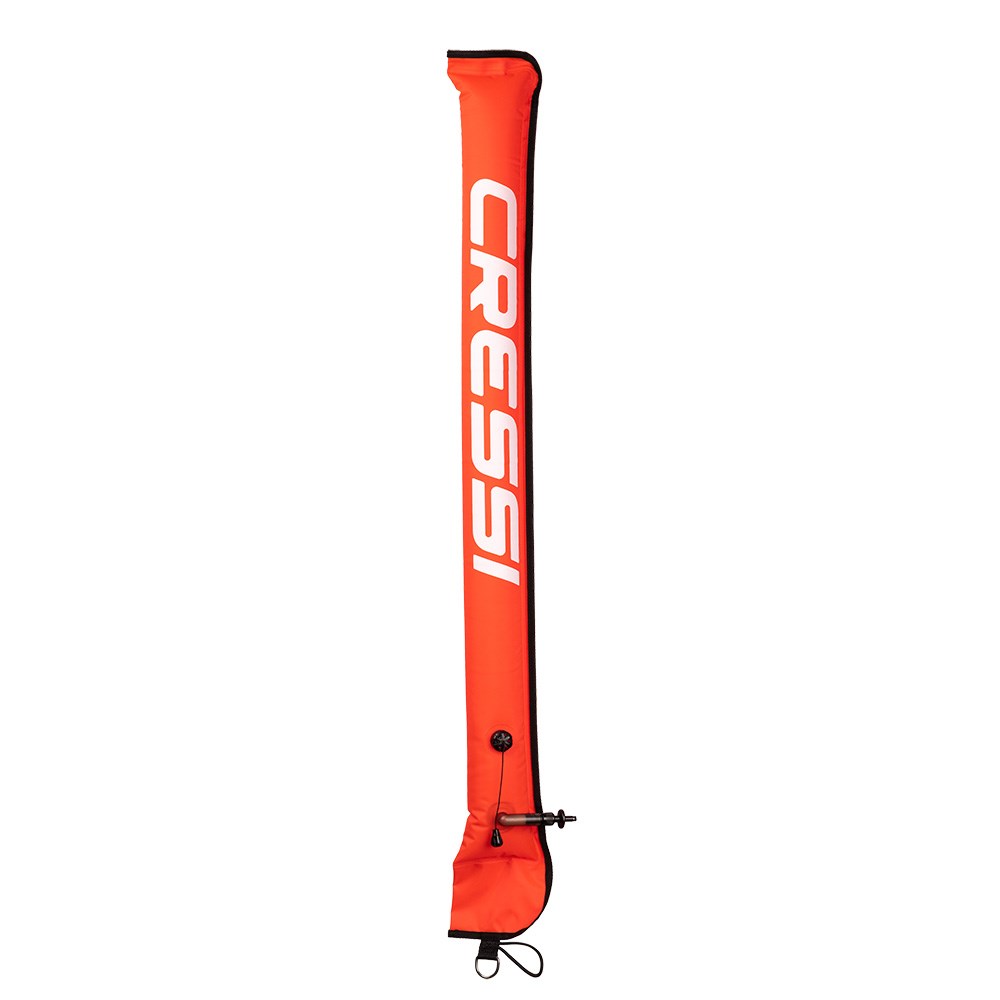
The Club HD is the SMB we would hand to any diver: $54, tough HD fabric that shrugs off boat ladders and rock entries, compact enough to live permanently in a BCD pocket, and reliable to deploy with a regulator purge or oral top-up. It stays upright and visible in open water rather than flopping in the chop. It suits everyone from new divers to dive pros, which is the point of a standard piece of kit. Trade-off: it is the buoy alone, so you will need a spool or reel to send it up from depth, and budget line wrapped around plastic is worth upgrading. Rated 4 in our testing. [Read our full review](https://scubadownunder.com/gear-reviews/cressi-club-hd-smb)
## Best starter kit: Pluzluce SMB Kit with Finger Spool and Whistle
For $79 the Pluzluce kit bundles everything the new diver is missing: SMB, finger spool, clip and whistle, in one purchase. That convenience is its argument. It suits freshly certified divers assembling their first safety setup and travellers who want a complete spare kit in the save-a-dive bag. Trade-offs: our 3.5 rating reflects budget components across the board, the buoy fabric and spool are serviceable rather than premium, and none of the individual pieces would win its category alone. As a way to go from owning nothing to carrying everything, it is hard to argue with. [Read our full review](https://scubadownunder.com/gear-reviews/pluzluce-smb-kit-spool-whistle)
## Best line cutter: Dive Rite Ceramic Line Cutter
A line cutter is the tool you hope to never use, which is exactly why the Dive Rite makes sense: the ceramic blade cannot rust, so it will still be sharp after two years of neglect in a BCD pocket. It slices monofilament and braid effortlessly, and the enclosed hook design means you cannot cut yourself or your gear while fumbling under stress. At $52 with a 4 rating it suits jetty and reef divers anywhere recreational fishing happens, which in Australia is everywhere. Trade-off: the small notch only cuts what fits inside it, so it complements rather than replaces a knife for rope and heavier work. [Read our full review](https://scubadownunder.com/gear-reviews/dive-rite-ceramic-line-cutter)
## Best budget line cutter: SPORTARC Line Cutter
At $41 the SPORTARC does the single job of getting fishing line off you, at the lowest price going. Our 3-star rating is honest: the finish is rough, the steel blade needs rinsing discipline to stay useful, and nothing about it feels refined. But a cutter you actually carry beats a better one left at home, and at this price there is no excuse not to have one clipped on. It suits divers adding a first cutter to the kit, or a second one mounted where the other hand can reach. Trade-off: treat it as a consumable and check the blade for corrosion each month. [Read our full review](https://scubadownunder.com/gear-reviews/sportarc-line-cutter)
## Best dive knife: Cressi Chaku
Some jobs need a blade with leverage, and the Chaku is the best-value proper knife we have tested. The dual-edge design pairs a smooth edge with a serrated one, so it handles rope and webbing as well as line, and the Italian build quality holds up at $68. It suits divers who anchor, wreck dive, or simply want one capable blade as the backbone of their safety kit. Trade-offs: it is steel, so it demands a freshwater rinse and the occasional wipe of silicone or it will pit, and a knife on your calf helps nobody, mount it where both hands can reach. Rated 4. [Read our full review](https://scubadownunder.com/gear-reviews/cressi-chaku-dive-knife)
## Best slate: SEAC Compact Writing Slate
A slate is the most underrated safety item in diving. The SEAC Compact is $35 of bright white writing surface that stays readable in murky green water, with a finish a step above the generic options. Use it to confirm a changed plan at depth, note your buddy's remaining gas, or write the thing your numb hands cannot sign. It suits buddy pairs, students and anyone diving low visibility. Trade-offs: it is a single panel, so space is limited, and our 3.5 rating reflects basics done well rather than anything clever. Wrist-mounted divers should look at the [Dive Rite wrist slate](https://scubadownunder.com/gear-reviews/dive-rite-wrist-slate) at $31, and instructors at the folding [Scuba Choice 3-panel slate](https://scubadownunder.com/gear-reviews/scuba-choice-3-panel-wrist-slate) for the same money. [Read our full review](https://scubadownunder.com/gear-reviews/seac-compact-writing-slate)
## Best gear tether: Boomerang Retractable Gear Tether
Dropped gear is a safety problem disguised as a money problem: chasing a sinking torch down a wall is how buddy pairs separate and deco stops get blown. The Boomerang fixes that with a Kevlar retractable cord that clips to a D-ring and keeps torches, cameras and gauges attached, extending when you need reach and snapping back out of the way. It is made in the USA, corrosion-proof and compact, and earned a 4 at $49. It suits photographers, night divers, and anyone whose hands are full underwater. Trade-off: retractors add one more clip to manage on your harness. If you prefer simpler, the [YYST stainless coiled lanyard](https://scubadownunder.com/gear-reviews/yyst-stainless-steel-scuba-lanyard) does the same basic job for $28. [Read our full review](https://scubadownunder.com/gear-reviews/boomerang-retractable-gear-tether)
## Best backup signalling light: SEAC Flash
After dark, your SMB needs help, and a torch is the surface signal that works at night. The SEAC Flash is a $36 compact backup light from a trusted Italian brand: clipped to your shoulder strap it covers night dive signalling, lights your gauges when the primary dies, and gives the boat something to find in the dark. It suits night divers and anyone applying the rule that one torch is no torch. Trade-offs: output is modest and our 3.5 rating reflects a light that does the basics well rather than impressing anyone. As the always-there layer of your signalling kit, that is exactly enough. [Read our full review](https://scubadownunder.com/gear-reviews/seac-flash-dive-light)
## How to choose
For SMBs, go at least 1.2 metres tall for open water, in orange or yellow, and prefer a closed or baffled bottom that keeps air in while you wait. Pair it with a spool carrying more line than your deepest planned dive: 15 metres is a minimum, 30 is better. Then practise. Deploy it at the safety stop on an easy shore dive until it is boring, because the first attempt in current at the [Yongala](https://scubadownunder.com/dive-sites/ss-yongala-wreck) is not the time to learn.
For cutting tools, placement beats quality. Mount your cutter or knife where both hands can reach it, on a waist strap or shoulder webbing, never on your calf. Ceramic blades suit divers who forget maintenance; steel suits divers who do not.
For the rest, think in layers: one visual signal, one audible signal, one cutting tool, one light, every dive. A whistle zip-tied to your inflator hose weighs nothing and is always there. And check the lot twice a year, the same day you check your smoke alarms: line on spools rots, whistles crack, o-rings dry out.
## The verdict
If you carry nothing today, start with the Cressi Club HD and a spool, add a whistle, and clip on the Dive Rite ceramic cutter: that is a complete surface safety setup for around $150, less than a double boat dive. The Pluzluce kit gets new divers there in one purchase, and the slate, tether and backup light round out a kit that handles the days that do not go to plan. None of it is exciting gear. All of it is the gear you will be most grateful for.
Where to Buy
Get the Best SMBs and Surface Safety Gear 2026 and experience the difference quality gear makes underwater.