Best Travel BCDs Australia 2026: Buying Guide
Australian buying guide to 2026 travel BCDs: Cressi Travelight, Aqua Lung Zuma, Aqualung Rogue, Scubapro Hydros Pro and Cressi Aquawing.
Where to Buy
Affiliate links: we may earn from qualified purchases
Best Travel BCDs Australia 2026: Buying Guide
Australian divers travel. Cairns to the Coral Sea, Perth to the Rowley Shoals, Sydney to Bali or Komodo or PNG, Melbourne to Tasmania for a long weekend. Domestic flights cap baggage at 23 kg checked and 7 kg carry-on, international economy adds a few extra kilos, and every gram of BCD that goes into the bag is a gram of camera or clothes that doesn't. A travel BCD is a BCD designed around weight and packed volume first, comfort and dive performance second. This guide covers the 2026 picks, framed for the trips Australian divers actually take.
The picks are anchored in BCDs SDU has reviewed in depth where possible. Pricing is current Australian retail at the time of writing. A travel BCD purchase has a 5-to-10-year ownership horizon for most divers; cross-shop in person where possible before committing to either of the premium options.
Quick comparison: travel BCD picks at a glance
| BCD | Tier | Weight (M) | Packs to | Approx AU price | Best for | |---|---|---|---|---|---| | Cressi Travelight | Most packable | 2.5 kg | 36 x 25 x 15 cm | $700 | Budget travel BCD, carry-on diving | | Aqua Lung Zuma | Lightest | 1.9 kg | Rolls flat | $899 | Minimum-weight travellers | | Aqualung Rogue | Most versatile | 3.4 kg | 40 x 30 x 18 cm | $1,099 | Travel plus everyday use | | Scubapro Hydros Pro | Premium | 2.7 kg | 38 x 27 x 16 cm | $1,399 | Premium build, long ownership horizon | | Cressi Aquawing | Wing-style travel | 3.1 kg | 40 x 30 x 18 cm | $1,099 | Travelling wing-divers |
What an Australian travel diver needs
The travel BCD decision is a three-way trade among weight, comfort, and price. The lightest BCDs (Aqua Lung Zuma, Cressi Travelight) sacrifice lift capacity, pocket volume, and padding for sub-3 kg dry weight. The premium picks (Scubapro Hydros Pro, Aqualung Rogue) deliver near-everyday-BCD comfort at meaningful weight penalties and meaningful prices. The trick is matching the BCD to the trips you actually take.
If you fly domestic-only and take one or two trips a year of three to seven days, prioritise weight. The Cressi Travelight or the Aqua Lung Zuma are the right picks, and the comfort penalty is acceptable for short trips.
If you fly international, take three-or-more trips a year, or extend stays to two weeks on liveaboards, prioritise versatility. The Aqualung Rogue or the Scubapro Hydros Pro will be your every-trip BCD, and the extra kilo of weight is repaid in shoulder comfort across a full week of two-tank days.
If you dive primarily with steel tanks or run double tanks, look at the wing-style options. The Cressi Aquawing or a dedicated wing-and-backplate setup is the right framework, and the travel BCD conversation becomes a backplate-material conversation (aluminium for travel, stainless for cold water).
Most packable: Cressi Travelight
The Cressi Travelight is the budget travel BCD that defined the segment. 2.5 kg in size medium, folds down to a 36 x 25 x 15 cm packed footprint via the FAST folding system, and sits at around AU$700 retail. SDU has reviewed the Travelight in depth; the verdict carries through here.
The Travelight is the right pick for divers building their first travel kit, divers on a hard budget, and divers who fly with checked-baggage limits as the binding constraint. The compromises are real: less padding than a non-travel BCD, smaller pockets, and a less-substantial backplate. The integrated weight pockets work cleanly; the wraparound bladder keeps you stable on the surface; the build survives chartered-boat handling in Coral Bay and Komodo. For the price, the Travelight is the highest-value travel BCD in the Australian market.
Lightest: Aqua Lung Zuma
The Aqua Lung Zuma is the lightest travel BCD currently produced, weighing 1.9 kg in size medium with a fully flexible fabric backplate that rolls flat for packing. The fabric-only construction is the headline feature and the principal compromise: there is no rigid backplate to distribute tank weight, which means the Zuma is the right choice for sub-100-bar dives in warm tropical water and the wrong choice for everyday diving on full 232-bar steel tanks.
Australian retail sits around AU$899. The Zuma has no SDU dedicated review yet but has earned strong real-world reviews from Caribbean and Pacific liveaboard divers travelling tight on baggage. For Australian divers chasing absolute minimum weight on a Maldives or Raja Ampat trip, the Zuma is the smallest-volume, lightest BCD that delivers competent recreational performance. For Australian divers doing two-tank shore dives off Manly or Port Phillip on a typical weekend, the Zuma is the wrong purchase.
Most versatile: Aqualung Rogue
The Aqualung Rogue is the travel BCD that handles every-dive duty as well. 3.4 kg in size medium, a soft wing-style bladder, modular harness sizing, and a packed footprint that fits cleanly in a 23 kg checked bag. Australian retail sits around AU$1,099. SDU has reviewed the Rogue in detail.
The Rogue is the right pick for divers who do not want to maintain two BCDs. It travels well enough that you take it on the Coral Sea trip; it dives comfortably enough that you also wear it on a Saturday morning shore dive at Bare Island; and the wing-style bladder distributes lift cleanly without the front-tilt that pure-jacket travel BCDs sometimes show on the surface. The trade-off is the weight penalty against the Travelight or the Zuma. If you fly four-plus trips a year, the kilo extra is offset by the convenience of one BCD instead of two.
Premium: Scubapro Hydros Pro
The Scubapro Hydros Pro is the long-tail premium choice, the BCD you buy expecting a decade of ownership. 2.7 kg in size medium, the unique Monprene injection-moulded harness construction, a modular pocket system, and integrated weight pockets that release reliably. Australian retail sits around AU$1,399. SDU has reviewed both the men's and women's Hydros Pro at 4.5 stars.
The Hydros Pro is the right pick for divers who travel regularly, do not want to compromise on comfort or build, and recognise that a premium BCD purchase amortises across a long ownership life. The Monprene harness is comfortable across long surface intervals, dries faster than fabric harnesses, and resists the salt-and-sand abrasion that wears down lower-tier BCDs over five years. The trade-off is the AU$1,399 price; cross-shop the Aqualung Rogue at AU$1,099 before committing to the full premium spend.
Wing-style travel: Cressi Aquawing
For divers who prefer a backplate-and-wing configuration over a jacket BCD, the Cressi Aquawing is the entry travel-friendly wing setup. 3.1 kg, an aluminium backplate that disassembles for travel, and an Australian retail around AU$1,099. SDU has reviewed the Aquawing.
Wing-style BCDs distribute lift behind the diver, which keeps you trimmed horizontal rather than tilted upright. For divers transitioning toward technical training, the Aquawing is the right framework BCD: same harness logic as a tech rig, same wing-style lift, packs flat for travel. The trade-off is on-surface comfort, pure wing-style BCDs are less comfortable on the surface than jackets when the wing is partially inflated. For trips with long boat rides and shore-surface intervals, factor that into the choice.
Buying considerations for Australian travel
Lift capacity matters more than dry weight. A 13 kg lift BCD is fine for an Australian diver in a 3 mm wetsuit with a single AL80; a 7 kg lift BCD is the minimum for a 7 mm wetsuit with a single LP95. Travel BCDs typically deliver 12-16 kg of lift; confirm the lift number matches your exposure protection and tank choice for the trip type.
Integrated weight pockets matter for solo travellers. Hire weight belts on liveaboards work; integrated pockets in the BCD eliminate one piece of kit to remember on the giant stride. Most modern travel BCDs include integrated pockets; confirm the size of the pockets fits the lead you typically use.
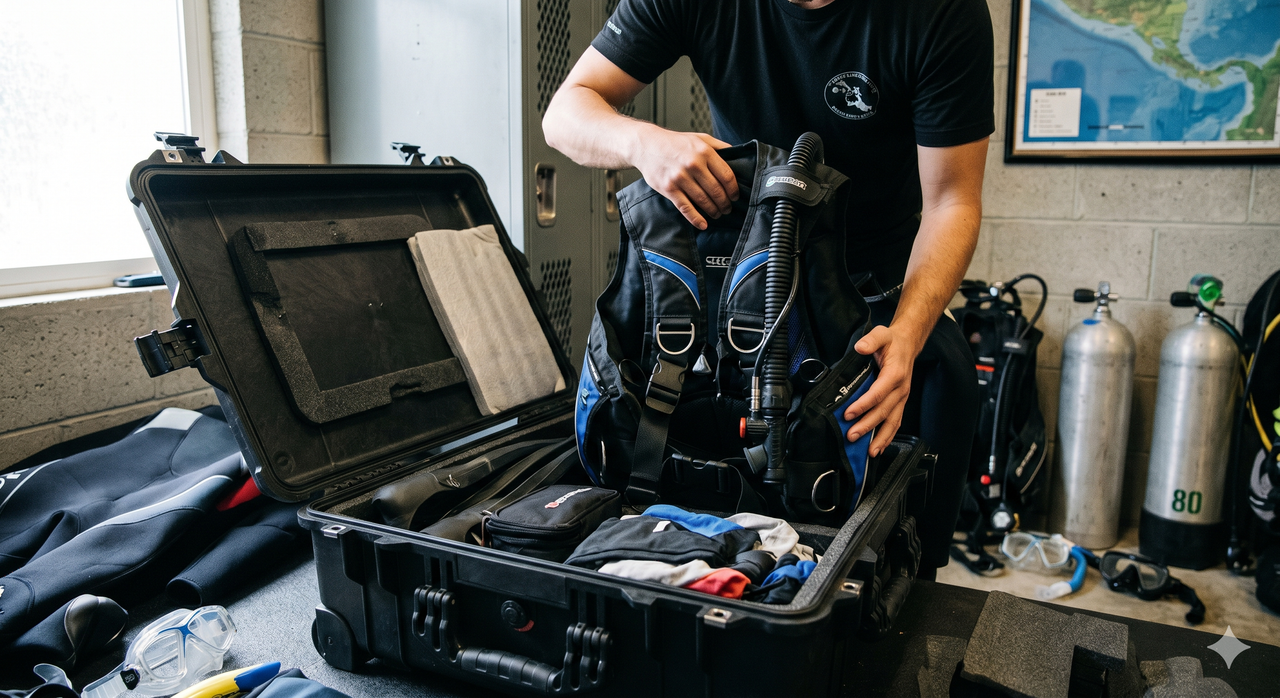
Carry-on packability is the binding constraint for Tasmania and Bali trips. Domestic Tasmanian flights cap carry-on at 7 kg; international carriers vary from 7 kg to 12 kg. A 2.5 kg BCD that packs into a 36 cm pouch leaves room for a regulator and a mask in the same carry-on bag.
Wetsuit thickness drives BCD choice more than people expect. A diver wearing a 3 mm wetsuit needs less BCD lift than a diver in a 7 mm; the lighter BCD is the right pick for the warm-water diver, the higher-lift BCD is the right pick for the cool-water diver. Don't buy a Coral Sea BCD if your typical diving is in 14°C Victorian water.
Service network matters across a 10-year ownership horizon. Scubapro, Aqua Lung, Cressi and Mares all have established Australian dive-shop service support. The bladder, the dump valves, and the integrated weight pockets are the wear items; a BCD without a clear Australian service path is a BCD you ship overseas for warranty work.
Verdict
For most Australian travel divers, the right answer is the Cressi Travelight as the budget pick (AU$700) or the Aqualung Rogue as the versatile every-trip pick (AU$1,099). Both are reviewed in detail on SDU and both deliver more value than their direct competitors in the Australian market.
For divers chasing minimum weight at the expense of versatility, the Aqua Lung Zuma is the lightest reliable option in 2026 at AU$899. For divers prioritising long-tail comfort and build quality, the Scubapro Hydros Pro at AU$1,399 is the long-ownership-horizon choice. For divers transitioning to wing-style configurations, the Cressi Aquawing is the right entry pick.
The deliberately-omitted recommendation is any travel BCD under AU$400 from unknown brands sold through marketplace channels. A BCD is a life-safety device; the wear items (bladder, dump valves, integrated weight releases) determine the lifetime of the unit, and the service path determines whether you replace a worn dump valve at AU$80 or replace the entire BCD at AU$700.
Whatever BCD you choose, weigh it dry, pack it once at home before the trip, and confirm it fits inside your carry-on bag with the regulator and mask. The BCD that arrives at the destination is the BCD that gets used; the BCD lost to checked-baggage damage is a no-BCD on day one of a four-day trip.
Where to Buy
Get the Best Travel BCDs Australia 2026: Buying Guide and experience the difference quality gear makes underwater.