SeaLife Micro 3.0 64GB Camera
A permanently sealed underwater camera that eliminates flooding risk entirely, delivering decent images with unmatched peace of mind.
Where to Buy
Affiliate links: we may earn from qualified purchases
The SeaLife Micro 3.0 is the most worry-free underwater camera you can buy — permanently sealed and genuinely flooding-proof, it lets you focus on composition instead of o-ring maintenance.
At $945, it sits in an unusual spot. It's more expensive than a compact camera in a housing, but cheaper than a mirrorless setup. What you're paying for is the peace of mind that comes from a camera that physically cannot flood — there are no doors, no seals to maintain, and no housing to assemble. For Australian divers who've watched a mate's camera flood on a liveaboard trip to the Coral Sea, that peace of mind has real value.
Overview
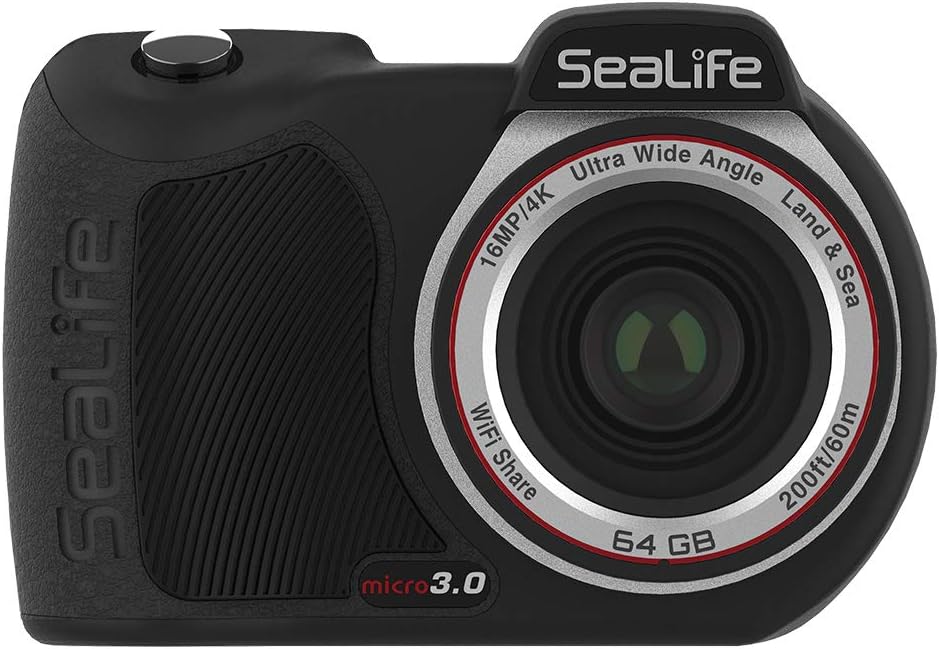
The SeaLife Micro 3.0 is a purpose-built underwater camera with a permanently sealed body rated to 60 metres. It captures 16MP stills and 4K video, stores everything on 64GB of internal memory, and includes colour-corrected underwater shooting modes designed to compensate for the colour loss that occurs at depth.
The permanent seal is the defining feature. There are no battery compartments, no memory card slots, and no removable ports — everything charges and transfers via a waterproof USB-C connection. This means there is genuinely zero risk of flooding from user error. If you've ever spent twenty minutes on a dive boat carefully greasing o-rings and checking for hair strands before sealing a housing, you'll appreciate how much simpler the Micro 3.0 makes the pre-dive routine.
The 16MP sensor produces decent results for a compact underwater camera. It won't compete with a Sony A7 IV in a housing, but that's not what it's designed to do. In good light — shallow reef dives at Ningaloo, snorkelling at the Great Barrier Reef, or well-lit kelp forests in Tasmania — the Micro 3.0 produces images that look sharp and colourful on a screen without heavy post-processing. The colour-corrected modes do a reasonable job of restoring reds and oranges that water absorbs, particularly in the 5-15 metre range where most recreational diving happens.
4K video is smooth and stable, though the camera lacks optical image stabilisation, so footage can show movement in current or surge. The 64GB internal storage holds roughly 90 minutes of 4K footage or several thousand stills, which comfortably covers a full day of diving. You won't run out of space on a typical two-tank boat dive out of Cairns or a day of shore diving around Sydney.
Compared to a GoPro in a housing, the Micro 3.0 offers better ergonomics for underwater stills — dedicated buttons, a proper grip, and a screen you can compose with. Against a housed compact like the Olympus TG-7 in a SeaFrogs housing, the Micro 3.0 trades image quality and flexibility for absolute reliability and simplicity.
Key Features
- Permanently sealed body rated to 60 metres — no housing required - 16MP Sony CMOS sensor - 4K video at 30fps - 64GB internal storage (non-expandable) - Colour-corrected underwater shooting modes - Waterproof USB-C port for charging and data transfer - Compatible with SeaLife's range of underwater lighting and accessories - Built-in flash for close-up macro work - Three-button operation with rear LCD screen - Approximately 260g in water
The Good
- Zero flooding risk removes the single biggest anxiety of underwater photography: No o-rings, no seals, no housing assembly. You charge it, turn it on, and dive. For travel divers who shoot in remote locations far from camera repair shops, this reliability is worth the premium alone. - Colour-corrected modes genuinely improve results without external filters: The underwater white balance presets produce noticeably better colour than a standard camera set to auto. On a reef dive at Lady Elliot Island between 8-15 metres, skin tones, corals, and fish colours come through looking natural without post-processing. - Handles Australian diving conditions well: The sealed construction shrugs off sand, salt spray, and the kind of rough handling that happens on commercial dive boats. You can rinse it under a tap, throw it in a mesh bag, and not worry about it. - Simple three-button interface works with gloves: The large buttons are easy to find and press with 3mm or 5mm neoprene gloves. Mode switching is quick, so you can move from video to stills without fumbling. - SeaLife accessory ecosystem is well designed: External video lights, macro lenses, and tray handles all mount via a straightforward bayonet system. Building up your rig over time is easy and the accessories are reasonably priced.
The Bad
- 16MP sensor falls behind current compacts in image quality: The TG-7 and recent smartphone cameras produce sharper, more detailed images in good light. The Micro 3.0's sensor is adequate but not impressive by 2025 standards — noticeable in large prints or heavy cropping. - 64GB internal storage with no expansion is a hard limit: Once it's full, you're done until you offload via USB-C. On a multi-day liveaboard to the Ribbon Reefs, this could become an issue if you shoot a lot of video. A housed camera with swappable memory cards is more flexible. - No optical image stabilisation: Handheld 4K video shows camera movement in surge or current. A GoPro with HyperSmooth handles this better. For serious video work, you'll want a tray and handles to steady the camera. - Built-in flash is underpowered for anything beyond macro distance: It'll light up a nudibranch at 15 centimetres, but it won't illuminate a reef scene. You'll need external strobes or video lights for anything more than close-up work, adding to the total cost. - No raw file support limits post-processing flexibility: JPEGs only, which means less latitude for recovering highlights, adjusting white balance, or correcting exposure in editing software.
Verdict
The SeaLife Micro 3.0 is built around a single, powerful idea: remove the possibility of flooding entirely. If you value reliability and simplicity above all else, it delivers on that promise completely. The image quality is acceptable for social media, dive logs, and moderate-sized prints, but photographers who want to push their underwater images further will find the sensor, lack of raw support, and fixed storage limiting. It's an excellent choice for travelling divers, casual shooters, and anyone who's ever lost a camera to a flooded housing. It's not the right tool for dedicated underwater photographers chasing publication-quality images. At $945, you're paying a premium for peace of mind — and for many divers, that premium is entirely justified.
Where to Buy
Get the SeaLife Micro 3.0 64GB Camera and experience the difference quality gear makes underwater.
Best price for Australian shipping