Shearwater Peregrine: Australian Diver Review
Shearwater Peregrine dive computer review: 2.2-inch colour screen, Bühlmann gradient factors, AU$735, and is it worth 2x a Zoop Novo?
Where to Buy
Affiliate links: we may earn from qualified purchases
The Shearwater Peregrine is the dive computer to buy if you can stretch two and a half Cressi Leonardos worth of budget and you plan to actually keep diving. It is the cheapest way into the Shearwater ecosystem, sits at around AU$735 from Australian retailers, and delivers a colour screen, Bühlmann gradient factors, and a rechargeable battery in a package that recreational divers can drive on day one. The question this review answers is whether that price tag is justified for an Australian recreational diver who already has a Suunto Zoop Novo, a Cressi Leonardo, or no computer at all.
Overview: Shearwater Peregrine
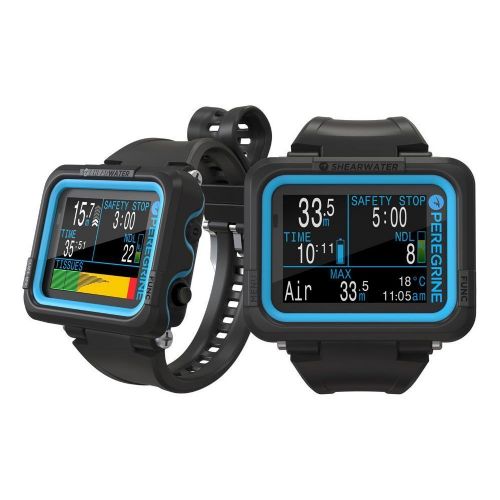
Shearwater built its reputation on technical-diving computers (Perdix, Teric) that pros wear because the screens are clear, the algorithms are honest, and the firmware is supported for years rather than discontinued the moment a new model ships. The Peregrine is the recreational entry to that lineage. It runs the same Bühlmann ZHL-16C algorithm with gradient factors that the flagship Perdix runs, on a smaller 2.2-inch 320x240 full-colour LCD, with a two-button interface that maps to the same logic Shearwater uses across the range. The depth rating is 120 metres, well past anything a recreational diver will ever see, and the wireless USB-C charging dock means there is no battery hatch to flood or O-ring to maintain.
Where the Peregrine sits in the Australian market is between the budget recreational computers (Cressi Leonardo at around AU$300, Suunto Zoop Novo at around AU$370) and the premium technical computers (Shearwater Perdix 2 around AU$1,400, Garmin Descent Mk3i around AU$2,300). For warm-water Queensland holiday divers who dive once a year on Heron Island, this is overkill. For NSW or Victorian club divers who get in the water twenty or thirty times a year, the price difference disappears across the first season of use, and you end up with a computer that reads cleanly on the wrist in low-viz green water rather than squinting at a segmented monochrome LCD.
Key Features
- 2.2-inch full-colour LCD, 320x240 QVGA resolution, very legible in turbid Sydney or Port Phillip viz - Bühlmann ZHL-16C algorithm with user-adjustable gradient factors (factory default GF Low 40, GF High 85) - Single-gas air and nitrox up to 100% O2, plus three-gas nitrox for light tech use - 120-metre depth rating, well beyond recreational and most tech limits - Rechargeable lithium-ion battery, factory replaceable, up to 30 hours per charge at medium brightness - USB-C wireless charging dock included (no battery door, no flooding risk) - Bluetooth sync to Shearwater Cloud (free) for dive log review on phone, tablet, or desktop - Two-button operator interface, same logic as Perdix and Teric for upgrade-path consistency - 122 grams on the wrist, large nylon strap fits over a 7mm wetsuit cuff - Vibration alert plus colour-coded warnings for ascent rate, NDL, and missed safety stop - Firmware-upgradeable indefinitely (Shearwater has historically supported computers a decade past purchase)
The Good
- The screen is the headline feature. A 320x240 colour LCD reads cleanly in shadow, on a sand bottom, and in green-tinted southern Australian water where segmented monochrome computers visually disappear at three metres. The colour coding for warnings means you do not need to read the number to know something needs your attention. - The Shearwater algorithm runs in the open. Gradient factors are user-adjustable from a factory-conservative 40/85 down to whatever you set for your style. That transparency matters when you transition to AOW and start running deeper profiles; the Suunto Fused RGBM algorithm in the Zoop Novo gives you the deco penalty but not the levers to manage it. - Bluetooth + Shearwater Cloud removes the cable. The free app reviews and edits dive logs, syncs across devices, and updates firmware over the air. The Zoop Novo and Cressi Leonardo both have weaker app stories and Cressi's is actively painful. - The battery solution is the right one for 2026. No hatch, no O-ring, no flood risk, no proprietary disposable cell, no shop trip. The wireless USB-C dock charges from any power source you would use for a phone. - Firmware support is the long-tail value. A 2020 Peregrine still receives feature updates in 2026. The Suunto Zoop Novo, in production since 2014, has not received a meaningful firmware update in years. Over five years of ownership the support difference is the real money saved.
The Bad
- AU$735 is a real number. That is twice a Suunto Zoop Novo, more than three times a Cressi Leonardo. For a holiday diver who logs five dives a year, the Zoop or Leonardo does the same job adequately, and the Peregrine premium pays for headroom you will not use. - No air integration, no compass. Both are available on the Peregrine TX at AU$1,095 (transmitter additional). If you want either, the standard Peregrine is the wrong purchase; cross-shop the Peregrine TX directly rather than retrofit. - The size is not a smartwatch. At 56mm wide and 122 grams, it is meaningfully larger than a Suunto D5 or Garmin Descent G1. Some divers strap-and-stow theirs in a BCD pocket rather than wear it dry between dives. Worth handling in a shop before committing. - Three-gas nitrox is the tech-side ceiling. The Peregrine handles light decompression with custom gas planning, but if you are heading down the trimix or full-CCR path the next purchase is a Perdix anyway. The Peregrine is the recreational ceiling, not a tech computer with training wheels.
Verdict
For an Australian recreational diver doing twenty or more dives a year, the Shearwater Peregrine is the right computer at the right price point. The colour screen, the open algorithm, the Bluetooth sync, and the firmware support story together justify the premium over a Suunto Zoop Novo across a single season of ownership, and the upgrade path to a Perdix or Teric later runs on the same interface logic. For five-dive-a-year warm-water holiday divers, the Cressi Leonardo or Zoop Novo does the same fundamental job for a third of the money; the Peregrine premium buys headroom those divers will not use. Buy the Peregrine if you are committing to the hobby. Buy a Leonardo if you are still figuring out whether you are.
Star Rating: ⭐⭐⭐⭐½ (4.5/5)
Where to Buy
Get the Shearwater Peregrine: Australian Diver Review and experience the difference quality gear makes underwater.