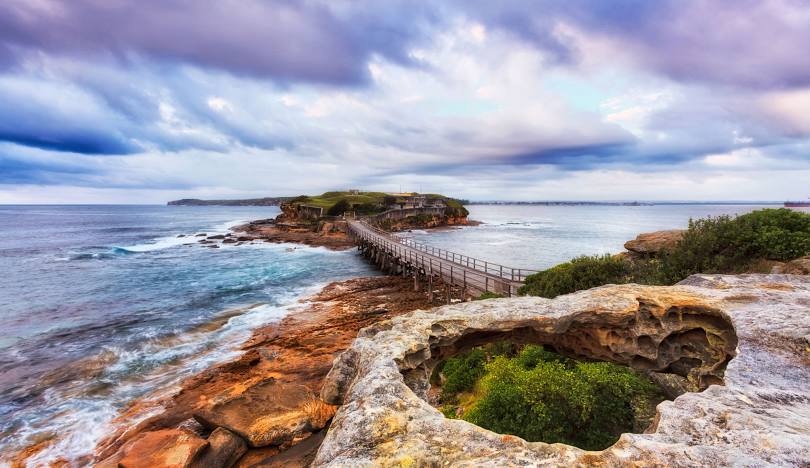
Bare Island
La Perouse, NSW
Bare Island Dive Guide: Sydney’s Shore Diving Gem in Botany Bay
By ScubaDownUnder Team · 2025-07-11
Access update, August 2026: NSW National Parks and Wildlife Service has closed the whole Bare Island precinct, including the access road, bridge, rock shelf and fort, from 24 August 2026 while the 1887 bridge is restored. Reopening is expected in late 2027, and until then the island's shore dives cannot be done. Check the NSW Environment and Heritage update for the latest before you go.
Introduction
There are few shore dives in Australia that blend vivid maritime history with thriving temperate reefs as seamlessly as Bare Island in Botany Bay. A short drive from Sydney’s CBD, the sandstone islet carries a nineteenth century fort on its grassy crown and a submerged kingdom of sponges, soft corals and charismatic critters below. Whether you are logging your first ocean immersion or hunting for elusive macro subjects, Bare Island rewards careful exploration with a spectrum of marine encounters, easy logistics and postcard scenery. Getting There and Surface Scene Bare Island sits at La Perouse on the northern headland of Botany Bay, linked to the mainland by a timber footbridge that featured in Mission Impossible II and several Australian films. The surrounding headland forms part of Kamay Botany Bay National Park, so you will find ample parking, public toilets and a clutch of cafés within strolling distance. Arrive early on weekends; Sydney divers treasure this site and spaces fill rapidly when seas are calm. After gearing up beside the car, walk over the bridge and pause halfway to admire the fort’s masonry. Constructed in the 1880s to protect the fledgling colony from naval attack, the battery never fired a hostile shot yet stands today as a photogenic backdrop and reminder that colonial fears once loomed as large as our modern appetite for adventure. # Entry Points and Orientation Bare Island's routes are named as you look at the island from the bridge, and the names trip up first-time visitors. Bare Island Right is the western side. Divers enter at the Western Point in calm seas, where the water is too shallow for a giant stride and you need to flop in, or at the Swimming Pool just inside it when the point is too rough, and finish at the boat ramp immediately to the right of the island end of the bridge. That boat ramp is the standard exit for every dive on the western side, usable in all but the biggest seas, and an easy entry for beginners. Bare Island Left is the eastern side, entered off the eastern face of the South-Eastern Point. It is often very slippery and too hard to use as an exit, so it suits divers who already know the island. Michael McFadyen's Bare Island locations guide maps every entry, exit and landmark in detail.
Underwater Topography
Immediately below the surface lies a maze of sandstone boulders mantled with yellow zooanthids and crimson sponge fans. At six metres you meet a sloping reef that steps down to a silty, kelp dotted plain at twelve metres. Swim through narrow swim-throughs formed by overlapping ledges or hover over bommies festooned with finger sponges. Look for scoured gutters where surge has polished the rock; these sheltered pockets harbour red Indian fish, dusky morwong and the bulbous pineapple fish whose golden armour glows beneath ledges. # Signature Marine Life Weedy sea dragons, Camouflage artists that glide through clumps of Ecklonia kelp. They are often spotted in pairs during summer courting season.
- White’s seahorse and pygmy pipehorse, Cling to sponge stalks and ascidian colonies in less than eight metres. - Giant cuttlefish, Winter to spring visitors that flash kaleidoscopic patterns while patrolling the sand line. - Port Jackson shark, Docile bottom dwellers resting in caves from August to November. - Nudibranchs, From blue ringed Tambja verconis to orange speckled Ceratosoma amoena, Bare Island is nirvana for macro photographers. - Schooling residents, Old wives, yellowtail scad and the friendly eastern blue groper cruise the reef edge, while latticed sandgobies sift sediment on the plain. The site’s biodiversity reflects its location at the confluence of warm East Australian Current eddies and cooler southern water, creating a habitat where subtropical and temperate species intermingle.
Conditions and Best Season
Bare Island can be dived year round, although winter yields the clearest water when plankton is sparse. Typical visibility is five to fifteen metres, peaking above twenty on a strong incoming tide. Water temperature ranges from fourteen to seventeen degrees in mid-winter and up to twenty one by late summer.
Because the island shields divers from prevailing north east sea breezes, conditions are often calm when open ocean sites are blown out. Avoid periods of heavy rainfall or prolonged southerly swells which stir silt within the bay. Check the forecast for winds below fifteen knots and plan on entering ninety minutes before high tide to enjoy optimal clarity.
Required Skills and Equipment
Open Water certification suffices, yet good buoyancy control is essential to spare fragile sponge gardens from fin wash. Nitrox extends bottom times in the ten to twelve metre band, while a macro-lens equipped camera unlocks the site’s real treasures. Pack a torch for peering under ledges, a compass for occasional navigation checks and surface signalling gear as small boats sometimes stray close inshore.
Shore divers should streamline equipment for the short scramble over rocks; stow accessories in pockets rather than dangling from D-rings. Gloves remain legal in New South Wales but use light finger dexterity and avoid grasping living substrate.
Safety Notes
Currents are generally weak yet surge can pulse around the point. Assess conditions from the bridge before committing to the left route. Entanglement hazards include anglers’ lines cast from the rocks; carry a line cutter and surface away from fishing platforms. The bay lies within a busy shipping approach to Port Botany, though vessels travel well offshore and standard surface intervals on the rocks remove any risk.
First aid and oxygen are available at local dive shops in nearby Randwick and Matraville. Mobile reception is reliable, and Prince of Wales Hospital sits twenty minutes’ drive north in case of emergency.
Conservation and Cultural Etiquette
Bare Island is part of Kamay Botany Bay National Park, and every seahorse, seadragon, pipefish and pipehorse around it is protected under the NSW Fisheries Management Act 1994. Sediment is easily stirred, so fin gently above sand and adopt a photographer’s mindset: leave nothing but bubbles.
On the surface, respect the heritage listed fortress that once served as Australia’s first veterans’ home and later reopened as a museum. Guided tours operate on Sundays; consider booking one to deepen your appreciation of the island’s layered past.
Post Dive Delights
After your second tank, warm up with fish and chips from La Perouse’s shoreline kiosks, watch pelicans circle for scraps and ponder the juxtaposition of Turrell’s bright pink artwork against sandstone ramparts across the bay. If energy allows, stroll to nearby Congwong Beach or the Henry Head walking track for panoramic views of Cape Banks and whale spouts in winter.
Final Thoughts
Bare Island epitomises urban diving done right. Accessible yet ecologically significant, shallow yet endlessly engaging, it rewards repeated visits as currents, seasons and daylight angles shift its mood. One day you may be entranced by a ballet of courting sea dragons, the next by a flamboyant nudibranch smaller than your fingernail. All the while, the weathered fort stands sentinel overhead, reminding you that these waters have witnessed centuries of exploration and defence long before neoprene and regulators arrived.
Slip beneath the footbridge on a slack tide and you will discover why Sydney locals claim Bare Island as the city’s most beloved shore dive and why visiting underwater photographers pencil it in as a must-shoot location. Pack your camera, respect the reserve and let Botany Bay reveal its secrets one sponge covered ledge at a time.
---
*Planning a NSW dive trip? See our region-by-region guide to the best places to dive in NSW for the full overview of dive sites across the state.*
Visibility at Bare Island
Visibility at Bare Island typically ranges from 5 to 15 metres, though it shifts with swell, wind and recent rainfall. October-May generally offers the best conditions for diving here.
Right now: approximately 9 m, 98% confidence (updated 13:47 AEDT).
Air, gear and guides near Bare Island
Browse dive shops in Sydney for fills, hire gear, servicing and guided dives at this site.