British Motorist
Darwin, NT
British Motorist
By ScubaDownUnder Team · 2026-05-20
The British Motorist was a British Empire tanker, hit during the first wave of the Darwin raid and burning when she sank into the inner harbour. The fire and the subsequent decades of tidal action have broken the wreck more thoroughly than any other major Darwin casualty, and the dive site reads today as a debris field rather than a hull. The British Motorist is the wreck that history pushed hardest, and the diving reflects what is left when a ship has been broken thoroughly.
The British Motorist was a tanker built in 1924 and operating on the Empire trade routes when she was caught in the Darwin attack with fuel cargo aboard. The combination of bombing and the subsequent fuel fire produced extensive structural damage. She sank in the inner harbour and broke up under sea conditions over the following years. The wreck is part of the Darwin Harbour cluster protected under the Historic Shipwrecks Act 1976. The Larrakia people are the traditional custodians of Darwin Harbour, and the 19 February 1942 raid that took the British Motorist is the largest single Japanese strike on Australian soil.
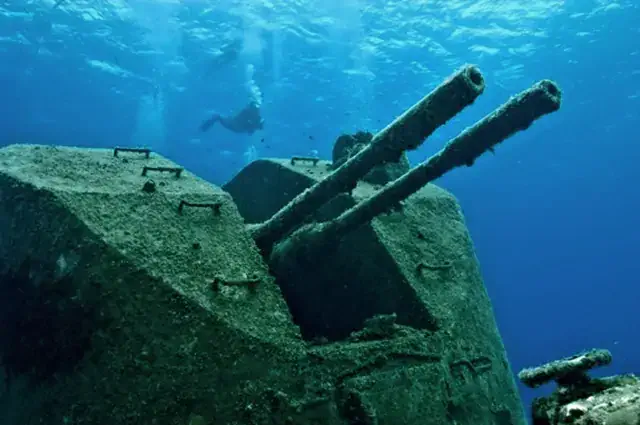
The British Motorist site is a debris field at 16 to 22 metres in the inner harbour, with hull sections, pipework, machinery and tank fragments scattered across the sand. The largest visible feature is a section of hull plating partially upright, providing a structural reference for navigation across the field. Operators drop divers on a fixed line near this feature and the dive runs as a slow circuit of the surrounding debris. Cargo tank fragments, propeller shaft sections, anchor chain and machinery components are identifiable in the broken material.
Marine life across the British Motorist debris is concentrated along the larger structural fragments where current accelerates and food gathers. Encrusting sponge and coral cover the iron in patches that vary by exposure to current. Schools of small reef fish work the broken edges. Scorpionfish lie motionless on plating. Resident moray eels hold in the larger pipework. The species density is lower than at the more intact wrecks but the macro and edge-habitat opportunities are stronger.
Inner harbour conditions apply: 8-metre tidal range, strong currents outside slack water, visibility 3 to 10 metres typically with sharp reduction on outgoing tide due to silt mobilisation, water temperature 23 to 30°C, box jellyfish October to May, crocodile risk year-round. The British Motorist sits in the inner harbour where the slack window is shorter and the visibility is generally lower than at the outer-harbour wrecks. May to October dry season is the working window.
The British Motorist is the most archaeological of the Darwin wreck dives. Repeat divers find ordnance, ship's machinery, navigation equipment and cargo fragments scattered across the field. The Historic Shipwrecks Act protections require divers leave all material in place. Photographers find the broken structure produces an industrial-ruin aesthetic distinct from the more intact wrecks. Night dives are uncommon at the site due to inner-harbour traffic and visibility.
The British Motorist is the dive for divers who prefer their wrecks broken. Where the Meigs sits intact and the Zealandia is split into recognisable sections, the British Motorist has been thoroughly disassembled by the combination of fire, sea and time. The site is less photogenic than the more famous Darwin wrecks but tells a more honest story about what bombing and burning actually did.
## Site Access and Logistics
The British Motorist is a boat dive only. Standard departure points are Cullen Bay Marina and the Stokes Hill Wharf area, with a transit of around 15 to 25 minutes to the inner harbour. The British Motorist sits in less-frequented water than the more famous outer-harbour wrecks and is dived less often in operator rotations.
Entry is a backward roll from the dive boat onto a fixed line at the largest structural fragment. Exit is up the line and re-board over the boat tubes, with safety stops conducted on the line. Surface marker buoy deployment is recommended.
Minimum certification is PADI Advanced Open Water. Twenty logged dives is a sensible working minimum, with awareness of broken-structure entanglement risk a particular requirement at this site.
Bookings run through [Dive Darwin](https://divedarwin.com.au) and other Darwin charter operators.
## Sources
- Dive Darwin, Darwin Harbour wreck charters: [https://divedarwin.com.au](https://divedarwin.com.au) - Australian National Shipwreck Database, British Motorist entry - Northern Territory Heritage Register, [Darwin Harbour wrecks](https://www.scubadownunder.com/dive-sites/darwin-harbour-wrecks) - Australian War Memorial, Bombing of Darwin records: [https://www.awm.gov.au](https://www.awm.gov.au) - Michael McFadyen's Scuba Diving, Darwin wreck references: [http://www.michaelmcfadyenscuba.info](http://www.michaelmcfadyenscuba.info)
Visibility at British Motorist
Visibility at British Motorist typically ranges from 3 to 10 metres, though it shifts with swell, wind and recent rainfall. May to October (dry season) generally offers the best conditions for diving here.