Chowder Bay
Mosman, NSW
Chowder Bay Dive Site Guide — Clifton Gardens, Sydney Harbour
By ScubaDownUnder Team · 2025-07-11
Few Sydney dives are as forgiving as Chowder Bay. The dive starts and ends from a sand beach at Clifton Gardens with no rocks to negotiate, the water rarely runs current, and the maximum depth is six metres if you push out to the wreckage. What makes it one of the most-visited sites in Sydney is not the topography — it is the macro life. Pygmy pipehorses, dragonets, frogfish on a good day, and an octopus living under almost every loose piece of debris. Chowder Bay rewards divers who slow down, look closely, and have come to terms with the harbour's signature low-visibility green water.
The bay sits inside Sydney Harbour National Park on the Mosman foreshore, between Bradleys Head and Middle Head. The HMAS Penguin naval base occupies most of the headland, and the diveable area is the small horseshoe of beach at Clifton Gardens at the bay's southern end. The site has been a Sydney training and macro hunting ground for decades, helped by the consistency — most days the bay is calm, the entry is benign, and there is enough structure to give a dive a route even when visibility is bad. The protected status of the surrounding national park keeps the resident fish numbers higher than anywhere else in the inner harbour.
The dive is a slow swim northward from the beach, working the sand-and-rubble bottom out to the line of old jetty pylons that mark the eastern edge of the bay. Depth gradually deepens from waist-water at the entry to four metres along the pylons, then six metres at the far end where the remains of an old structure sit on the sand. The pylons are the productive ground — encrusted in sponge, ascidian and algae growth, with crevices full of small reef fish and the occasional moray. The sand around them is where the macro hunting happens. The route back along the beach side takes in the shallow seagrass beds, where pipefish and seahorses turn up.
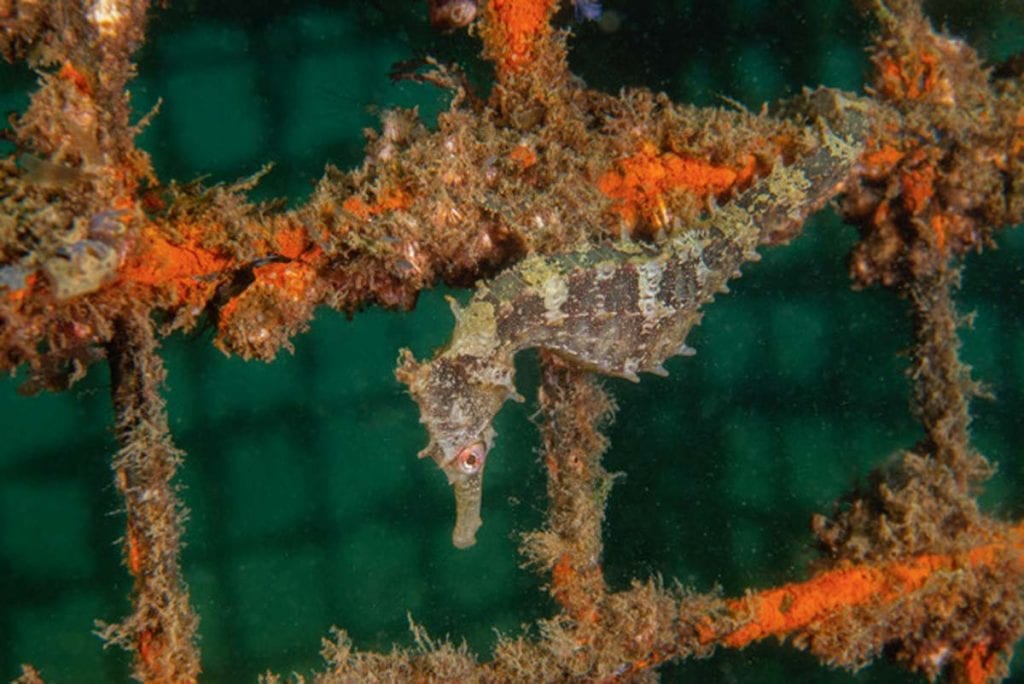
The headline species at Chowder Bay are the small ones. Sydney's pygmy pipehorses live on the pylons and the algae-covered ropes — well-camouflaged, two to three centimetres long, and the reason most visiting macro photographers come. Octopus are everywhere, often two or three on a dive, in everything from old bottles to discarded shoes. Anglerfish (frogfish) turn up on the pylons in the cooler months — irregular but a real prize when they appear. Pipefish, ornate cowfish, dragonets, decorator crabs and a steady supply of juvenile fish round out the macro work. Blue groper occasionally drift through, and schools of yellowtail and mulloway move along the deeper edge. The site is not about wide-angle reef shots; it is a critter-hunt site, and treated as one it consistently delivers.
Conditions are as benign as Sydney diving gets. Visibility typically runs three to five metres — harbour silt and the green tide that wraps around the foreshore — and lifts to seven or eight on a still day after sustained dry weather. Heavy rain anywhere in the catchment drops it to under two metres for several days. Water temperature ranges from around 16°C in late winter to 24°C in February and March, with a 5mm wetsuit comfortable year-round. Currents inside the bay are negligible. The site is sheltered from all swell directions. There is no real "best season" beyond avoiding the days after heavy rain — the dive is genuinely year-round, and the macro species cycle through different highlights month by month.
For divers willing to make the same dive several times, Chowder Bay rewards local knowledge. The pylon line is the obvious focus, but the more subtle dive is the slow drift along the edge of the seagrass on the western side, where pygmy pipehorses tuck into the algae and seahorses occasionally hold a single piece of weed for weeks at a time. Night dives at Chowder Bay are excellent — the macro density jumps and the resident octopus become more confident — and the site is a favourite for Sydney photographers running training sessions before international macro trips.
Chowder Bay is the dive Sydney introduces to its instructors and brings its visitors back to year after year. It is not the deepest, the clearest or the most dramatic site in the harbour, but for sheer reliability of small marine life, ease of access and the number of dives that turn up something good, it has no equal in inner Sydney. The harbour green is part of the deal; the rest of the dive is what divers come back for.
Site Access and Logistics
Chowder Bay is a shore dive accessed from Clifton Gardens beach, Mosman, NSW. The entry point is the sand at the eastern end of the beach beside the heritage jetty. Parking is in the council car park at the top of the hill on Morella Road — a steep walk down to the beach with kit, easier with a wheeled trolley. There is a small free shoreside car park at the beach itself but it is usually full by mid-morning on weekends.
Entry is a walk-in giant stride from the sand to chest-deep water, then a fin-out across the bay. Exit is the same point. Skill prerequisites are minimal — Chowder Bay is one of Sydney's main Open Water training sites and is accessible to recently certified divers. The shallow depth and lack of current make it appropriate for buddy teams without local guides, though the visibility may surprise divers used to ocean dives.
Facilities: Public toilets, change rooms, picnic area and grassed parkland at the Clifton Gardens reserve; a café operates on the foreshore in summer. Most Sydney dive shops include Chowder Bay in their guided shore dive program — Plunge Diving is the closest dedicated dive shop and runs regular guided trips, with Dive Centre Manly and Frog Dive Willoughby also active at the site.
Sources
- NSW National Parks and Wildlife — Sydney Harbour National Park: https://www.nationalparks.nsw.gov.au/visit-a-park/parks/sydney-harbour-national-park - Plunge Diving, Mosman: https://www.plungediving.com.au - Dive Centre Manly: https://www.divesydney.com.au - Michael McFadyen's Scuba Diving — Chowder Bay: http://www.michaelmcfadyenscuba.info - Sydney Institute of Marine Science (SIMS) — Sydney Harbour species records
Visibility at Chowder Bay
Visibility at Chowder Bay typically ranges from 3 to 5 metres, though it shifts with swell, wind and recent rainfall. Year-round generally offers the best conditions for diving here.
Right now: approximately 2 m, 98% confidence (updated 10:33 AEDT).
Air, gear and guides near Chowder Bay
Browse dive shops in Sydney for fills, hire gear, servicing and guided dives at this site.