Clerke Reef
Offshore Broome, WA
The Crystal Cathedral: Diving Clerke Reef Marine Park, WA
By ScubaDownUnder Team · 2025-12-15
The Crystal Cathedral: Diving Clerke Reef Marine Park, WA
If you were to design the perfect coral atoll in a laboratory, it would look exactly like Clerke Reef.
Located approximately 300 kilometres west of Broome on the very edge of the Australian continental shelf, Clerke Reef is one of three pear-shaped atolls that make up the legendary Rowley Shoals. While its siblings, Mermaid Reef and Imperieuse Reef, are spectacular in their own right, Clerke Reef holds a special place in the heart of the Western Australian diving community. It offers a rare combination of adrenaline-pumping drift dives, vertical wall drops that disappear into the abyss, and a lagoon so clear it feels like you're floating in air.
Because of its extreme isolation, this isn't a weekend trip. It is a true expedition. But for those willing to make the journey, the rewards are visibility that defies belief and marine life that has rarely seen a human.
Entry and Exit: The "Rollercoaster" Drift
Diving at Clerke Reef is almost exclusively done via liveaboard tenders, and the entry procedures are dictated entirely by the tides. The atoll is essentially a giant bucket; when the tide changes, millions of litres of water are forced through narrow channels, creating some of the most exhilarating drift dives on the planet.
The Entry: Most dives here, particularly the signature "Channel Drift," begin with a "negative entry" from a tender. You roll back, dump your air immediately, and descend to avoid the surface chop and get straight into the laminar flow of the current. The water is often moving at a speed of 3 to 4 knots (and sometimes faster on spring tides).
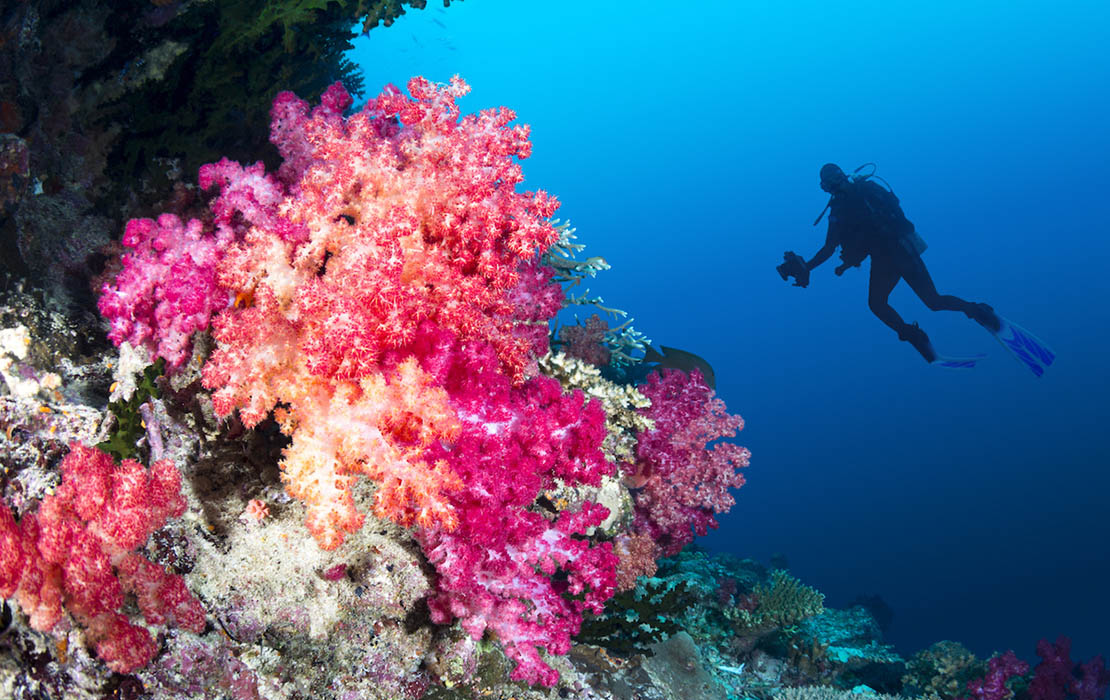
The Dive: Once you are in the slipstream, you don't swim. You fly. The entry point is usually on the outer edge of the channel. As the incoming tide sucks you into the lagoon, you are swept past a kaleidoscope of soft corals and gorgonian fans that are whipped into a feeding frenzy by the nutrient-rich water.
The Exit: Exit points are critical here. The drift eventually deposits you into the calmer waters of the lagoon. Safety sausages (DSMBs) are mandatory. The tender drivers are experts at spotting them, but you must deploy your buoy while doing your safety stop to ensure they track your drift. The water inside the lagoon is often glass-calm, making the ladder climb back onto the tender a breeze compared to the open ocean swell outside.
Marine Life: An Aquarium in the Ocean
The Rowley Shoals are frequently described as "an aquarium in the middle of the ocean," and Clerke Reef is the main tank. The isolation has created a unique ecosystem where species from Southeast Asia mix with Western Australian endemics.
The Mega-Fauna: You will lose count of the Grey Reef Sharks. They patrol the channel entrances in squads, accompanied often by the sleeker, silvery flash of Silvertip Sharks. But the true celebrities here are the Potato Cod (*Epinephelus tukula*). Unlike their sometimes shy cousins elsewhere, the Potato Cod at Clerke Reef are notoriously friendly, often approaching divers to inspect mask reflections. They can grow up to two metres in length and weigh over 100 kilograms, gentle giants that love a photo op.
The Pelagics: On the outer walls, look into the blue. You are likely to see dogtooth tuna, Spanish mackerel, and giant trevally (GTs) hunting in the current. Sailfish and marlin are occasionally spotted cruising the drop-offs, attracted by the sheer density of baitfish.
The Macro: Don't let the big stuff distract you entirely. The lagoon creates a sanctuary for macro life. The coral bommies (pinnacles) inside are covered in clouds of anthias and damselfish. If you look closely at the gorgonians, you’ll find Longnose Hawkfish and a variety of commensal shrimps. The nudibranch diversity is staggering, with species often found here that are rarely seen on the mainland coast.
lifecycle Note: If you are lucky enough to visit in October, you might witness the coral spawning. This usually occurs around the full moon, turning the water into a biological soup of gametes that kickstarts the entire food chain, drawing in manta rays and whale sharks to feed on the slick.
Topology: The Pear-Shaped Atoll
Geologically, Clerke Reef is a textbook "shelf atoll." It rises almost vertically from the ocean floor, which sits at about 390 metres deep.
* The Outer Walls: The exterior of the reef is a sheer limestone wall that plummets into the dark. It is covered in hard corals near the surface and massive gorgonian fans as you descend past 20 metres. * The Channels: There are three narrow passages connecting the ocean to the lagoon. The main channel is the most diveable, acting as a funnel for water and life. The topography here is scoured clean by the current, featuring hard corals adapted to high-energy flow. * The Lagoon: Inside the rim, the depth creates a stark contrast. It is shallow (mostly under 10 metres), sandy, and studded with coral bommies. The contrast between the deep indigo of the outer wall and the electric turquoise of the lagoon is visible from space. * Bedwell Island: Uniquely, Clerke Reef hosts a small sandy cay called Bedwell Island at its northern end. It’s a flat, unvegetated roost for seabirds, but underwater, the sloping sands around the island provide a different habitat suitable for rays and sand-dwelling critters.
Depth and Visibility: The Gin-Clear Standard
If you are used to "good" visibility being 20 metres, prepare to have your standards recalibrated.
* Visibility: It is not uncommon to have 40 to 60 metres of visibility at Clerke Reef. The nearest river runoff is 300km away on the mainland, meaning there is zero sediment. The water is oceanic blue and exceptionally clear. * Depth: * *Lagoon Dives:* 5m, 12m (Perfect for long afternoon dives or snorkelling). * *Channel Dives:* 15m, 30m (Stay off the bottom to avoid damaging coral in the drift). * *Wall Dives:* The wall drops to ~400m. Recreational limits (30m-40m) are easily hit, so watch your computer. The clear water makes depth perception tricky; 40 metres looks like 20.
Best Time and Conditions
The diving window for the Rowley Shoals is incredibly narrow due to the cyclone season and trade winds.
* The Season: Late September to early December. * *October* is generally considered the peak month. The trade winds drop, leaving the ocean glassy, and the water temperature warms up. * Water Temperature: Expect a balmy 26°C to 29°C (79°F - 84°F). A 3mm wetsuit is usually sufficient, though a 5mm is nice for repetitive diving over a week. * Conditions: During the season, swells are generally low, but tidal movement is massive. The tidal range can be over 4 metres, which is what powers the intense drift dives.
Amenities: The Definition of Remote
There is zero infrastructure at Clerke Reef. No dive shop, no jetty, no mobile reception, and definitely no latte art.
* Liveaboard Only: You must book a trip on a specialized liveaboard vessel departing from Broome. Operators like *True North*, *Odyssey Expeditions*, and *Ocean Dream* run scheduled charters during the season. * Tank Refills: Your boat is your lifeline. All diving support (compressors, Nitrox fills, medical oxygen, recompression advice) comes from the mothership. * Closest Port: Broome, WA. If you forget a spare O-ring or a battery, you aren't getting another one. Pack redundant gear (spare mask, strap, computer battery).
History and Surrounds: Captains and Cays
The reef was named by Captain Phillip Parker King in 1818, honouring Captain Clerke, a whaler who had reported the shoal sometime between 1800 and 1809. It’s a nod to the area's history not just as a marine sanctuary, but as a navigational hazard for early mariners.
Bedwell Island: The small sandy cay at the north, Bedwell Island, is one of only two breeding sites in Western Australia for the Red-tailed Tropicbird. If your liveaboard offers a shore excursion (tides permitting), walking on this tiny patch of sand in the middle of the Indian Ocean is a surreal experience. You are standing on the only dry land for hundreds of kilometres, surrounded by nesting birds that have no fear of humans because they simply never see them.
The "Wild West": Unlike the Great Barrier Reef, which has seen heavy tourism, Clerke Reef remains much as it was 100 years ago. The fishing restrictions are strict (it is a Marine Park with sanctuary zones), which explains why the fish here are so big and so bold. You aren't just observing nature here; you are immersing yourself in a baseline ecosystem, what the oceans *used* to look like.
---
Would you like me to detail the specific gear checklist you should pack for a remote liveaboard trip like this, or perhaps explore the neighbouring Mermaid Reef next?
Visibility at Clerke Reef
Visibility at Clerke Reef typically ranges from 30 to 40 metres, though it shifts with swell, wind and recent rainfall. October-December generally offers the best conditions for diving here.
Right now: approximately 4 m, 98% confidence (updated 12:29 AEDT).