Cook Island
Tweed Heads, NSW
Cook Island Dive Guide: Turtles off Tweed Heads
By ScubaDownUnder Team · 2026-04-08
Cook Island is a small rocky island about 600 m off Fingal Head and 4 km south-east of Tweed Heads, in far northern New South Wales. The water around it is the Cook Island Aquatic Reserve, and for Tweed and Gold Coast divers it is the local all-weather site: a short boat ride, sheltered options on most days, and a large population of green turtles that are used to divers.
Turtles have been part of the island's story for a long time. In 1823 two of John Oxley's crew landed and named it Turtle Island after the sea turtles they found there; Henry John Rous renamed it Cook's Isle five years later, and Cook Island became the official name in 1970. Visit NSW gives the reserve's Aboriginal name as Jungarra Ngarrian.
The Dive Sites
Divernet counts around a dozen dive sites around the island in 6 to 22 m, and Diveplanit describes rocky reef all the way round in 5 to 20 m. Public moorings mark the popular spots, and Kirra Dive, which runs Cook Island trips from Tweed Heads, describes its sites by those moorings.
The North Wall, also called the Northern Ledges, is the most dived site and usually the most sheltered. Kirra describes five moorings along a wall that starts at about 5 m and drops to sand at about 13 m. Diveplanit puts the boulder wall at 5 to 12 m, with coral gardens and anemones on top and a dozen or more turtles commonly waiting in the shallows to be cleaned. Out across the sand, rocky outcrops in 15 to 18 m hold stingrays, wobbegongs, turtles, the occasional blue groper and small critters such as dragonets, velvetfish and pipefish.
Mary's Rock is a pinnacle off the northern tip of the island, with gutters, walls and caves to around 20 m. Kirra rates it an advanced dive because of the current that usually runs there; its Cook Island page gives a maximum depth of about 21 m, while its advanced-trip page lists 8 to 28 m. A drift from the North Wall to Mary's Rock is one of Kirra's most popular dives for experienced divers. Pelagic fish, wobbegongs, turtles, eagle rays, groper and at times grey nurse sharks are seen around the rock.
The eastern side is dived only when the sea is calm. Diveplanit describes ledges and caves in 6 to 12 m, worth a torch for banded wobbegongs, loggerhead turtles, brown-banded bamboo sharks, crayfish and pineapplefish. Kirra calls its Eastern Mooring a fish bowl, with a wall and canyons leading to a feature called the Chimney at about 5 m.
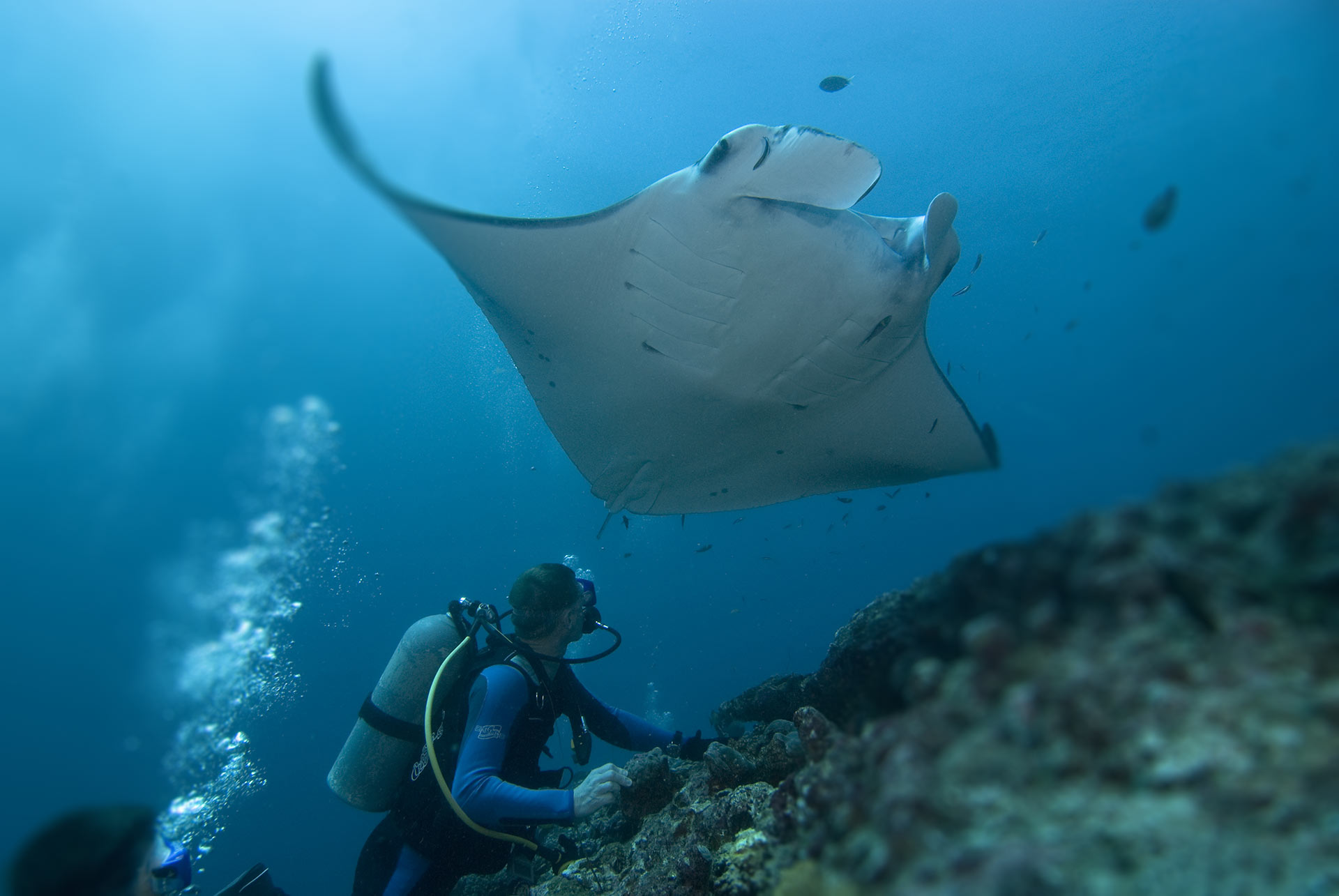
The southern side has another boulder wall: Diveplanit takes it to 15 m, and Kirra gives 5 to 11 m across five moorings, rarely troubled by current. Manta rays visit a small bommie there in summer to be cleaned, near Mooring 2 according to Kirra. Off the western side, Turtle Bommie has wobbegongs, turtles, stingrays, stingarees and crayfish.
Kirra also points divers to a Turtle Sanctuary, a resting area for green turtles about five minutes' swim from the North Wall on a bearing of 330 degrees. Visits there are kept short under a strict do-not-disturb rule: watch quietly, then leave.
Marine Life
Cook Island is best known for its turtles, and Divernet notes that dozens are often seen on a single dive. Many sit on top of the wall to be cleaned by surgeonfish or tuck under the boulders to sleep. PADI's listing describes a permanent colony of green and loggerhead turtles, and Diveplanit adds hawksbill turtles on the southern side.
The boulders hide moray eels, lionfish, scorpionfish, leopard blennies, octopus, cuttlefish and Australian pineapplefish, and the nudibranchs include Spanish dancers. On the sand at the base of the walls are stingrays, shovelnose rays and wobbegongs, and over the warmer months leopard sharks and whitespotted wedgefish rest on the bottom, sometimes lined up in rows. Grey nurse sharks visit in winter. Humpback whales pass the island on their winter migration; underwater encounters are rare, but you may hear them singing.
NSW DPIRD lists the giant Queensland groper, black rockcod, goldspotted rockcod and grey nurse shark among the threatened or protected species found in the reserve. Hard and soft corals, sponges, black coral trees and gorgonians cover parts of the reef.
Conditions
Diving is possible year-round. Visibility is typically 8 to 15 m and generally clearest after a spell of southerly winds (Diveplanit). Kirra gives water temperatures of about 19°C in winter to about 26°C at the height of summer. Current is generally mild along the North Wall and the South Side, but it can pick up past Moorings 1 and 5 and is usually stronger around Mary's Rock.
Kirra rates the north and south sides suitable for entry-level divers, with Mary's Rock and the drift for advanced divers. Snorkellers are welcome on Kirra's dive trips when the weather allows, and it also runs snorkelling tours to swim with the turtles.
Reserve Rules
Cook Island Aquatic Reserve is managed by NSW DPIRD and covers about 78 hectares, from the island's high-water mark out to 500 m from a survey marker on the island. Scuba diving and snorkelling are allowed and popular.
Fishing by all methods and collecting are prohibited inside the fishing closure, an area bounded by five coordinate marks around the island. The marks are usually shown by marker buoys, but DPIRD warns the buoys are not always in place, especially after severe weather. In the rest of the reserve, fishing (except with set lines) and collecting are allowed under the normal NSW rules.
Public moorings at the popular dive spots replace the need to anchor and protect the corals and other invertebrates, so boats should use them. The island itself is a nature reserve with a large population of nesting seabirds, and recreational use of it is not permitted.
Grey nurse sharks are listed as critically endangered in NSW, and DPIRD applies the national code of conduct for diving with them in all NSW waters. Divers must not touch, feed, chase or harass the sharks, must not block gutters or cave entrances, must not use mechanical devices such as scooters or shark pods, and groups must total no more than ten divers.
Site Access and Logistics
Cook Island is a boat dive. Kirra Dive runs trips from Wharf Street, Tweed Heads: a 15 to 20 minute ride along the Tweed River with a light bar crossing. Gold Coast Dive Adventures runs double-dive trips from Runaway Bay Marina for certified divers (Open Water or higher), with about 45 minutes on the boat to reach the island. Private boats can launch from ramps in the Tweed River estuary and should use the public moorings. Both operators hire gear; there are no facilities on the island, which is closed to visitors.
For a shore dive nearby, the Tweed River rock walls at Jack Evans Boat Harbour are dived around high tide. Advanced divers can add Nine Mile Reef, the offshore shark dive; Gold Coast Dive Adventures uses Cook Island for the surface interval on its Nine Mile trips. For the rest of the state, see our region-by-region guide to the best places to dive in NSW.
Sources
- NSW DPIRD: Cook Island Aquatic Reserve (dpird.nsw.gov.au) - NSW DPIRD: Greynurse shark (dpird.nsw.gov.au) - NSW DPIRD: Fishing and diving rules at Greynurse Shark aggregation sites (dpird.nsw.gov.au) - Diveplanit: Turtles and Other Treasures of Cook Island - Divernet: A Guide to Diving the Gold Coast, Part 2: Cook Island, Nine Mile Reef and Beyond - Kirra Dive: Double Dive Cook Island - Kirra Dive: Snorkel with the Turtles - Kirra Dive: Advanced location SCUBA - Kirra Dive: Clean-up dives, Jack Evans Boat Harbour - Gold Coast Dive Adventures: Cook Island Marine Reserve dive trips - Gold Coast Dive Adventures: Nine Mile Reef dive trip - PADI: Cook Island dive site - Visit NSW: Cook Island Aquatic Reserve - Wikipedia: Cook Island (New South Wales)
Header photo: Cook Island seen from Fingal Head, by Kgbo, CC BY-SA 4.0, via Wikimedia Commons.

Visibility at Cook Island
Visibility at Cook Island typically ranges from 8 to 15 metres, though it shifts with swell, wind and recent rainfall. Year-round generally offers the best conditions for diving here.
Right now: approximately 10 m, 83% confidence (updated 18:24 AEDT).
Air, gear and guides near Cook Island
Browse dive shops in Gold Coast for fills, hire gear, servicing and guided dives at this site.