Darwin Catalinas
Darwin, NT
Darwin Catalinas
By ScubaDownUnder Team · 2026-07-14
Four PBY Catalina flying boats were moored at the Darwin flying boat base on the morning of 19 February 1942 when Japanese fighters arrived. All four were destroyed by strafing fire and sank at their moorings within minutes. Today the four aircraft sit in 5 to 15 metres of water across the inner harbour and are the only aircraft wrecks in the Darwin Harbour cluster, the shallowest of the dive-able wrecks, and the most accessible of the Darwin sites for divers building experience toward the deeper ship wrecks.
The Catalinas were a mix of US Navy and Royal Australian Air Force aircraft based at Darwin's flying boat moorings as part of the Allied long-range patrol effort. The 19 February attack arrived faster than the moored aircraft could be deployed, and Japanese A6M Zeros strafed the moorings in coordinated runs. All four Catalinas at the site were destroyed. The aircraft are part of the Darwin Harbour wartime wreck cluster and are protected under the Historic Shipwrecks Act 1976. The PBY Catalina was a long-range patrol amphibian and one of the most-produced military aircraft of the war. The Larrakia people are the traditional custodians of Darwin Harbour.
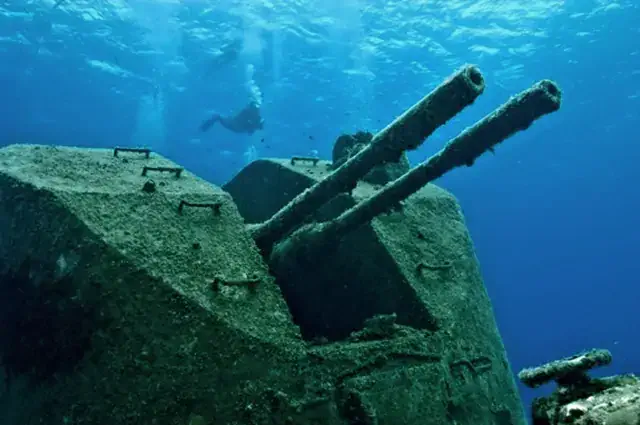
The four aircraft sit in different parts of the inner harbour at depths of 5 to 15 metres, and operators visit them as separate dives or as a multi-aircraft circuit on a single tank. Each Catalina is broken across its airframe with engines, hull frames, wing sections and propellers identifiable. The aluminium construction degrades differently to the steel-hulled ships around them, and the airframes read as more open and skeletal. The shallowest aircraft sits at 5 to 8 metres and is the most accessible of the Darwin wrecks; the deeper Catalinas sit at 12 to 15 metres.
Marine life on the Catalinas is the inner harbour assemblage in shallow form. Encrusting sponge and coral cover the airframes, schools of small reef fish work the broken structure, juvenile batfish gather around the engines, stingrays cross the surrounding sand. Lionfish hold inside the engine nacelles. The shallow depth means more light reaches the wrecks than the deeper ship sites and the encrustation reads as more colourful in consequence.
Inner harbour conditions apply: 8-metre tidal range, strong currents outside slack water, visibility 3 to 10 metres, water temperature 23 to 30°C, box jellyfish October to May, crocodile risk year-round. The shallow Catalinas are dive-able in a wider range of conditions than the deeper ship wrecks because the gas planning is less constrained and the surface time is shorter. May to October dry season working window.
The Catalinas reward divers prepared to work with the airframe geometry of a 1940s flying boat. The engine nacelles, propellers, wing roots and hull architecture differ fundamentally from the ship wrecks around them. Photographers find the broken airframes against the inner harbour silt produce an unusual aesthetic distinct from steel hull diving. The aluminium construction has degraded enough that some sections are skeletal rather than enclosed, with light passing through the airframe in ways the ship hulls do not allow.
The Catalinas are the dive that completes the Darwin Harbour story. The ship wrecks tell the story of the bombs and the fires; the aircraft tell the story of the strafing runs and the shorter, sharper attacks on the long-range patrol assets that the Allies could not get airborne in time. For divers building experience across the Darwin cluster, the shallowest Catalina is the place to start. For divers finishing a Darwin trip, it is often the dive that closes the visit.
## Site Access and Logistics
The Darwin Catalinas are a boat dive only. Standard departure points are Cullen Bay Marina and the Stokes Hill Wharf area, with a transit of 10 to 25 minutes depending on which aircraft is the target. Operators visit the four aircraft as separate dives or as a sampling circuit on a single tank, depending on tide and visibility on the day.
Entry is a backward roll from the dive boat onto a fixed line near the chosen aircraft. Exit is up the line and re-board over the boat tubes, with safety stops conducted on the line. Surface marker buoy deployment is recommended at the deeper aircraft due to surface boat traffic.
Minimum certification is PADI Open Water. The shallowest Catalina is suitable for newer divers in good conditions; the deeper sites are better for divers with experience in current and limited-visibility conditions. The Catalinas are commonly used as the introductory dive of a Darwin wreck-diving trip before divers move to the deeper ship wrecks.
Bookings run through [Dive Darwin](https://divedarwin.com.au) and other Darwin charter operators.
## Sources
- Dive Darwin, Darwin wreck briefings: [https://divedarwin.com.au](https://divedarwin.com.au) - Australian National Shipwreck Database, Darwin aircraft entries - Northern Territory Heritage Register, [Darwin Harbour wrecks](https://www.scubadownunder.com/dive-sites/darwin-harbour-wrecks) - Australian War Memorial, Bombing of Darwin records: [https://www.awm.gov.au](https://www.awm.gov.au) - RAAF Museum, PBY Catalina records - Michael McFadyen's Scuba Diving, Darwin wreck references: [http://www.michaelmcfadyenscuba.info](http://www.michaelmcfadyenscuba.info)
Visibility at Darwin Catalinas
Visibility at Darwin Catalinas typically ranges from 3 to 10 metres, though it shifts with swell, wind and recent rainfall. May to October (dry season) generally offers the best conditions for diving here.