Eyre Island Channels
West Coast, SA
Eyre Island Channels Dive Guide | West SA
By ScubaDownUnder Team · 2026-04-14
The Eyre Island group sits offshore from the mid-west Eyre Peninsula coast, a cluster of low-lying islands whose most significant underwater feature is the channels between them. These passages funnel the tidal exchange of the surrounding Southern Ocean into focused, powerful flows that create drift-diving conditions and concentrate the marine life that current-fed environments support. The combination of remoteness, exceptional visibility, and an Australian sea lion population that moves through the channels regularly produces one of [South Australia](https://scubadownunder.com/blog/best-places-to-dive-in-south-australia)'s most rewarding advanced dive experiences, for divers who can reach it on a settled-weather window.
The island group is uninhabited and rarely visited by recreational divers. Its distance from Streaky Bay, the nearest dive infrastructure, and the open-ocean conditions of the crossing limit access to operators with suitable vessels and divers with the experience to manage the channel conditions. What that limited access has preserved is a marine environment in essentially undisturbed condition. The sponge diversity on the channel walls, the size of the resident sea lion population on the islands, and the fish biomass in the current-exposed sections all reflect an ecosystem operating without significant recreational pressure, a quality increasingly difficult to find on the Australian coast.
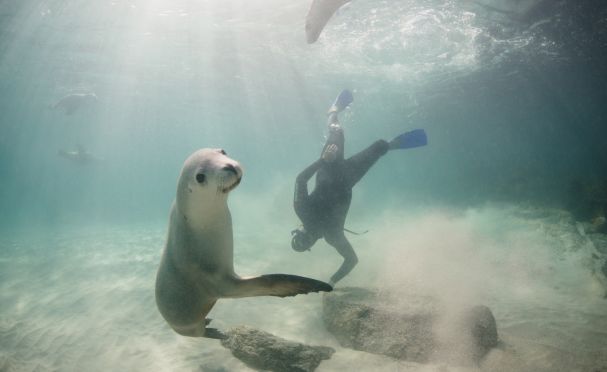
Australian sea lion colonies use the islands for hauling out and breeding, and the animals move through the channels regularly on their foraging and social activity. In-water encounters in the channels follow the pattern of the species, on their terms, at their pace, and most rewarding for divers who can hold position in the current and allow the animals to approach. A juvenile sea lion in the mood for a play session is one of the most charismatic marine encounters available to recreational divers in Australia, and the willingness of the Eyre Island animals to engage with divers reflects the lack of negative human contact in their experience.
The channel currents are the technical constraint. On the spring tidal runs, the water moves through the passages with enough force to make swimming against it impossible. The dive works as a drift, enter at the up-current end, follow the flow through the channel, exit at the down-current point to the waiting vessel. Slack water on a neap cycle provides the calmer alternative for less experienced divers, and most operators time the trips to the slack window for the dive itself, with the running tide as the transit between sites. Reading the tide tables is a non-negotiable part of planning any dive in this group.
The walls of the channels are vertical to overhanging in places, with sponge gardens on the more sheltered faces and encrusting bryozoan and ascidian growth across the current-exposed surfaces. The sponge diversity is exceptional, reflecting decades of undisturbed colonisation in the cold, productive Southern Ocean water that the Eyre coast receives. Schools of trevally and pelagic species hold in the current-fed sections, and the larger fish, mulloway, snapper, kingfish, work the channel mouths where the flow concentrates baitfish.
Visibility in the channels on a clear day reflects the Southern Ocean source water: 20–30 metres is achievable in good conditions, with the combination of clear water and strong current creating a diving experience with a physical dynamism that calmer sites cannot replicate. Water temperature ranges from 14°C in winter to 20°C in late summer, with a 7mm wetsuit the practical minimum for repeat dives across a day. On the rare exceptional day the visibility opens beyond 30 metres and the channel walls disappear into deep blue water, these are the conditions that justify the journey.
This is not a casually organised destination. Trip planning must include a weather window sufficient for the crossing, the dive, and the return in daylight, and the Bight margin produces few of those windows outside the October-to-April settled season. For divers willing to commit to the logistics, what waits in the channels is some of the most genuinely wild diving available in temperate Australia.
## Site Access and Logistics
Eyre Island is accessed by boat from Streaky Bay, on the west Eyre Peninsula coast approximately 720km west of Adelaide via the Eyre Highway. The crossing is open ocean and weather-dependent, operators run trips only on settled forecasts, and last-minute cancellations are routine.
Advanced Open Water certification is the formal minimum, but the relevant qualifications are practical: open-water and current diving experience, comfort with drift dives in significant flow, and the ability to deploy and follow an SMB at the channel exit. Nitrox is recommended for divers cycling through multiple channel dives across a day. A 7mm wetsuit or drysuit, gloves, and hood are the standard exposure protection.
Book through Streaky Bay-based charter operators. The trip is typically run as a full-day or multi-day expedition rather than a half-day excursion, given the crossing time. Combine with the protected jetty diving at Streaky Bay and Port Kenny for variety on a multi-day itinerary.
## Sources
- Atlas of Living Australia, Australian sea lion (*Neophoca cinerea*) colony and distribution records - Department for Environment and Water SA, Nuyts and Eyre Peninsula marine parks - Marine Life Society of South Australia, Far west Eyre Peninsula site notes - Bureau of Meteorology, South Australian coastal waters forecasts - Michael McFadyen's Scuba Diving, West Eyre offshore site profiles
Visibility at Eyre Island Channels
Visibility at Eyre Island Channels typically ranges from 6 to 10 metres, though it shifts with swell, wind and recent rainfall. Spring–Summer generally offers the best conditions for diving here.
Right now: approximately 8 m, 98% confidence (updated 07:02 AEST).
View the live forecast and 7-day outlook for Eyre Island Channels →