Kelat
Darwin, NT
Kelat
By ScubaDownUnder Team · 2026-06-15
The Kelat was an iron sailing ship built in Glasgow in 1881, sixty years before the morning the Japanese aircraft arrived over Darwin. By 1942 she had finished her sailing career and was anchored in the harbour as a coal hulk for refuelling steamships. Hit during the raid, she sank in 12 to 18 metres of water and is today the oldest of the Darwin wrecks and the shallowest of the major sites. The Kelat is the dive that puts a Victorian-era iron sailing ship inside the Darwin Harbour wreck cluster.
The Kelat was a four-masted iron sailing barque, built on the Clyde and operating on the British-to-Australia trade through the late nineteenth century. By the early twentieth century the steam transition had ended her commercial career, and she was decommissioned as a sailing ship and moored in Darwin Harbour as a coal hulk: a floating fuel depot that supplied steamships passing through the port. She was anchored in this role when the 19 February 1942 raid arrived. The Kelat predates every other Darwin wreck by decades and represents a different era of merchant shipping. The wreck is protected under the Historic Shipwrecks Act 1976. The Larrakia people are the traditional custodians of Darwin Harbour.
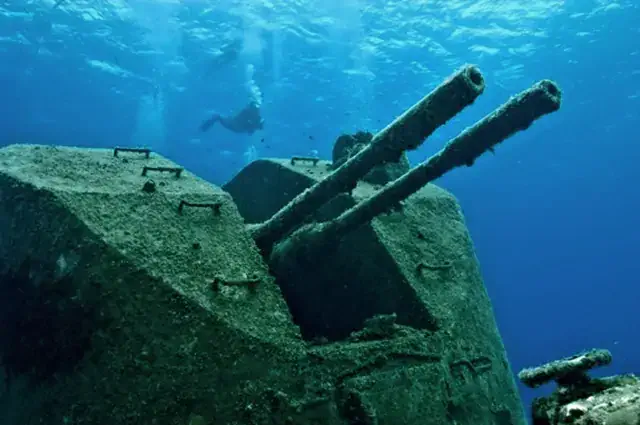
The Kelat lies broadly upright on the harbour floor at 12 to 18 metres in the inner harbour, broken in places but with the iron hull lines and major structural elements still recognisable. The hull is more open than the steel-hulled war wrecks because the iron plating has degraded differently across the century-plus underwater. Cargo holds, the chain locker, anchor mounts and the lower mast structure are identifiable. The shallower depth makes the Kelat the most accessible of the Darwin wrecks for less experienced divers when conditions allow.
The Kelat's longer time underwater means denser encrustation than the war wrecks. Soft coral, sponge and bryozoan cover the iron in thick layers, and the surface texture of the wreck reads as more reef than ship in places. Schools of trevally and small reef fish work the upper structure. Lionfish, scorpionfish and resident moray eels hold inside the holds and along the rail edges. Stingrays cruise the surrounding sand, and octopus den in the broken pipework and cargo cavities.
Inner harbour conditions apply: 8-metre tidal range, current outside slack water, visibility 3 to 10 metres, water temperature 23 to 30°C, box jellyfish October to May, crocodile risk year-round. The Kelat's shallower depth profile means more flexible decompression and longer bottom time for given gas, making it the site of choice for repeat divers managing nitrogen across multiple wrecks. May to October dry season working window.
The Kelat rewards divers willing to read the structural geometry of a sailing ship versus a steamer. The mast structure, even broken, retains the proportions of a working sailing barque. Cargo holds, when light permits, hold the geometry of a different shipping era. Repeat divers find the Kelat the most visually distinct of the Darwin wrecks because the iron hull and sailing-ship architecture set it apart from the steel-hulled war ships around it.
The Kelat is the wreck that pre-dates the war that defines the rest of Darwin's wrecks. Built in 1881, sunk in 1942, she was already an old ship when the bombs arrived. For divers who want a longer historical thread on a Darwin trip, the Kelat is the entry point: the same harbour, the same morning, but a vessel that connects to a different chapter of shipping history.
## Site Access and Logistics
The Kelat is a boat dive only. Standard departure points are Cullen Bay Marina and the Stokes Hill Wharf area, with a transit of around 15 to 25 minutes to the inner harbour. The Kelat is often dived as the second tank of an inner-harbour day with the Neptuna or as a stand-alone dive when divers want a shallower profile.
Entry is a backward roll from the dive boat onto a fixed line at the wreck. Exit is up the line and re-board over the boat tubes, with safety stops conducted on the line. Surface marker buoy deployment is recommended.
Minimum certification is PADI Open Water with experience in current diving. The shallower depth and intermediate skill rating make the Kelat the most accessible of the Darwin wrecks, suitable for divers building experience toward the deeper outer-harbour sites.
Bookings run through [Dive Darwin](https://divedarwin.com.au) and other Darwin charter operators.
## Sources
- Dive Darwin, Darwin wreck briefings: [https://divedarwin.com.au](https://divedarwin.com.au) - Australian National Shipwreck Database, Kelat entry - Northern Territory Heritage Register, [Darwin Harbour wrecks](https://www.scubadownunder.com/dive-sites/darwin-harbour-wrecks) - Australian War Memorial, Bombing of Darwin records: [https://www.awm.gov.au](https://www.awm.gov.au) - Michael McFadyen's Scuba Diving, Darwin wreck references: [http://www.michaelmcfadyenscuba.info](http://www.michaelmcfadyenscuba.info) - Australian Maritime Museums Council, late 19th century iron sailing ship records
Visibility at Kelat
Visibility at Kelat typically ranges from 3 to 10 metres, though it shifts with swell, wind and recent rainfall. May to October (dry season) generally offers the best conditions for diving here.