Long Reef Wall (The Apartments)
Collaroy, NSW
Long Reef Wall and The Apartments Dive Guide
By ScubaDownUnder Team · 2025-12-11
The light changes before the reef comes into focus. A few metres above the boulders, schools of pomfret hang so thick that the bottom dims as if a cloud has crossed the sun, and when the fish part, the slow grey shapes beneath them turn out to be grey nurse sharks holding station over the sand. Michael McFadyen, who has kept records of his Sydney dives since 1988, wrote that one dive here in June 1995 rivalled the best he had done anywhere in the Pacific, and that on another the fish were packed so densely that torches were needed on a bright, sunny day.
The Wall at Long Reef, also known as The Apartments, is a boat dive off Long Reef on Sydney's Northern Beaches, and Sydney Dive Charters calls it the best recreational dive site Sydney has to offer. It is a reef of big rectangular boulders, a north-south wall, caves and swim-throughs, and a cavern called The Cathedral, all close enough to the city that McFadyen could see the centre of Sydney from the dive location.
The site lies off the north point of Long Reef, the prominent headland between Dee Why and Collaroy, north-east of Fishermans Beach. McFadyen uses both names for the same reef and is unsure whether "Apartments" refers to the apartment block on the shore or the hundreds of little "apartments" formed under the boulders, while Sydney Dive Charters treats The Wall as the section extending north from The Apartments. McFadyen lists it alongside Dee Why Wide under the Long Reef area. The headland itself is protected by Long Reef Aquatic Reserve, declared in 1980 as the oldest aquatic reserve in NSW, but that reserve reaches only 100 m offshore, and Sydney Dive Charters reports large numbers of fishing boats working The Apartments. The grey nurse sharks that headline the dive are listed as critically endangered in NSW.
The reef's spine is a ridge running roughly north-south with its top at about 8-10 m. On the eastern side it steps down in a series of drops to about 15 m, where a field of large boulders begins, and the seabed falls past 20 m further east. With the anchor set on the ridge in about 10 m, as McFadyen recommends, a dive begins bright and shallow before divers drop to the foot of the wall and follow its edge. Sydney Dive Charters describes a valley cut into the reef, entered from the shallow reef top or from the boulder field east of the wall. Inside, divers head north-west through the pomfret schools to a sand patch where the main body of sharks usually sits. Roughly 30 m east of the valley entrance stands the big rock, and on its northern side, at around 21 m, is the entrance to The Cathedral. West of the valley the reef opens into a plateau of rock, kelp and sand in around 12-13 m.
The Cathedral is formed by two huge sandstone slabs leaning together into a pitched, church-like roof. The route runs through the cavity past the "altar" and out via the "stained glass window", usually through a crowd of fish gathered at the openings. Somewhere along the wall at about 15 m is Andys Cave, a large and complex system that McFadyen admits can be hard to find. Its entrance is a big rock lying at an angle; divers go in under the rock, turn right through a low, wide cave, follow a short passage into a longer chamber with skylight openings overhead, and exit through the top. Sydney Dive Charters warns that some of the swim-through passages here are dead ends that have to be backed out of.
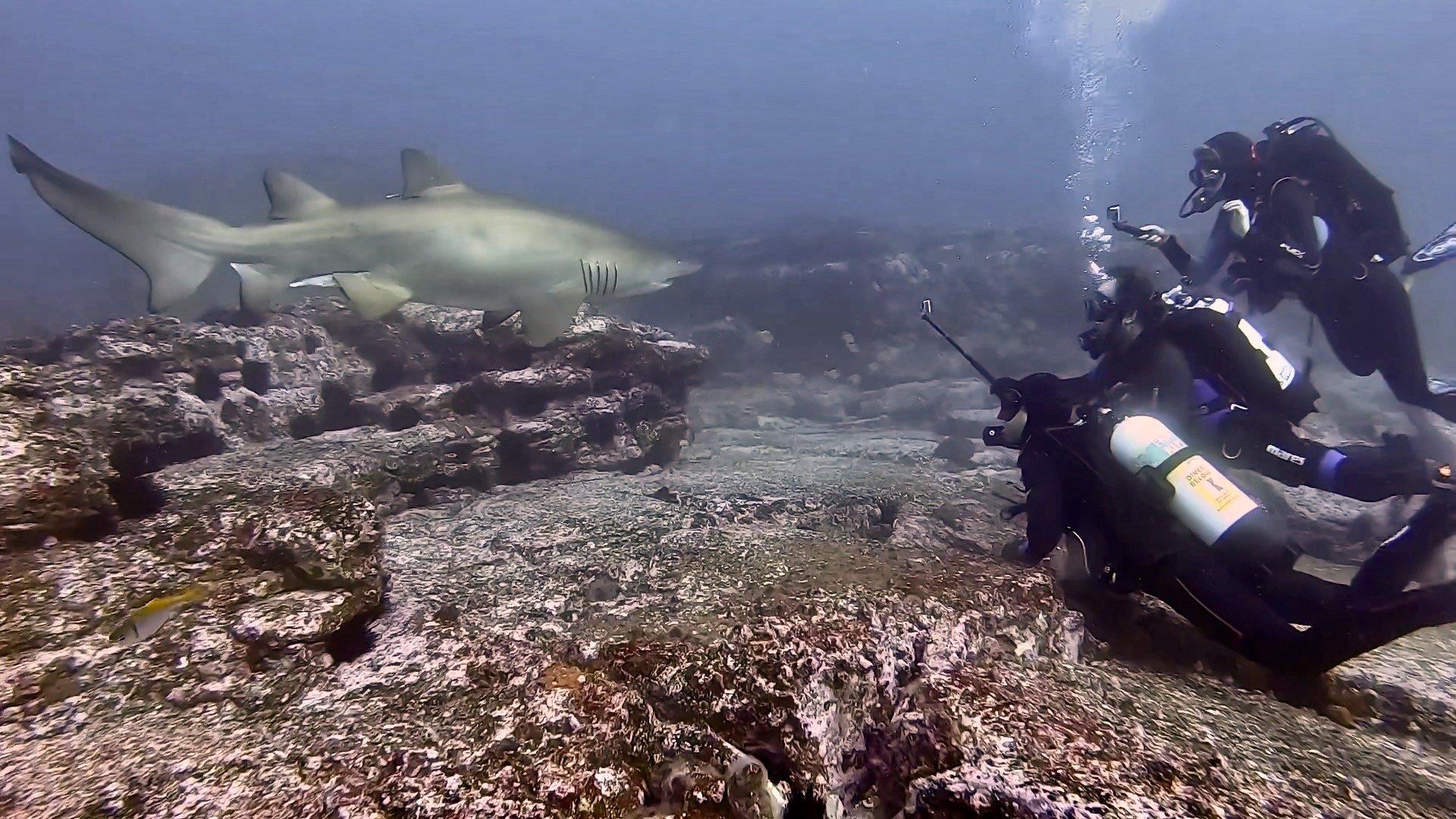
Grey nurse sharks are the headline. Sydney Dive Charters reports them at The Apartments all year, with numbers building from around December and peaking in April and May as the sharks gather to mate; counts of 25 to 30 are possible, and mating scratches around the head are common. The same operator notes that numbers here once ran into the hundreds before large numbers were killed in the 1980s, which gives every encounter today some weight. The crew's approach is to settle low at the edge of the reef and stay out of the sharks' path until they drift off over the valley rim.
The pomfrets are the other spectacle. McFadyen describes tens of thousands of fish, including yellow-finned pomfret, yellowtail and silver sweep, hovering over the gullies between the larger boulders, with what are most likely ladder-finned pomfret crowding The Cathedral's openings. Giant cuttlefish are a fixture of the caves and boulder holes. Between February and May they are mating and can be remarkably interactive, and McFadyen once counted 15 in Andys Cave alone. Wobbegong sharks rest at the base of the swim-throughs, octopus den along the rocky valley edges, and several eastern blue groper live in the valley, including a friendly blue male the regulars call Wally. Through the 1980s, Sydney Dive Charters recalls, schools of big kingfish streamed past here for the whole of a dive before mid-water fishing traps wiped them out, and large bull rays still glide through. Red morwong, bream, leatherjackets, sea pike, sergeant baker and schooling old wives fill in the reef.
Visibility is often generous by Sydney standards. Sydney Dive Charters quotes 10-40 m, and McFadyen notes that the reef can usually be seen from the surface. His long-term logbook analysis across Sydney sites puts the best visibility in June to August and the worst in October and November, with clean water often following a spell of southerly winds. Across Sydney, his records show water averaging about 16 °C in August and September and close to 20 °C in March and April, with readings ranging from 11.5 °C to just over 24 °C. A 7 mm wetsuit with a hood suits most of the year. Sydney Dive Charters recommends a surface marker buoy on every dive here, not least because of the fishing boats overhead. The site is exposed: McFadyen's rule of thumb is that winds over 15 knots from anything but the west or north-west are unsuitable for boat diving off Sydney, and in a southerly he warns against running north, since getting back can become difficult if the seas build. On those days the sheltered shore dives at Shelly Beach and Fairy Bower are the local fallback. Wave records from the buoy off the Northern Beaches show May to September has the best chance of seas under a metre, although May and June also bring the most days over 2 m. May is the sweet spot, where the end of the shark peak meets improving winter visibility.
Photographers find their frame in The Cathedral, where sunlight cuts into the caves and fish swirl through exhaust bubbles. Sydney Dive Charters notes that the swim-throughs at The Apartments carry some of the largest hard corals in Sydney, which makes good buoyancy non-negotiable inside, both for the growth and for the dead-end passages. A torch earns its place even at midday: McFadyen describes swimming under the fish and finding it so dark it was almost like a night dive.
Few Sydney sites pack this much into one tank: a shallow reef top for an easy start, a wall and boulder field with real architecture, a cavern that earns its name, and for much of the year, sharks resting beneath a ceiling of fish. After decades of return visits, McFadyen's advice was to make a point of diving The Wall at Long Reef in winter.
Site Access and Logistics
The Wall at Long Reef is reached by boat only. Sydney Dive Charters runs single and double guided boat dives here, picking divers up at Little Manly Boat Ramp or Rose Bay Public Wharf. Entry and exit are from the boat, and a double dive day takes about four hours. Private boaters can use McFadyen's GPS mark of 33° 44.295' S, 151° 19.640' E (WGS84): run east or west until the depth rises from over 20 m to 8-10 m on the ridge, then anchor in about 10 m. Expect fishing boats on the mark and carry an SMB. Sydney Dive Charters requires Open Water certification at minimum and recommends at least 10 previous boat dives. Open Water divers are trained to 18 m, so Advanced Open Water is the better fit for The Cathedral at around 21 m and the swim-throughs. Air or nitrox both suit the profile.
Sources
- Michael McFadyen's Scuba Diving: The Wall (The Apartments) - Michael McFadyen's Scuba Diving: Visibility and Wave Averages in Sydney - Sydney Dive Charters: The Apartments Shark Dive Site - Sydney Dive Charters: Guided Double Boat Dives - NSW DPIRD: Long Reef Aquatic Reserve - NSW DPIRD: Greynurse Shark critical habitat and aggregation sites
Visibility at Long Reef Wall (The Apartments)
Visibility at Long Reef Wall (The Apartments) typically ranges from 10 to 40 metres, though it shifts with swell, wind and recent rainfall. December-May for grey nurse sharks (peak April-May); June-August for visibility generally offers the best conditions for diving here.
Right now: approximately 6 m, 98% confidence (updated 10:34 AEDT).
View the live forecast and 7-day outlook for Long Reef Wall (The Apartments) →
Air, gear and guides near Long Reef Wall (The Apartments)
Browse dive shops in Sydney for fills, hire gear, servicing and guided dives at this site.