MV Neptuna
Darwin, NT
MV Neptuna
By ScubaDownUnder Team · 2026-06-11
The largest single explosion of the 19 February 1942 Darwin raid happened at Stokes Hill Wharf when the Norwegian motor freighter MV Neptuna, hit during the first wave of the attack, ignited her cargo of depth charges. The blast destroyed the ship, killed 45 wharf labourers and crew, and damaged the wharf structure itself. Today the Neptuna lies as a wide debris field at 14 to 20 metres just off the modern wharf, the most heavily fragmented of the major Darwin wrecks and the one most defined by the manner of its sinking.
The Neptuna was a Norwegian motor freighter built in 1924 and pressed into Allied service. She was alongside Stokes Hill Wharf on the morning of 19 February, offloading depth charges and other ordnance, when Japanese aircraft attacked the wharf area. Multiple bombs hit the ship and the wharf simultaneously, igniting the depth charges in her hold. The resulting explosion was the largest single event of the raid and was visible across the harbour. The attack on Darwin sank or damaged thirty ships and killed at least 235 people across the morning, the deadliest single attack on Australian soil. The Neptuna is part of that record and is protected under the Historic Shipwrecks Act 1976. The Larrakia people are the traditional custodians of Darwin Harbour.
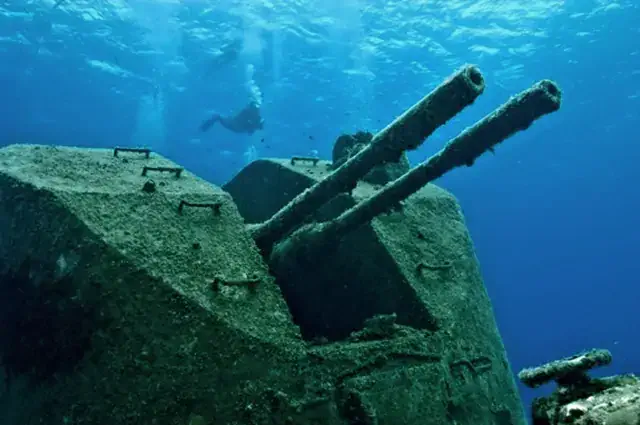
The Neptuna site reads as a debris field rather than a single ship. The explosion broke the hull into multiple sections and scattered machinery, cargo and pipework across an area of perhaps 80 by 40 metres. The deepest sections sit at 20 metres and the shallower debris reaches to 14. Operators drop divers near the largest visible structural fragment and the dive runs as a slow circuit of the field. Hull plating, machinery components, anchor chain, propeller shafting and miscellaneous cargo are all recognisable in among the broken wreckage. The site sits close to the modern Stokes Hill Wharf and divers on safety stops can usually see wharf piles and harbour traffic above them.
Marine life on the Neptuna debris is rich for the depth and reflects the broken structure's edge habitat. Schools of trevally and small jacks work the upper debris, encrusting sponge and coral cover the metal across the field, and scorpionfish lie motionless on the larger plating. Stingrays and small reef sharks cross the surrounding sand. Resident moray eels hold in the larger pipework. The site reads as a productive artificial reef in habitat-edge form: less continuous than an intact hull but with high species density along the broken edges where current accelerates and food concentrates.
Darwin Harbour conditions apply: tidal range over 8 metres, strong currents through the inner harbour outside slack water, visibility 3 to 10 metres typically, water temperature 23 to 30°C. The Neptuna's location alongside the active wharf means surface boat traffic is constant and surface marker buoys are mandatory. Visibility on outgoing tide drops sharply due to silt mobilisation in the inner harbour. Box jellyfish October to May. Saltwater crocodile risk year-round. May to October dry season is the working dive window. The site is shallower than the outer-harbour wrecks but the conditions are arguably tighter due to wharf traffic and the constrained slack window in the inner harbour.
The Neptuna debris field rewards careful work along the larger structural fragments and the boundary between wreck and sand. Hull plating sections hold ordnance fragments and ship's machinery in identifiable form. The propeller shaft and rudder section is the largest single structural element. Photographers find the contrast of bright-coloured encrustation against the broken metal produces a distinctive look. Night dives are not commonly run due to the wharf traffic and conditions but reveal the typical inner-harbour cast: feeding moray eels, octopus, scorpionfish in active hunting posture.
The Neptuna is the wreck defined by the manner of its sinking. Where the Meigs sank from bombs and settled intact and the Mauna Loa broke gradually under sea conditions, the Neptuna disintegrated in a single moment, scattered across the harbour floor by her own cargo. Most of the dive sites Darwin Harbour holds are archaeological. The Neptuna site is forensic.
## Site Access and Logistics
The MV Neptuna is a boat dive only. The standard departure point is Cullen Bay Marina, with a transit of 15 to 20 minutes to the inner harbour. Several Darwin charter operators include the Neptuna in their wreck-diving rotation. The site sits close to the modern Stokes Hill Wharf and dive plans must coordinate with active commercial wharf traffic.
Entry is a backward roll from the dive boat onto a fixed line dropped near the largest structural fragment. Exit is up the line and re-board over the boat tubes, with safety stops conducted on the line. Surface marker buoy deployment is mandatory due to wharf traffic.
Minimum certification is PADI Advanced Open Water. Twenty logged dives is a sensible working minimum, and divers should be confident with current diving and broken-structure awareness. The shallower depth profile makes the Neptuna more accessible than the outer-harbour wrecks but the surface conditions can be more demanding.
Bookings run through [Dive Darwin](https://divedarwin.com.au) and other Darwin charter operators.
## Sources
- Dive Darwin, Darwin wreck briefings: [https://divedarwin.com.au](https://divedarwin.com.au) - Australian National Shipwreck Database, MV Neptuna entry - Northern Territory Heritage Register, [Darwin Harbour wrecks](https://www.scubadownunder.com/dive-sites/darwin-harbour-wrecks) - Australian War Memorial, Bombing of Darwin and Stokes Hill Wharf records: [https://www.awm.gov.au](https://www.awm.gov.au) - Michael McFadyen's Scuba Diving, Darwin wreck references: [http://www.michaelmcfadyenscuba.info](http://www.michaelmcfadyenscuba.info)
Visibility at MV Neptuna
Visibility at MV Neptuna typically ranges from 3 to 10 metres, though it shifts with swell, wind and recent rainfall. May to October (dry season) generally offers the best conditions for diving here.