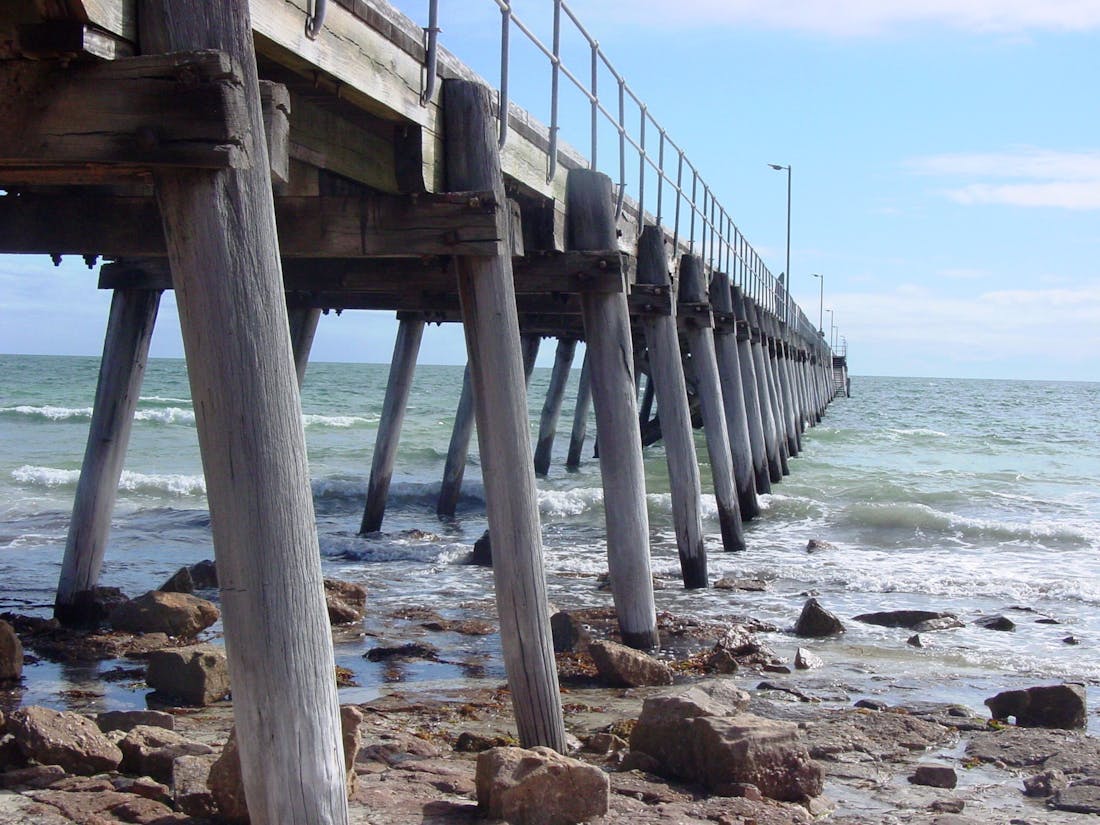
Port Hughes Jetty
Yorke Peninsula, SA
Port Hughes Jetty Dive Site Guide | Yorke Peninsula, SA, Australia
By ScubaDownUnder Team · 2025-05-23
Water laps quietly against the timber pylons at first light, and the sun, low enough to cut laterally through the shallow bay, lays down bright stripes on the ribbon weed below. A short-headed seahorse wraps a single tail loop around a seagrass blade and rides the pulse of light without shifting position. Further out, a pot-bellied pipefish hangs nose-down among the fronds, hunting mysid shrimp with small, precise strikes. The first sea dragon of the morning, when it appears, does so without any sense of occasion. It simply drifts into view between two pylons, pauses, and resumes its slow patrol of the weed, and the divers fall quiet with the realisation that the animal has been within a metre of them since descent.
Port Hughes is a modest coastal township on the northern Yorke Peninsula, part of the Copper Coast along with Kadina, Moonta, and Wallaroo, and its name recalls the copper-mining heritage that drove the region's development in the 1860s. The Narungga people are the traditional owners of the country, and their long association with this coastline predates the European settlement by many thousands of years. The jetty served originally as a shipping point for copper from the Moonta mines, carried by tram from the inland smelters and loaded onto ketches bound for Adelaide, and the broader bay still carries the archaeological footprint of that copper trade in scattered ballast stones and period artefacts on the sea floor. The current structure has been a fixture of the foreshore for generations, its pylons standing long enough to accumulate the thick encrusting growth that defines a mature gulf jetty dive. The site has emerged in recent years as one of the northern peninsula's most reliable macro diving locations, regularly cited alongside Wallaroo and Edithburgh among the best jetty dives in South Australia, and is a regular training site for Adelaide-based dive schools running peninsula weekend trips.
The jetty extends into the sheltered northern end of the peninsula's eastern shore, where the prevailing southerly weather is blocked by the peninsula's landmass and conditions are consistently calmer than the exposed southern sites. Depth runs from approximately 1 metre at the steps to 6 or 7 metres at the outer pylons. Below the decking, the sandy bottom is broken by extensive seagrass beds that run well beyond the structure on both sides. The pylons carry the classic accumulated community of a long-standing timber jetty, sponges in cream and yellow and deep red, hydroid colonies that flex in any light current, and ascidians clumped at pylon junctions. Leatherjackets hold station in the shadow of the decking, and bullseyes pulse in tight balls beneath the cross-pieces. Short-headed seahorses and pot-bellied pipefish occupy the seagrass edge.
Weedy sea dragons are the consistent headline, reliably present in the pylon zone across the year and most easily found in the mid-section of the jetty where seagrass density is highest. Densities are among the best on the northern peninsula, and finding two or three individuals on a careful dive is realistic. Leafy sea dragons are sighted with less frequency but are known from the site and worth the search in the deeper seagrass beyond the outer pylons. Giant cuttlefish occupy the water column under the jetty year-round, with winter breeding displays from July to September drawing competitive males into close proximity. The pylon surfaces support a diverse nudibranch community from April through October, with chromodoris, aphelodoris, and the striking ceratosoma amoena regularly photographed. Frogfish, angler-family ambush predators with extraordinary camouflage, occasionally appear among the encrusting growth and reward slow, methodical inspection. Blue-ringed octopus live in the shell rubble near the pylon bases.
Visibility at Port Hughes runs between 4 and 14 metres, with 8 to 12 metres achievable on most settled days, and exceptional 15-metre days during extended calm periods. The sheltered northern aspect gives consistent conditions through the prevailing southerly and southwesterly weather. Northerly and northwesterly winds disturb the shallow sandy bottom and visibility can drop to 4 or 5 metres after sustained onshore blow. Water temperature follows the upper gulf pattern, 13 to 14 degrees C in winter, up to 21 to 22 degrees C in summer. A 7mm wetsuit is recommended for winter diving, with a 5mm comfortable from November to April. Current is negligible. The site is diveable year-round, with conditions most reliably good from April through October when wind patterns settle and the temperate invertebrate community is at peak activity.
Repeat divers work the pylon sections methodically rather than completing a full length transit. The encrusting community is at its densest along the midsection, where nudibranch searchers spend entire dives on two or three adjacent pylons. The outer seagrass edge produces the less common sea dragon sightings and the occasional octopus species beyond the blue-ringed. Night dives transform the site, with pyjama squid, decorator crabs, and spiny prawns active on the open sand, and the nudibranch community shifting into its most visible phase. The combination with the Port Hughes Barge Wreck, 200 metres south, gives a productive two-dive morning with contrasting habitats.
The site's reputation among underwater photographers has grown substantially in recent years, with publications and social media coverage regularly featuring images from the pylon zone. Certain specific pylons, known to regular divers by their position in the structure, have developed reputations as reliable subjects for sea dragon portraits or for particular nudibranch species. Local knowledge about which pylon currently hosts which subject changes slowly across seasons and can be worth asking dive operator staff before entering. The site also supports spotted pipefish and the less common southern gulf pipehorse, both of which entwine in seagrass blades with camouflage that resists casual identification.
The jetty is also a productive freediving and snorkelling site in its shallower sections, and the shallow draft of the water directly beneath the decking means that skin divers and scuba divers regularly share the same small marine territory without conflict. Training dives, including Open Water final dives and Advanced Open Water navigation and peak performance buoyancy exercises, are conducted here throughout the year given the forgiving conditions and reliable depth profile. For experienced divers, the site rewards repeat visits across seasons, with the winter nudibranch abundance and the summer cuttlefish breeding period offering distinctly different dive experiences on the same structure.
Port Hughes delivers reliability and quiet reward rather than spectacle. On a calm morning with 10 metres of visibility and the low sun cutting through the seagrass, the site offers a version of temperate jetty diving at its most approachable, a patient, close-focus dive where the animals are small, the colours are subtle, and the best moments come at the edge of attention when a leaf-like appendage resolves into a sea dragon already moving away.
Site Access and Logistics
Port Hughes is on the northern Yorke Peninsula, approximately 165 kilometres from Adelaide via the Yorke Peninsula Highway through Kadina. Entry is a direct shore dive from the steps on the northern side of the jetty, roughly one third of the way along its length, where the depth is around 2.5 metres. Parking is free at the foreshore reserve on The Esplanade, with public toilets, showers, and rinse facilities adjacent to the car park. The township offers a caravan park, general store, and cafe. Open Water certification is appropriate, and the shallow depth and forgiving conditions make this a reasonable site for recently certified divers. The nearest air fills are at Kadina, approximately 15 kilometres north. The Dive Shack in Adelaide (https://thediveshack.com.au) provides mobile dive services to the Copper Coast and can coordinate guided Port Hughes diving. The site combines naturally with the Port Hughes Barge Wreck and Wallaroo Jetty for a multi-site northern peninsula day.
Sources
- The Dive Shack, Local Dive Sites Yorke Peninsula, https://thediveshack.com.au/dive-sites/local-dive-sites-yorke-peninsula/ - Divernet, Port Hughes Jetty Dive, https://divernet.com/world-dives/australia-oceania/port-hughes-jetty-dive-site-south-australia/ - Visit Copper Coast, Port Hughes, https://visitcoppercoast.com.au/port-hughes - Scuba Divers Federation of South Australia, Yorke Peninsula, https://sdfsa.net/sa-dive-sites/yorke-peninsula/ - Atlas of Living Australia, Weedy sea dragon (Phyllopteryx taeniolatus) distribution
Visibility at Port Hughes Jetty
Visibility at Port Hughes Jetty typically ranges from 6 to 8 metres, though it shifts with swell, wind and recent rainfall. October-April generally offers the best conditions for diving here.
Right now: approximately 14 m, 98% confidence (updated 13:47 AEDT).
View the live forecast and 7-day outlook for Port Hughes Jetty →