Second Valley
Fleurieu Peninsula, SA
Second Valley Dive Site Guide | Fleurieu Peninsula, SA, Australia
By ScubaDownUnder Team · 2025-12-18
A cuttlefish the size of a watermelon ripples from cream to deep maroon in a pulse that travels the full length of its mantle, hovers motionless for a second against a granite boulder, and then flashes rapid zebra stripes as a second cuttlefish approaches from the open sand. The water is fifteen metres across, the depth three, and the Second Valley headland rises in red granite cliffs above a bay that has probably seen more first sea dragon sightings than any other site on the Fleurieu. Divers come here on their first weekend trip from Adelaide, find a leafy sea dragon in the seagrass before the first dive is half over, and start planning the return drive before they have rinsed their gear.
Second Valley sits in a narrow valley at the meeting point of a seasonal creek and Gulf St Vincent, approximately 90 kilometres south of Adelaide on the Fleurieu coast. A small community of a few dozen permanent residents swells each summer with campers drawn to the foreshore caravan park, the short jetty, and the swimming bay enclosed by the headlands. The valley has been a coastal retreat for Adelaide families since the nineteenth century, and the jetty, rebuilt several times across its history, continues to serve small-vessel traffic and the recreational fishing that uses the sheltered bay. The surrounding waters fall within the Encounter Marine Park, and the local topography, with granite headlands on either side of the bay, produces better shelter from prevailing southerly weather than most comparable Fleurieu sites.
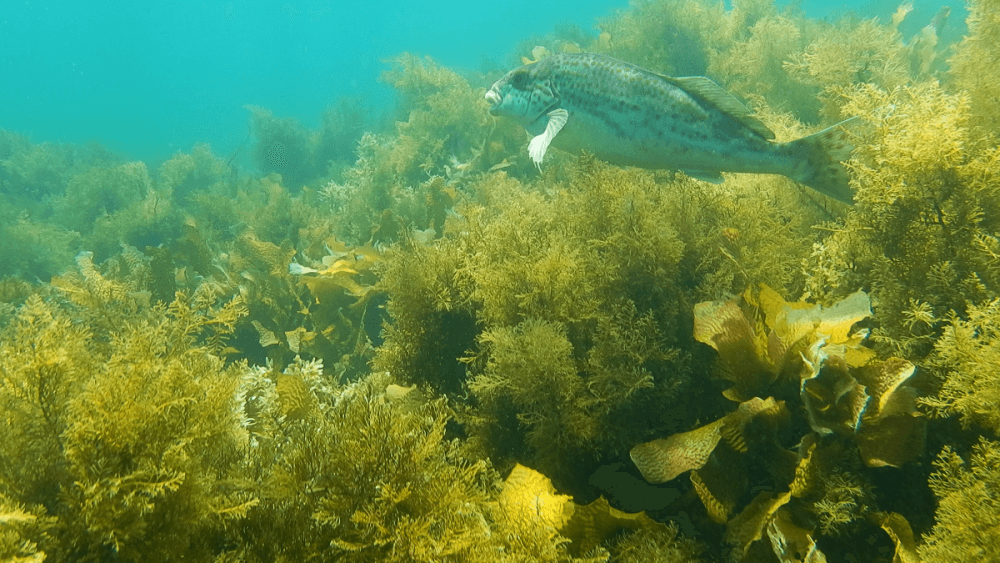
The dive has two distinct character zones that together provide the full site experience. The jetty and anchor chain area runs from the foreshore entry into five to ten metres of water, with the old anchor chain lying along the sandy bottom as an organic navigation reference that divers follow out to the outer marker and back along a natural circular route. The chain itself is encrusted with sponges and ascidians and provides the hard substrate that the macro community depends on in an otherwise sandy environment. Beyond and alongside the jetty, posidonia seagrass beds extend across the bay floor in patches of varying density, interspersed with kelp fronds and the occasional granite boulder. It is in this mixed zone, where seagrass meets kelp, that the sea dragons live. The outer section of the bay, closer to the headlands, opens into a small reef system with swim-throughs, cracks in the granite, and ledges that host the larger reef fish community.
Leafy sea dragons (*Phycodurus eques*) are present at Second Valley in smaller numbers than at Rapid Bay, but the sightings are real and consistent enough to make encounters a reasonable expectation rather than a hopeful possibility. Weedy sea dragons (*Phyllopteryx taeniolatus*) are more reliably seen, typically in the kelp edges and slightly deeper seagrass. Both species are most active during the spring breeding season, when males carrying rows of pink eggs along their tails become visible to careful observers. Giant cuttlefish occupy the site in moderate numbers year round and produce extraordinary colour and pattern displays; their late winter and early spring breeding activity, August through October, brings competitive male behaviours into the jetty area at close range. Blue devils, an endemic temperate reef species, hold territorial positions in the crevices of the outer reef. Southern blue-ringed octopus inhabit the rubble at the base of the jetty and in the boulder fields beyond; they must never be handled, and their venom is serious. Old wives, zebra fish, and various wrasses round out the reef fish community on the rocky outer zones.
Visibility at Second Valley is consistently better than many comparable Gulf St Vincent sites. The bay's partial enclosure reduces sediment disturbance, and six to twelve metres is the typical range in settled conditions, with fifteen to eighteen metres achievable on exceptional days. Water temperature tracks a seasonal range of thirteen to twenty degrees Celsius, with five millimetre wetsuits appropriate for most of the year and seven millimetre preferred for winter dives. Current is generally weak within the bay, though spring tides can produce some movement around the headlands that divers notice as they approach the outer reef. Southerly swell is the primary condition that limits the site; when it pushes into the bay through the mouth, surge reaches the jetty and the entry beach becomes choppy. The best diving window is April through October, when the southerly weather settles and visibility reaches its upper range. The site shuts down only rarely.
Repeat divers develop routine approaches. The seagrass immediately beside the jetty on the north side is the most reliable sea dragon zone, often worked for the first fifteen minutes of the dive. The anchor chain provides the easiest navigation aid for newer divers practising compass and natural navigation, and several Adelaide operators use the site for Advanced Open Water navigation training. The swim-throughs at the southern headland reward patient torch work; small blennies, decorator crabs, and nudibranchs inhabit the shaded granite surfaces. Night dives at Second Valley produce a different community, with cuttlefish hunting in the mid-column and the full decapod community active on the reef edges.
What distinguishes Second Valley is completeness. The jetty, the seagrass, the anchor chain, the boulder field, and the reef swim-throughs together provide a full temperate South Australian dive within a single bay, at beginner depth, with a café open for a late breakfast on the foreshore afterwards. Divers who start here often never find a reason to leave.
Site Access and Logistics
Second Valley is a shore dive with entry from the jetty steps, or via a sandy beach entry adjacent to the boat ramp when swell conditions make the jetty awkward. From Adelaide, drive south on the Main South Road through Normanville, turn off at the Second Valley sign, and follow the road into the valley, approximately ninety minutes total. Free parking is available on the foreshore with public toilets at the caravan park and a boat ramp alongside the jetty.
Open Water certification is appropriate, and the site is well suited to recently qualified divers. The anchor chain route makes an ideal training dive for PADI Advanced Open Water navigation adventures. Sea Dragon Dive Lodge (seadragondivelodge.com.au) is based in Second Valley itself, offering air fills to 230 bar, full equipment hire, accommodation, and guided leafy sea dragon tours. Diving Adelaide (divingadelaide.com.au) runs guided trips to the site from the city. Camping is available at the Second Valley Foreshore Caravan Park; reservation essential in summer.
Sources
- Diving Adelaide, Second Valley - Sea Dragon Dive Lodge, Second Valley - PADI, Second Valley dive site - Department for Environment and Water SA, Leafy sea dragon species profile - National Parks SA, Encounter Marine Park
Visibility at Second Valley
Visibility at Second Valley typically ranges from 8 to 12 metres, though it shifts with swell, wind and recent rainfall. October-March generally offers the best conditions for diving here.
Right now: approximately 12 m, 98% confidence (updated 13:50 AEDT).
View the live forecast and 7-day outlook for Second Valley →
Air, gear and guides near Second Valley
Browse dive shops in Adelaide for fills, hire gear, servicing and guided dives at this site.