SS Mauna Loa
Darwin, NT
SS Mauna Loa
By ScubaDownUnder Team · 2026-05-29
Five hundred metres west of the [USAT Meigs](https://www.scubadownunder.com/dive-sites/usat-meigs), on the same sand floor in the outer reaches of Darwin Harbour, lies the SS Mauna Loa: a US merchant cargo ship sunk in the same morning attack that took the Meigs. The two wrecks are routinely dived as a single two-tank trip, the Meigs as the deeper first dive and the Mauna Loa as the shallower second. Where the Meigs is the largest wreck in the harbour, the Mauna Loa is its sister: smaller, more broken, but lying close enough that a single boat moves divers between the two on consecutive slack windows.
The Mauna Loa was an American cargo ship loaded for the South West Pacific theatre, anchored alongside the Meigs and other vessels of the same convoy when the Japanese attack arrived. Hit during the first wave on the morning of 19 February 1942, she settled in the outer harbour close to her companion. Like the Meigs, the Mauna Loa is part of the Darwin raid's documented wreck cluster and is protected under the Historic Shipwrecks Act 1976. The 19 February attack remains the largest single Japanese strike on Australian soil and the event that anchors Darwin's wartime identity. The Larrakia people are the traditional custodians of the Darwin region.
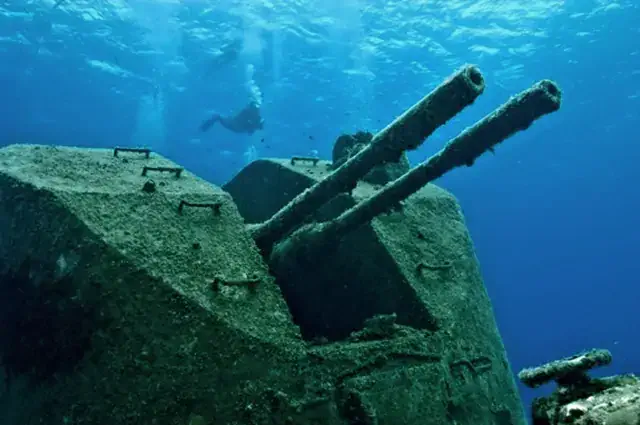
The Mauna Loa is more broken than the Meigs but still substantial. The main hull lies along the sand at 18 to 22 metres, with the upper deck plating partially collapsed and the bow and stern recognisable as discrete sections. Cargo hatches, machinery, hull frames and pipework are visible across the wreck length. The site is dived as a slow circuit at depth with most of the structural interest concentrated in the midships area. Most operators run the Mauna Loa as the second tank of a Meigs trip and tighten the dive profile to manage repetitive depth across the two sites.
Marine life on the Mauna Loa parallels the Meigs: soft coral and sponge encrustation across the metal, schools of fusiliers and trevally working the central wreckage, lionfish along the broken rail edges, scorpionfish lying still on the deck plating. Resident moray eels hold inside the larger machinery spaces. Batfish drift through in small groups. The species list is essentially the Darwin Harbour assemblage that has colonised every metal structure in the outer harbour over eighty years.
Darwin Harbour conditions apply to the Mauna Loa as they do to all the harbour wrecks: tidal range over 8 metres, strong currents outside slack water, visibility 3 to 12 metres typically, water temperature 23 to 30°C across the year. Box jellyfish from October through May. Saltwater crocodile risk year-round. May to October, the Top End dry season, is the working dive window. The Mauna Loa's slightly shallower depth profile makes it the more flexible of the two outer-harbour sites for divers managing repetitive depth or working up to the Meigs across multiple trips.
The Mauna Loa rewards repeat divers willing to slow down and read the broken structure. Deck cargo lying scattered across the sand around the wreck holds artefacts and machinery undisturbed since the sinking. The midships break offers the most photographically interesting section, with collapsed deck plates framing the cargo holds in a way the more intact Meigs does not allow. Penetration is technically possible in some sections but requires appropriate training and is run only by operators with qualified guides.
The Mauna Loa exists in the Meigs's shadow: smaller, more broken, less famous. But the two wrecks were sister ships in the same convoy and lie close on the same sand. For divers planning a Darwin trip, the Meigs is the dive that justifies the journey and the Mauna Loa is the dive that doubles its value.
## Site Access and Logistics
The SS Mauna Loa is a boat dive only and is most often dived as the second tank of a USAT Meigs trip. Standard departure points are Cullen Bay Marina and the Stokes Hill Wharf area, with a transit of around 25 to 30 minutes to the wreck. Most operators run the Meigs and Mauna Loa as a paired two-tank day with a surface interval back at the boat between dives.
Entry is a backward roll from the dive boat onto a fixed line at the wreck. Exit is up the line and re-board over the boat tubes, with safety stops conducted on the line. Surface marker buoy deployment may be required.
Minimum certification is PADI Advanced Open Water with deep diving experience and at least one prior wreck dive. Forty logged dives is a sensible working minimum given the conditions and the typical pairing with the Meigs.
Bookings run through [Dive Darwin](https://divedarwin.com.au) and other Darwin charter operators.
## Sources
- Dive Darwin, Darwin wreck briefings: [https://divedarwin.com.au](https://divedarwin.com.au) - Australian National Shipwreck Database, SS Mauna Loa entry - Northern Territory Heritage Register, [Darwin Harbour wrecks](https://www.scubadownunder.com/dive-sites/darwin-harbour-wrecks) - Australian War Memorial, Bombing of Darwin records: [https://www.awm.gov.au](https://www.awm.gov.au) - Michael McFadyen's Scuba Diving, Darwin wreck references: [http://www.michaelmcfadyenscuba.info](http://www.michaelmcfadyenscuba.info)
Visibility at SS Mauna Loa
Visibility at SS Mauna Loa typically ranges from 3 to 12 metres, though it shifts with swell, wind and recent rainfall. May to October (dry season) generally offers the best conditions for diving here.