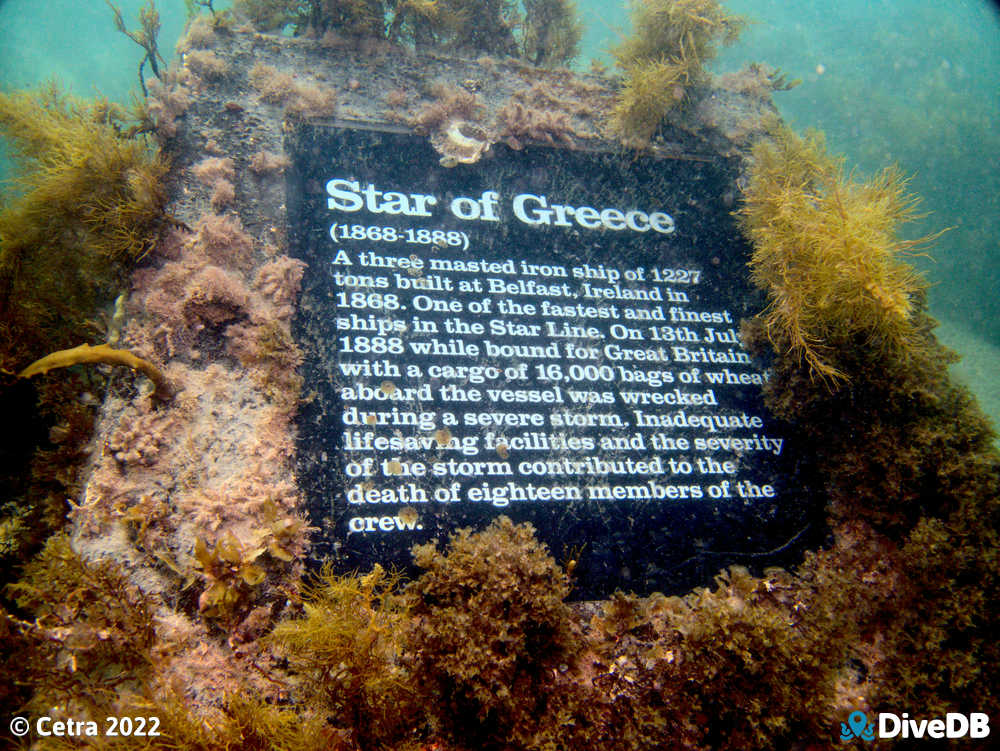
Star of Greece Wreck
Port Willunga, SA
Star of Greece Wreck Dive Site Guide | Port Willunga, SA, Australia
By ScubaDownUnder Team · 2025-07-29
Four metres of clear gulf water stand between the surface and a tangle of iron frames and plates scattered across a reef of coralline algae and kelp, the ribs of a three-masted sailing ship drawn long across the sand in shapes now softened by decades of encrusting growth. A weedy sea dragon drifts past a section of corroded hull. A southern blue devil holds territorial position on the iron, its turquoise body rendered almost luminous against the rust. On the clifftop 750 metres south, diners at a restaurant named for the ship look out across the gulf and, on most days, have no idea that the wreck still lies directly below where they are eating. The Star of Greece is one of the most accessible and atmospheric wreck dives on the South Australian coast, and its combination of history, shallow depth, and reef-integrated debris field makes it one of the state's defining heritage dive sites.
The Star of Greece was a three-masted iron sailing barque of 1,227 tonnes, built at Belfast in 1868, and she was outbound from Port Adelaide with a cargo of grain when she was driven onto the reef at Port Willunga in the early hours of 13 July 1888. The ship struck approximately 200 metres from shore in six metres of water, broken on a reef that experienced coastal navigators knew to avoid, on a night of poor visibility and misread navigation. Of a crew of 28, eighteen were lost. The wreck became one of South Australia's more significant colonial maritime disasters, prompting an inquiry into port signalling and rescue response, and catalysing improvements to coastal rescue infrastructure along the Gulf St Vincent. The site today is a protected historic shipwreck under Commonwealth legislation, and disturbance or removal of artefacts is prohibited.
The dive environment unfolds across a broad debris field that integrates with the natural reef system of Port Willunga's shallow coastal waters. The wreck site sits 750 metres north of the Star of Greece Road car park, reached by a swim along the coastline at two to four metres depth. The substrate transitions between fine sand, scattered reef rubble, and the kelp and coralline algae that cover the reef platform. Ship structures begin to appear as the diver approaches the main wreck site: iron plates half-buried in the sand, hull frames running parallel to the reef in rows of curved members, and the boiler, which stands clear of the surrounding debris with enough residual mass to serve as a navigational anchor point. Maximum depth across the site is around twelve metres at the deeper edges; most of the wreck sits in four to eight metres. All of the iron is heavily encrusted with coralline algae, orange and yellow sponges, and filamentous weed, softening the edges of the original metalwork into reef-adapted structure.
The marine life at the wreck combines temperate reef residents with species that specifically use the iron structure as habitat. Weedy sea dragons drift through the kelp adjacent to the wreck site and can be found with some reliability by divers who spend time in the weed rather than only at the iron. Southern blue devils (*Paraplesiops meleagris*) establish territorial positions on the wreck frames and in the crevices of the reef rock, their intense turquoise colouration making them the most visually striking resident. Giant cuttlefish patrol the boundary between wreck debris and open reef, particularly in late winter and early spring when breeding activity peaks. Port Jackson sharks shelter in the deeper crevices through the winter months, and their eggcases appear tucked into rock overhangs with some consistency. Old wives, zebra fish, sweep, and various wrasses populate the mid-column around the iron, and a population of common octopus inhabits the cavities in the collapsed hull sections. The combination of historical structure, temperate reef community, and shallow clear water gives the site a visual context that purely artificial reef sites cannot replicate.
Conditions at the Star of Greece are defined by swell exposure. The coast here faces west across Gulf St Vincent without offshore island protection, and any westerly swell reaches the beach with the full energy of a 150-kilometre fetch. The wreck is diveable only in genuinely flat conditions; a swell of half a metre or less is the practical upper limit for safe shore entry and comfortable underwater conditions. Visibility ranges from four metres in post-swell stirred conditions to fifteen metres on settled days, with the best clarity arriving in April through October when the winter weather patterns produce extended periods of offshore easterly winds. Water temperature tracks a seasonal range of thirteen to twenty degrees Celsius. A five millimetre wetsuit is adequate for most of the year; seven millimetre is preferable in winter. Current along the reef is generally weak, though the shore approach can be affected by along-shore drift in the afternoon when seabreeze develops. Check the Port Willunga swell forecast before driving to the site; the margin for error is small, and the 750-metre swim out to the main wreck in moving water is genuinely demanding.
Repeat divers develop familiarity with the wreck's geometry. The boiler is the most reliable navigational reference and the obvious starting point for each dive. The stern section and the collapsed hull plates produce the most dramatic compositions for wide-angle photography; the macro life concentrates on the encrusted iron frames near the boiler. The kelp fringes at the edges of the debris field hold the weedy sea dragons that reward divers willing to drift slowly rather than tour the iron at pace. Night dives at the site are possible in settled conditions and reveal a different community, with crayfish emerging from the iron cavities and octopus active on the reef edges, though the exposed entry and swim-out make night dives here a commitment requiring experienced planning.
The Star of Greece is a dive that reaches across 138 years of local maritime history to produce a shallow, living reef in clear water. The drowned ship, the lost crew, the subsequent reform of coastal rescue, and the cliff-top restaurant that carries her name are all still present in the site in different ways. Each dive ends with a walk back along a beach where, in the late afternoon light, the clifftop café looks down over water that has reclaimed its own.
Site Access and Logistics
The Star of Greece is a shore dive accessed from Port Willunga, approximately 35 kilometres south of Adelaide via the Southern Expressway and Main South Road. The preferred access point is the sandy car park at the western end of Star of Greece Road, directly on the beach below the cliff-top café. From the car park, gear up on the beach and walk or swim north approximately 750 metres along the coastline to the wreck site. The cliff-top car park on The Esplanade is an alternative; descend to the beach via the cliff path. Public toilets are available at the Port Willunga foreshore reserve. The Star of Greece restaurant on the clifftop is a South Australian institution and a genuinely worthwhile post-dive destination.
Open Water certification is appropriate but the exposed entry, long swim-out, and shallow reef conditions make the site better suited to divers with post-certification experience and confidence in moderate surface swims. A surface marker buoy is strongly recommended; boat traffic on the coast is present on summer weekends. A 5mm wetsuit is adequate for most of the year; 7mm in winter. Tank fills are not available at Port Willunga; plan fills from Adelaide before travel. Diving Adelaide (divingadelaide.com.au) runs guided trips to the wreck and is the authoritative operator for the site.
Sources
- Diving Adelaide, Star of Greece Wreck - Diving Adelaide, Diving into History at the Star of Greece Shipwreck - Department for Environment and Water SA, Historic shipwrecks register - History Trust of South Australia, Star of Greece - South Australian Trails, Adelaide's Underwater Heritage Trail
Visibility at Star of Greece Wreck
Visibility at Star of Greece Wreck typically ranges from 8 to 12 metres, though it shifts with swell, wind and recent rainfall. November-March generally offers the best conditions for diving here.
Right now: approximately 12 m, 98% confidence (updated 13:51 AEDT).
View the live forecast and 7-day outlook for Star of Greece Wreck →
Air, gear and guides near Star of Greece Wreck
Browse dive shops in Adelaide for fills, hire gear, servicing and guided dives at this site.