USAT Meigs
Darwin, NT
USAT Meigs
By ScubaDownUnder Team · 2026-05-29
Two hundred metres east of Talc Head in Darwin Harbour, on a sand floor at twenty-eight metres, the largest casualty of the 19 February 1942 Japanese raid sits broadly upright in the dark green water. The USAT Meigs was a US Army transport of 12,500 tons and over 130 metres in length, the biggest ship lost in the attack, and today she remains the biggest dive-able [wreck](https://scubadownunder.com/blog/best-wreck-dives-in-australia) in Darwin Harbour. The diving here is technical: tight slack-water windows, strong tide-driven current, limited visibility, and a depth profile that puts most of the structure beyond Open Water limits. The reward is a single intact ship, eighty years on the sand, almost intact in profile.
On 19 February 1942 Darwin became the first Australian city to come under sustained foreign attack since European settlement, when 188 Japanese aircraft launched two raids on the harbour and town. The Meigs was anchored in the outer harbour, loaded for the South West Pacific theatre, when the first wave of Aichi D3A dive bombers and Mitsubishi A6M fighters arrived just before ten in the morning. She was hit by multiple bombs in rapid succession, caught fire, and sank within minutes. The Darwin attack sank or damaged thirty ships across the harbour and killed at least 235 people, the largest single Japanese strike on Australian soil. The Meigs is part of that record and is protected under the Historic Shipwrecks Act 1976. The Larrakia people are the traditional custodians of the Darwin region.
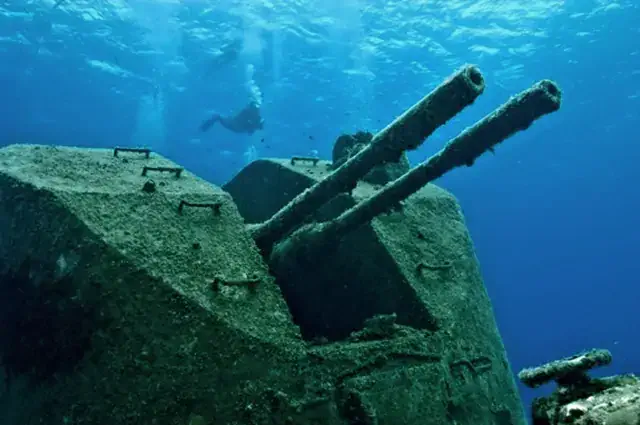
The Meigs lies on a sand floor in Darwin Harbour outer waters, broadly intact and oriented along the line of her sinking. The main deck reaches up to twenty metres at the highest point and the keel sits at twenty-eight, with the superstructure collapsed onto the deck and the cargo holds now open to the water column. Operators drop divers on a fixed line tied to a recognisable feature near the bow, and standard dive plans run a single circuit of the upper deck level rather than penetrating the holds. The hull plating is heavily encrusted with soft coral, sponges and barnacle growth. Cargo hatches, deck winches, anchor chains and the remains of deck guns are recognisable through the encrustation. The wreck's size means a single dive samples one section: most divers come back over multiple trips to work through the bow, midships and stern in turn.
The Meigs is now reef habitat as much as historical structure. Soft coral, sponge and ascidian cover the iron in dense, colourful layers that contrast hard with the dark surrounding water. Schools of trevally and snapper work the upper deck and the open holds. Lionfish hover along the rail edges and inside the wreckage in their familiar fan-spread, and scorpionfish lie motionless on the deck plating where their camouflage is total. Batfish drift in slow groups around the superstructure. Resident moray eels live inside the larger pipework and machinery spaces. Reef sharks pass through occasionally on tide change, and large rays cruise the sand around the perimeter. The marine life is rich for tropical wreck conditions, and the Meigs reads as a productive artificial reef as much as a historic site.
Darwin Harbour produces some of the most challenging recreational dive conditions in Australia. Tidal range exceeds 8 metres, and the resulting tidal currents through the harbour can be fierce: outside the brief slack water window at the top and bottom of each tide, currents are strong enough to make the dive impractical. Operators time entries to slack water and pull divers out before the next flow runs. Visibility in the harbour typically runs 3 to 10 metres, with the cleanest water on incoming tides during the dry season. Heavy rain and runoff during the wet season can drop visibility to under 2 metres for days. Water temperature ranges from around 23°C in July to 30°C in December. A 3mm wetsuit is comfortable across the year. Box jellyfish are present from October through May and dictate full coverage during those months. Saltwater crocodile risk in Darwin Harbour is real and ongoing. May to October, the Top End dry season, is the working dive season.
Repeat divers on the Meigs find the ship's scale rewards careful work along its length. The bow section holds the chain locker and anchor windlass, intact enough to read clearly through the encrustation. The midships cargo holds, when penetrated under appropriate training, hold artefacts and machinery undisturbed since the sinking. The stern holds the propeller shaft and rudder structure. Photographers find the dark green water against the colourful coral encrustation produces a distinctive Darwin Harbour aesthetic that contrasts with the blue-water wreck photography most Australian divers chase. Penetration diving on the Meigs is run by some operators with appropriate certification and is best treated as an independent dive plan rather than a casual extension of the recreational profile.
The Meigs is the dive that anchors Darwin Harbour's wreck story. Eighty years after the raid that sank her, she remains the biggest single ship lost on Australian soil to enemy action and the most substantial dive-able war wreck on the Australian coast. The diving is harder than most Australian wreck dives. The historical weight is heavier than most. For divers prepared to manage the conditions, the Meigs is the reason Darwin shows up on the national wreck-diving map at all.
## Site Access and Logistics
The USAT Meigs is a boat dive only. Standard departure points are Cullen Bay Marina and the Stokes Hill Wharf area, with a transit of around 20 to 30 minutes to the wreck. Several Darwin charter operators run regular trips, with most dives planned around the slack water window dictated by the local tide.
Entry is a backward roll from the dive boat onto a fixed line tied to a recognisable feature on the wreck, with a controlled descent down the line into the visible structure. Exit is up the line and re-board over the boat tubes, with safety stops conducted on the line in any current. Surface marker buoy deployment may be required if divers are pushed off the wreck during ascent.
Minimum certification is PADI Advanced Open Water with deep diving experience. Fifty logged dives is a sensible working minimum, and divers should have prior experience with current diving and limited-visibility conditions. Penetration of the cargo holds requires wreck diving certification and is run only by operators with qualified guides.
Bookings, gear hire and accommodation packages run through Darwin charter operators including [Dive Darwin](https://divedarwin.com.au).
## Sources
- Dive Darwin, Darwin Harbour wreck charters: [https://divedarwin.com.au](https://divedarwin.com.au) - Australian National Shipwreck Database, USAT Meigs entry: [https://www.environment.gov.au/heritage/historic-shipwrecks](https://www.environment.gov.au/heritage/historic-shipwrecks) - Northern Territory Heritage Register, [Darwin Harbour wrecks](https://www.scubadownunder.com/dive-sites/darwin-harbour-wrecks) - Australian War Memorial, Bombing of Darwin records: [https://www.awm.gov.au](https://www.awm.gov.au) - Department of Defence, Defending Australia, Darwin 1942 documentation - Michael McFadyen's Scuba Diving, Darwin wreck references: [http://www.michaelmcfadyenscuba.info](http://www.michaelmcfadyenscuba.info)
Visibility at USAT Meigs
Visibility at USAT Meigs typically ranges from 3 to 12 metres, though it shifts with swell, wind and recent rainfall. May to October (dry season, surface conditions) generally offers the best conditions for diving here.