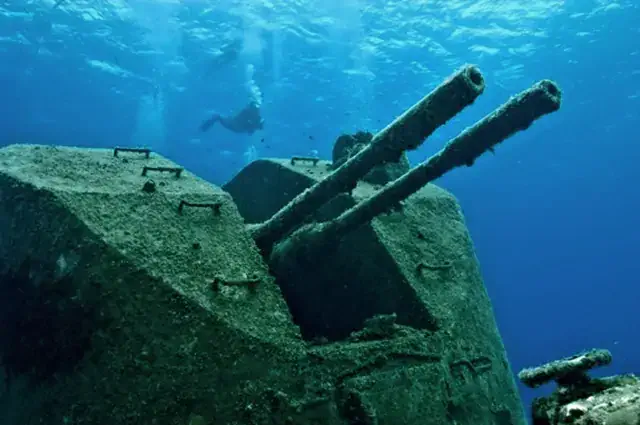
Darwin Harbour Wrecks
Darwin, NT
Darwin Harbour Wrecks Dive Guide
By ScubaDownUnder Team · 2025-09-21
# [Darwin Harbour Wrecks](https://www.scubadownunder.com/dive-sites/darwin-harbour-wrecks)
On the morning of 19 February 1942, 188 Japanese aircraft launched two raids on Darwin Harbour and the surrounding township. The attack sank or damaged thirty ships across the harbour, destroyed a flight of moored Catalina patrol aircraft, and killed at least 235 people. It was the first sustained foreign attack on an Australian city since European settlement and remains the largest single Japanese strike on Australian soil. Eighty years later, the wrecks left on the harbour floor that morning are still down there: the largest concentration of war-era dive-able shipwrecks on the Australian coast, scattered across an inner and outer harbour that combines tropical water, an 8-metre tidal range and visibility that runs from useful to almost zero depending on the day.
The Larrakia people are the traditional custodians of Darwin Harbour and the wider region, and the wrecks themselves sit within a working harbour that remains a major commercial and naval port today. All wrecks are protected under the Historic Shipwrecks Act 1976: divers must not move material, recover artefacts or interfere with structure. Some sites are war graves with stricter restrictions still.
Diving the harbour is technical but accessible. Conditions are governed entirely by the tide, with tight slack-water windows constraining each dive to 30 to 60 minutes. Visibility runs 3 to 12 metres typically and drops sharply on outgoing tide and after wet-season runoff. Water temperature ranges from around 23°C in July to 30°C in December, comfortable in a 3mm wetsuit year-round. Box jellyfish are present from October through May. Saltwater crocodile risk is real and ongoing; surface support and observation are part of every dive plan. The working dive season is May through October during the Top End dry.
The wrecks below are listed roughly by depth and accessibility. Each has its own review article with full conditions, history, marine life and operator briefing.
## The dive-able wrecks
### Darwin Catalinas
Four PBY Catalina flying boats moored at the Darwin flying boat base were strafed and sunk during the attack. The aircraft sit in 5 to 15 metres of water across the inner harbour and are the only aircraft wrecks in the cluster, the shallowest of the dive-able sites and the most accessible for divers building experience toward the deeper ship wrecks.
[Read the Darwin Catalinas review](https://www.scubadownunder.com/blog/darwin-catalinas)
### [Kelat](https://www.scubadownunder.com/dive-sites/kelat)
The oldest of the Darwin wrecks. A four-masted iron sailing barque built in Glasgow in 1881, decommissioned and moored in Darwin as a coal hulk in the early twentieth century, sunk during the 1942 raid. The hull lies in 12 to 18 metres of water with the iron lines and lower mast structure still recognisable, the most distinctively pre-war ship in the harbour.
[Read the Kelat review](https://www.scubadownunder.com/blog/kelat)
### MV Neptuna
The Norwegian motor freighter exploded alongside Stokes Hill Wharf when bombing ignited her cargo of depth charges. The blast was the largest single event of the raid, killed 45 wharf labourers and crew, and scattered the ship across an 80-by-40-metre debris field at 14 to 20 metres just off the modern wharf. The most heavily fragmented of the major wrecks and the one most defined by the manner of its sinking.
[Read the MV Neptuna review](https://www.scubadownunder.com/blog/mv-neptuna)
### [British Motorist](https://www.scubadownunder.com/dive-sites/british-motorist)
A British Empire tanker, hit during the first wave of the attack and burning when she sank into the inner harbour. The fire and the subsequent decades of tidal action have broken the wreck more thoroughly than any other major Darwin casualty. The site reads as a debris field at 16 to 22 metres with hull plating, pipework, machinery and tank fragments scattered across the sand.
[Read the British Motorist review](https://www.scubadownunder.com/blog/british-motorist)
### SS Mauna Loa
US merchant cargo ship anchored alongside the [USAT Meigs](https://www.scubadownunder.com/dive-sites/usat-meigs) in the same convoy when the attack arrived. Hit during the first wave and settled in the outer harbour close to her companion. The hull lies along the sand at 18 to 22 metres, more broken than the Meigs but still substantial. Routinely dived as the second tank of a Meigs trip on the same slack-water day.
[Read the SS Mauna Loa review](https://www.scubadownunder.com/blog/ss-mauna-loa)
### SS Zealandia
Australian passenger and cargo steamship with a longer history than most Darwin wrecks. Built in Glasgow in 1910, the Zealandia worked the Sydney to Wellington passenger route for thirty-two years before her requisition for war service. Hit during the 1942 attack and now lies in two main sections in 18 to 24 metres in the outer harbour. The midships break is the most photographically distinctive feature in the cluster.
[Read the SS Zealandia review](https://www.scubadownunder.com/blog/ss-zealandia)
### USAT Meigs
Largest casualty of the raid and the biggest dive-able wreck in Darwin Harbour. The 12,500-ton US Army transport sits broadly upright on a sand floor at 28 metres in the outer harbour, over 130 metres in length and broadly intact in profile. Cargo hatches, deck winches, anchor chains and the remains of deck guns are all recognisable through eight decades of soft coral and sponge encrustation. Technical conditions, Advanced Open Water minimum.
[Read the USAT Meigs review](https://www.scubadownunder.com/blog/usat-meigs)
## The war grave
### USS Peary
The American destroyer USS Peary was lost with 91 crew during the first wave of the attack, the largest single loss of life at sea during the raid. The wreck lies in deeper water in the outer harbour and is a designated war grave under Australian Federal and US Navy protocols. Recreational diving on the Peary is prohibited. The wreck is included in the historical record of the harbour cluster but is not a dive-able site, and is mentioned here for completeness rather than as a planning option.
## Conditions and logistics
All Darwin Harbour wrecks share the same operating conditions: tidal range over 8 metres, strong tide-driven currents outside the brief slack-water window, visibility 3 to 12 metres typically, water temperature 23 to 30°C across the year, box jellyfish October to May, and saltwater crocodile risk year-round. The dry season from May to October is the working dive window.
All sites are boat dives. The standard departure point is Cullen Bay Marina, with shorter transits to the inner-harbour sites (Catalinas, Kelat, Neptuna, British Motorist) and longer transits to the outer-harbour sites (Mauna Loa, Zealandia, Meigs). Several Darwin charter operators include the wrecks in their rotation, with bookings, gear hire, drysuit rental and accommodation packages available through [Dive Darwin](https://divedarwin.com.au) and other operators.
Minimum certification varies by site. The shallowest Catalina and the Kelat are suitable for PADI Open Water with current-diving experience and a guided briefing. The deeper outer-harbour wrecks require Advanced Open Water with deep diving experience and at least 40 to 50 logged dives. Wreck penetration on any site requires wreck diving certification and a qualified operator guide. Surface marker buoy deployment is mandatory at all sites due to harbour traffic.
## Sources
- Dive Darwin, Darwin wreck briefings: [https://divedarwin.com.au](https://divedarwin.com.au) - Australian National Shipwreck Database, Darwin Harbour entries: [https://www.environment.gov.au/heritage/historic-shipwrecks](https://www.environment.gov.au/heritage/historic-shipwrecks) - Northern Territory Heritage Register, Darwin Harbour wrecks - Australian War Memorial, Bombing of Darwin records: [https://www.awm.gov.au](https://www.awm.gov.au) - Department of Defence, Defending Australia, Darwin 1942 documentation - Michael McFadyen's Scuba Diving, Darwin wreck references: [http://www.michaelmcfadyenscuba.info](http://www.michaelmcfadyenscuba.info)
Live Visibility Forecast for Darwin Harbour Wrecks
Darwin Harbour Wrecks is a Viz Check tracked dive site. View today's forecast and the 7-day visibility outlook on the live forecast hub, updated daily from observed conditions and seasonal models.