Hippolyte Rocks
Tasman Peninsula, TAS
Hippolyte Rocks
By ScubaDownUnder Team · 2026-05-02
Five kilometres off the dolerite columns of the Tasman Peninsula, two rocky pinnacles rise from open ocean and break the southern Tasman Sea. Hippolyte Rocks is a small place by surface measure, a pair of weather-stained columns and a haul-out for fur seals, but the underwater terrain that drops from their base into the cold green Tasmanian water is among the richest temperate diving on the Australian coast. The fur seals are the headline. The sharks, the kelp gardens, the crayfish and the dolerite walls are why divers stay long enough to make the boat ride worth the trip.
Hippolyte Rocks sits within a Tasmanian Wildlife Sanctuary, recognising the islands as a major Australian fur seal breeding colony with hundreds of animals using the rocks year-round. The surrounding waters fall within the broader Tasman National Park marine boundaries, with restrictions on take and disturbance. The Tasman Peninsula falls within the country of the palawa people of lutruwita, whose connection to this coast and its waters predates European arrival by tens of thousands of years. The dolerite cliffs and offshore stacks of the peninsula are some of the most dramatic in the country, formed by Jurassic basalt intrusions and weathered into the columnar geometry visible above and below the water. Recreational diving at Hippolyte has been run from Eaglehawk Neck for decades, and the site sits at the centre of the Tasmanian dive year for divers travelling from the mainland.
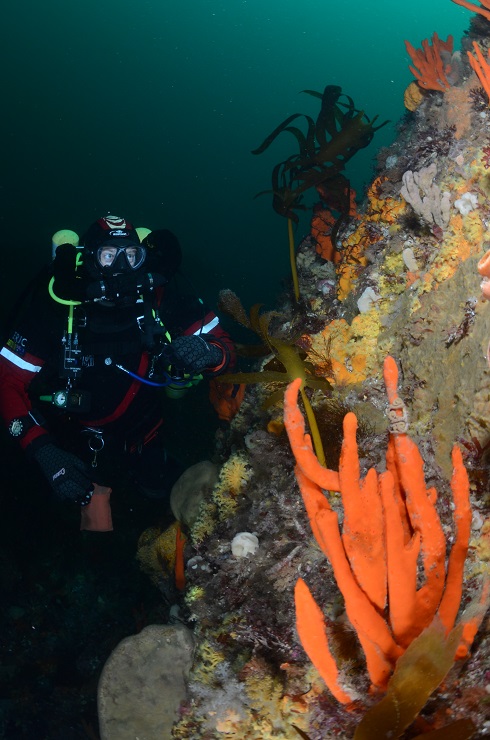
The two rocks rise from a base at around 30 metres and shoulder upward into the splash zone of Tasmanian Sea swell. Most dive plans start with a giant stride from the boat near the western face, where conditions are usually lightest. Descent runs down a steep dolerite wall, fluted in vertical columns the size of telegraph poles, and the first species to register are usually the fur seals, who arrive curious within the first minute and orbit divers through the descent. The wall drops in stepped terraces past 25 metres into deeper water that operators discourage divers from exploring on a recreational profile. The terrain on the rocks themselves is bull kelp on the upper crowns, transitioning to common kelp gardens through the mid-water, and bare dolerite with sponge encrustation and sea whips on the deeper walls. Crayfish wedge into the deeper crevices. The water itself is the substrate for the headline experience: a green-black Tasmanian backdrop that turns the seal action into theatre.
The Australian fur seal colony at Hippolyte is the reason most divers make the trip. Hundreds of seals use the rocks across the year, with peak in-water activity through summer when juveniles work the water around the base of the colony. The seals are curious and confident, often passing within a metre of divers, blowing bubbles and weaving in close arcs that read as play behaviour. Bulls during the breeding season from October through December are larger, slower and more territorial, and operators brief divers on holding still and letting the bulls pass. Broadnose sevengill sharks are the second headline species: ancient-looking sharks with the long bodies and primitive jaw structure that make them one of the most photographed species in Tasmanian waters. Sightings are most reliable in winter and shoulder seasons. Bull rays cruise the sand patches at the deeper transitions, and large schools of jackass morwong, butterfly perch and trumpeter work the mid-water. Giant Maori octopuses, the largest octopus species in Australian waters, hold dens in the deeper crevices and emerge to hunt at dusk. Long-snout boarfish and southern blue devils round out the fish list.
Visibility at Hippolyte typically runs 10 to 20 metres and can reach 30 metres on the best days, when the water column has settled and there is no plankton bloom. Tasmanian water carries more particulate than tropical water and the green tint is permanent: divers visiting from the mainland adjust their expectations from blue to green. Water temperature ranges from around 11°C in August to 18°C in February. A drysuit is the comfortable choice across all seasons; experienced divers run 7mm semi-dry through summer. Currents around the rocks vary by tide and offshore movement, with the western face usually sheltered and the eastern face often current-swept enough that operators dive it only on slack water. Surface conditions close the site frequently: anything over 2 metres of swell or 20 knots of southerly wind makes the boat trip impractical. Summer through autumn, November to April, is the working season for visiting divers, with the calmest seas and warmest water. Winter delivers the best shark sightings and the clearest water but adds layers of weather risk.
Beyond the seals and the sevengills, Hippolyte rewards divers prepared to read the temperate substrate carefully. The bull kelp on the upper crowns hides juvenile fish and small octopuses, and the seasonal die-back through summer exposes dolerite ledges that hold morwong and crayfish. The deeper sponge gardens at 20 to 25 metres host large basket stars that emerge after dark, and the dolerite columns themselves are sculpture: textured by encrustation and worth a slow circuit on the safety stop. Photographers working the seals find that backlit silhouettes against the surface produce the most consistent results, and that the same juveniles can be relocated on consecutive days within a single trip. Dwarf minke whales and southern right whales pass the site during migration and have been encountered on transit. White sharks are recorded in the broader area but in-water encounters at the rocks are rare.
Hippolyte Rocks sits at the limit of recreational diving in southeast [Tasmania](https://scubadownunder.com/blog/best-places-to-dive-in-tasmania), far enough offshore to demand a settled forecast and exposed enough to be lost to weather more often than not. The reward for the boat trip is a kind of diving that the warmer Australian coast does not offer: cold, green, dolerite-walled water with hundreds of fur seals as casual hosts. For divers who chase temperate experiences, Hippolyte is the site that defines the Tasmanian east coast.
## Site Access and Logistics
Hippolyte Rocks is a boat dive only. The standard departure point is Pirates Bay at Eaglehawk Neck, with a transit of 25 to 35 minutes depending on sea state. Charters run almost exclusively through Eaglehawk Dive Centre, the long-established operator on the peninsula and the only operator with consistent year-round access to the site.
Entry is a backward roll or giant stride from the dive boat at one of the seasonal moorings on the western face. Exit is a controlled ascent to the boat with safety stops conducted near the hull. Conditions on the day determine which face of the rocks the operator dives and whether the dive is run as a circuit or out-and-back along the wall.
Minimum certification is PADI Advanced Open Water with cold-water and drysuit experience. Fifty logged dives is a sensible working minimum. Drysuits are available for hire through the operator and are recommended even in the warmest months. Nitrox is available and recommended for divers planning multiple dives across consecutive days.
Bookings, gear hire, drysuit rental and accommodation packages all run through [Eaglehawk Dive Centre](https://www.eaglehawkdive.com.au) at Pirates Bay.
## Sources
- Eaglehawk Dive Centre, site description and seasonal briefings: [https://www.eaglehawkdive.com.au](https://www.eaglehawkdive.com.au) - Parks Tasmania, Tasman National Park information: [https://parks.tas.gov.au](https://parks.tas.gov.au) - Department of Natural Resources and Environment Tasmania, Wildlife Sanctuary listings and fur seal management - Institute for Marine and Antarctic Studies (IMAS), University of Tasmania, broadnose sevengill shark research - Michael McFadyen's Scuba Diving, Tasmanian dive site references: [http://www.michaelmcfadyenscuba.info](http://www.michaelmcfadyenscuba.info) - Australian Museum, Australian fur seal and giant Maori octopus species pages
Visibility at Hippolyte Rocks
Visibility at Hippolyte Rocks typically ranges from 10 to 25 metres, though it shifts with swell, wind and recent rainfall. December to April generally offers the best conditions for diving here.
Right now: approximately 15 m, 98% confidence (updated 23:21 AEST).
View the live forecast and 7-day outlook for Hippolyte Rocks →