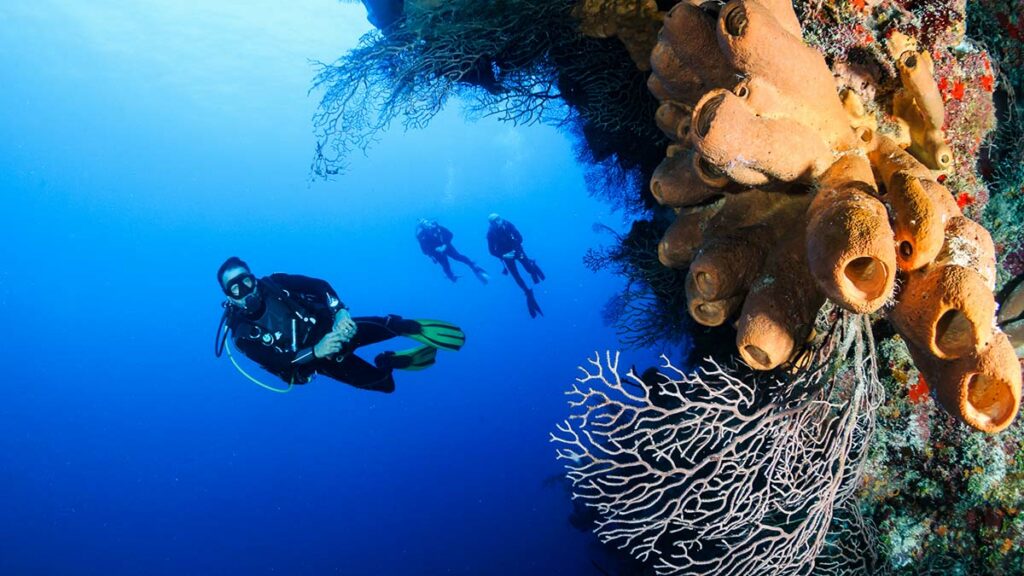
Bare Island Deep Wall
La Perouse, NSW
Bare Island Deep Wall Dive Guide, La Perouse
By ScubaDownUnder Team · 2026-10-18
Five minutes' swim south-west of Bare Island's western point, the gently sloping kelp reef simply runs out. An obvious crack opens in the rock floor, then the bottom steps down more than three metres onto sand at 18 metres, and the face of that step carries some of the most colourful sponge growth in Sydney. Boulders sit out on the sand, thick with growth and weed, and somewhere in that weed, swaying a fraction out of time with the surge, there is very likely a pygmy pipehorse no longer than three centimetres.
This is the Bare Island Deep Wall, the deepest and most demanding of the many shore dives around Bare Island. Michael McFadyen, who has logged more than 700 dives at the island and documented its reefs route by route, calls it "a fantastic dive site, one of the best in Sydney". It also punishes casual planning: long swims, currents that can defy the tide tables and reefs that look alike in poor visibility.
Bare Island lies off La Perouse on the northern shore of Botany Bay, about 20 kilometres from the centre of Sydney, joined to the headland by a 110-metre timber bridge built in 1887, and forms part of Kamay Botany Bay National Park. The shallower routes and history are covered in our Bare Island dive guide. The Deep Wall is the outer edge of the island's reef off its western and south-western side, where rock meets sand at 18-19 metres, at roughly 33.9928° S, 151.2297° E by McFadyen's GPS mark. Every seahorse, seadragon, pipefish and pipehorse here is protected under the NSW Fisheries Management Act 1994. Critically, NSW National Parks and Wildlife Service closed the whole Bare Island precinct, including the access road, bridge, rock shelf and fort, from 24 August 2026 for a bridge restoration expected to run until late 2027. Every shore route McFadyen describes to the Deep Wall starts and finishes on the island, so the wall is out of reach for shore divers until the bridge reopens.
In normal times the classic approach starts at the Western Point, the far end of the island's rock platform, where the water is too shallow for a giant stride. Divers flop in, swim about 15 metres out and descend onto kelp-covered rock in 2 metres. Heading south-west, the bottom deepens to 8 metres within two minutes, levels briefly, then slopes gently to about 15 metres as kelp gives way to sand and sponge-dotted rock. Around five minutes from the descent, just past the crack, the reef ends at the Deep Wall proper: a prominent drop with overhangs, cracks and a small cave, the sand at 18 metres and 20 metres on a big high tide. Isolated rocks dot the sand off the wall.
On a first dive, McFadyen's advice is to turn right and follow the wall north-west, checking the sea tulips for big-belly seahorses. The wall bends right and fades into the sand at about 17 metres, where small overhangs sometimes shelter blue devilfish. A sandy gully then leads north past Red Indianfish Reef, a low, flat reef covered in sea whips, to a concrete block where fine-lined tambjas and Verco's tambja sometimes appear, with spiny gurnards often on the sand nearby. A short crossing north reaches 15 Metre Reef, a low ridge of sponges, sea whips, sea fans and sea tulips, and another 10 metres of sand brings divers to Sea Horse Corner at about 14 metres, where the main reef leads back to the exit beside the bridge. The loop takes at least 55 to 60 minutes; McFadyen allows around 80 and recommends a large tank.
Pygmy pipehorses are the headline act. McFadyen reports finding them on every dive here, usually on the weedy rocks scattered off the wall. They measure about 5 to 30 millimetres, red or red and white, and are one of three syngnathid species found only in NSW. The trick is to get low and watch for a frond moving out of step with the surge; once found, an individual often stays put for a month or two. Australian red Indianfish are the other prize, so well matched to the sponges that divers swim straight past them, and McFadyen once counted six along the wall on a single night dive. Cuttlefish tuck themselves into sponges and dwarf firefish have been photographed on the wall. Weedy seadragons were once regulars, but McFadyen now writes about them in the past tense, so a sighting is a bonus. Port Jackson sharks turn up along the top of the reef in spring, and the wider fish list includes old wives, red morwong, maori wrasse, pineapplefish, octopus and moray eels. McFadyen has even recorded grey nurse sharks and a seal here, although divers wanting reliable grey nurse encounters head to Magic Point.
The Deep Wall needs flat water. McFadyen calls for extremely calm seas at the Western Point, where waves can wash across the platform at high tide even on a calm day, and Abyss Scuba Diving advises changing plans whenever southerly or south-easterly swell is causing wash or surge at the entry. Unlike the shallow routes, this dive is shaped by the tide. An incoming tide is preferred, and currents in the 16-19 metre band can run opposite to the prediction, including outgoing flow on a supposedly incoming tide. High tide generally brings the least current and the best visibility. McFadyen has recorded 20 metres or more on the deeper reef, but prolonged heavy rain can cut visibility to one or two metres. Across his Sydney logbook, June to August brings the clearest water, with May and September close behind, while October and November are the murkiest. Abyss puts the water at about 15°C in the cooler months and around 24°C in summer; many Sydney divers wear a 5-7 mm wetsuit, adding a hood in winter.
Repeat divers come back for the details. Pygmy pipehorses are easier to find at night, when a torch catches the glint of their eyes, and McFadyen's group often dives the wall after dark; he also finds pygmies more common from late spring to early autumn. Immediately south of the Western Point, about 15 metres off the main wall, The Bubbles, the floats of an old trawl net still holding loops of rope above the sand at 18-19 metres, mark small boulders where pygmies are usually close by. When an outgoing current makes the deep section hard work, McFadyen's fallback is the Not So Deep Wall at about 14 metres. The most ambitious variation is the Deep Wall Drift, entered from the island's south-eastern point on an incoming tide, past sections where the wall rises four to five metres and boulders form canyons. McFadyen rates it probably one of Sydney's top two shore dives, but only for divers with 100 or more dives, and never on an outgoing tide.
The Deep Wall is where Bare Island stops being a gentle macro pottering ground and asks for a planned route, a watched gauge and respect for water that moves on its own schedule. Those who do the shallower dives first, learn the landmarks and wait for a flat morning on a rising tide find a sponge-lined edge where some of Sydney's smallest animals live in the island's biggest scenery. With the bridge closed into 2027, it is a dive to plan now and enjoy on the first calm day after the island reopens.
Site Access and Logistics
Bare Island sits just off Anzac Parade at La Perouse. McFadyen advises parking on the edge of Anzac Parade above the island and checking the water from the headland; parking fills quickly on weekends. In normal times this is a shore dive: walk across the bridge to the Western Point (or the pool just inside it when the point is rough), enter there and exit at the boat ramp immediately right of the island end of the bridge. The Western Point is an entry only. Until the NPWS bridge restoration finishes (completion is scheduled for late July 2027, with reopening expected late 2027), the island, bridge, access road and rock shelf are fenced off and McFadyen lists the Deep Wall as not diveable. Treat Advanced Open Water certification as the minimum, as the wall sits at 18-20 metres, and McFadyen recommends several shallower Bare Island dives first or a buddy who knows the site well. Abyss Scuba Diving in Ramsgate runs guided Sydney shore dives and publishes daily conditions, including current Bare Island access advice. For a gentler La Perouse macro dive, see our Frenchmans Bay guide.
Sources
- Michael McFadyen: Bare Island Deep Wall - Michael McFadyen: Bare Island Deep Wall Drift - Michael McFadyen: Bare Island geographical definitions - NSW Environment and Heritage: Bare Island bridge repairs - Abyss Scuba Diving: Bare Island dive site guide - NSW DPIRD: Syngnathiformes, protected seahorses, seadragons and pipehorses
Header photo: A southern sea fan (Sphaerokodisis australis) at Bare Island, La Perouse, by John Turnbull, CC BY-SA 2.0, via Wikimedia Commons.

Visibility at Bare Island Deep Wall
Visibility at Bare Island Deep Wall typically ranges from 5 to 15 metres, though it shifts with swell, wind and recent rainfall. May-September, flat seas, incoming or high tide generally offers the best conditions for diving here.
Right now: approximately 7 m, 98% confidence (updated 10:35 AEDT).
View the live forecast and 7-day outlook for Bare Island Deep Wall →
Air, gear and guides near Bare Island Deep Wall
Browse dive shops in Sydney for fills, hire gear, servicing and guided dives at this site.