Dive Sites Near Darwin
7 dive sites in and around Darwin, NT, nearest first, with the depth, skill level and conditions for each one.
Darwin's diving is wreck diving with a history. On 19 February 1942, Japanese aircraft attacked the ships in Darwin Harbour, and their remains are now the city's dive sites: the US Army transport USAT Meigs, the largest, with the SS Mauna Loa beside it, the troopship SS Zealandia, and the Catalina flying boats sunk at their moorings. Salvors cut many of the hulls down in 1959 and 1960, leaving lower hulls and debris fields.
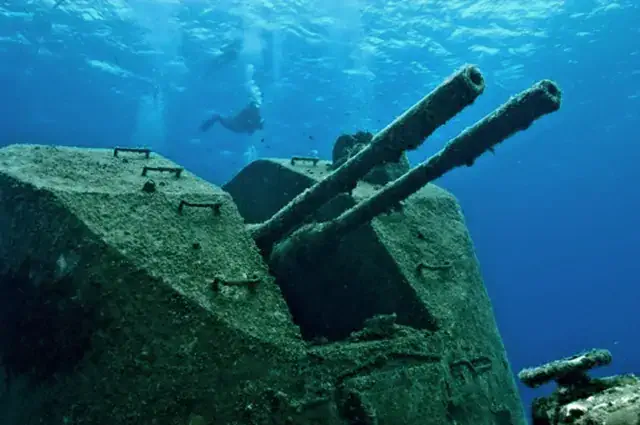
Darwin Catalinas
Darwin, NT
Cluster of four PBY Catalina flying boats strafed and sunk at their moorings during the 19 February 1942 raid, the shallowest of the Darwin wreck dives.
View dive site →
British Motorist
Darwin, NT
A 1924 tanker bombed while refuelling USS Peary in the 1942 Darwin raid; refloated by salvors in 1959, she left an 18m debris field with live shells.
View dive site →
SS Zealandia
Darwin, NT
A Huddart Parker liner and two-war troopship, bombed at anchor in the 1942 Darwin raid and salvaged in 1960, now on her side in 22m off East Arm.
View dive site →
Darwin Harbour Wrecks
Darwin, NT
The wrecks of the 1942 Darwin air raid, cut down to their lower hulls by salvors in 1959-60, are dived on guided permit trips to sites like the Mauna Loa at 19m.
View dive site →
Kelat
Darwin, NT
An 1881 iron sailing ship turned Navy coal hulk that sank at her East Arm moorings days after the 1942 raid; salvors left about 70m of ship floor in 10m.
View dive site →
USAT Meigs
Darwin, NT
Largest casualty of the 19 February 1942 Darwin raid, the 12,500-ton US Army transport USAT Meigs sits broadly upright on the sand at 28 metres and is the biggest dive-able wreck in Darwin Harbour.
View dive site →
SS Mauna Loa
Darwin, NT
US merchant cargo ship sunk in the 19 February 1942 Darwin raid, lying close to the USAT Meigs and routinely dived as the second tank of a Meigs trip.
View dive site →Diving near Darwin: what to know
Dive in the dry season, about May to October. The harbour's spring tides range up to almost 8 metres, so wreck dives are timed around neap tides and slack water, visibility is often only a few metres, and several wrecks lie beside the shipping channel. Most are dived on guided permit trips with a local operator.
Box jellyfish are most likely from October to June but have been recorded in every month, and saltwater crocodiles live in the harbour. Some wrecks still hold unexploded ordnance, including live shells in the British Motorist debris field, so never touch anything. The water is warm, about 23°C to 30°C.
Read next: Box jellyfish ID guide | PADI Wreck Diver course
Planning a dive? Check today's visibility forecast, or browse every dive site in Australia.