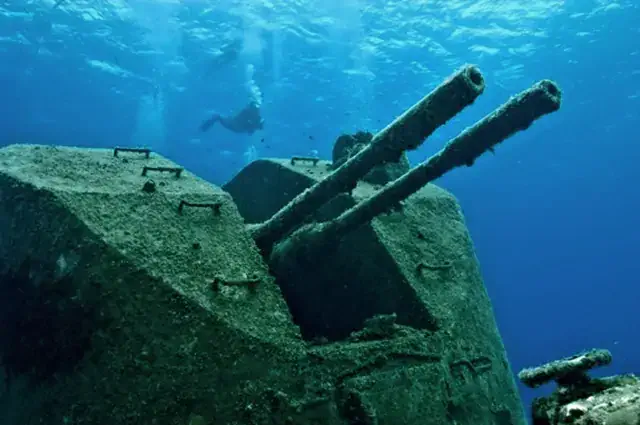
SS Zealandia
Darwin, NT
SS Zealandia
By ScubaDownUnder Team · 2026-07-20
For thirty-two years before the war, the SS Zealandia worked the Sydney to Wellington passenger route as one of the Huddart Parker line's familiar ships, carrying passengers and cargo across the Tasman Sea. By 1942 she had been requisitioned for war service and was anchored in Darwin Harbour when the Japanese attack arrived. Today the Zealandia lies in two main sections in 18 to 24 metres of water in the outer harbour, a substantial dive on a ship that had a longer civilian life than most of the Darwin wrecks around her.
The Zealandia was built in Glasgow in 1910 and operated on the Trans-Tasman passenger and cargo trade through to her requisition for war service. By February 1942 she was in Darwin loaded for the South West Pacific theatre. Hit during the first wave of the 19 February attack, she settled in the outer harbour and broke gradually into two sections under sea action over the following decades. Her pre-war passenger life means the wreck holds a different character to the purpose-built war transports: cargo holds, passenger spaces and the structural fittings of a working merchant steamer alongside the deck guns and military equipment added for war duty. The Larrakia people are the traditional custodians of Darwin Harbour, and the wreck is protected under the Historic Shipwrecks Act 1976.
The Zealandia sits broadly upright but in two main sections, with the bow at around 18 metres and the stern at 24. The midships break is the most visually distinctive feature, with broken hull plates framing the cargo holds and the boilers visible through the gap. The wreck is heavily encrusted with sponge and coral after eighty years on the harbour floor. Operators run the dive as a circuit of the upper structure with the bow and stern sections sampled separately on multi-dive trips. Cargo holds, deck winches, the propeller shaft and the original passenger cabin structures are identifiable.
Marine life on the Zealandia is the Darwin Harbour assemblage in concentrated form: dense soft coral and sponge encrustation across the metal, schools of trevally and snapper through the central structure, lionfish along the rail edges and inside the broken cabin spaces. Scorpionfish lie still on the deck plating. Batfish drift in slow groups around the superstructure. Resident moray eels live inside the larger machinery and pipework spaces, and reef sharks pass through occasionally on tide change.
Darwin Harbour conditions apply: 8-metre tidal range, strong currents outside slack water, visibility 3 to 12 metres, water temperature 23 to 30°C, box jellyfish October to May, crocodile risk year-round, May to October dry season working window. The Zealandia's location in the outer harbour puts it in similar conditions to the Meigs and Mauna Loa, and the three sites are often dived in different combinations across a multi-day trip.
The Zealandia rewards repeat divers who slow down to read the structure of a passenger ship rather than a transport. The cabin spaces, partially collapsed but readable, hold the geometry of merchant marine architecture from a different era of shipping. Photographers find the midships break produces the most usable wide-angle shots in the harbour, with broken plating framing the boilers and cargo holds in dramatic form. Penetration of the holds is run by operators with appropriate guides and certification.
The Zealandia is the dive that introduces a longer historical thread into the Darwin wreck story. Where the Meigs and Mauna Loa were built for war service and lasted only their final voyages, the Zealandia carried passengers and freight across the Tasman for three decades before the morning of 19 February 1942. The wreck reads as an older ship, and the diving feels accordingly different.
## Site Access and Logistics
The SS Zealandia is a boat dive only. Standard departure points are Cullen Bay Marina and the Stokes Hill Wharf area, with a transit of around 25 to 30 minutes to the wreck. The Zealandia is often dived as part of a multi-day Darwin trip rotated with the Meigs and Mauna Loa.
Entry is a backward roll from the dive boat onto a fixed line at the wreck. Exit is up the line and re-board over the boat tubes, with safety stops conducted on the line. Surface marker buoy deployment may be required.
Minimum certification is PADI Advanced Open Water with deep diving experience. Forty logged dives is a sensible working minimum, and divers should be comfortable with the navigation challenge of the two-section wreck layout.
Bookings run through [Dive Darwin](https://divedarwin.com.au) and other Darwin charter operators.
## Sources
- Dive Darwin, Darwin wreck briefings: [https://divedarwin.com.au](https://divedarwin.com.au) - Australian National Shipwreck Database, SS Zealandia entry - Northern Territory Heritage Register, [Darwin Harbour wrecks](https://www.scubadownunder.com/dive-sites/darwin-harbour-wrecks) - Australian War Memorial, Bombing of Darwin records: [https://www.awm.gov.au](https://www.awm.gov.au) - Michael McFadyen's Scuba Diving, Darwin wreck references: [http://www.michaelmcfadyenscuba.info](http://www.michaelmcfadyenscuba.info) - Australian Maritime Museums Council, Trans-Tasman passenger trade history
Visibility at SS Zealandia
Visibility at SS Zealandia typically ranges from 3 to 12 metres, though it shifts with swell, wind and recent rainfall. May to October (dry season) generally offers the best conditions for diving here.