Fly Point to Pipeline Drift
Port Stephens, NSW
Fly Point to Pipeline Drift, Port Stephens
By ScubaDownUnder Team · 2026-10-11
The stairs at Fly Point lead down to a path cleared through the rocks, and on this dive that path is the last fixed point for the next half hour. On an incoming tide the water in front of Nelson Bay runs west, and divers who descend here do not come back the way they went in. They ride the flood for about 1.2 km along the southern shore of the port, beneath the mouth of the Nelson Bay marina and in towards its breakwall, and climb out at the Pipeline near the fishing co-op.
Michael McFadyen, whose write-up is the standard reference for the route, calls it a very good shore dive but only suitable for more experienced divers or those under close supervision of experienced divers. It is not a beginner's outing, and every part of the plan is built around current and boat traffic.
Port Stephens is a huge estuary with a narrow, shallow mouth, and its tidal flows are fierce. On the flood, ocean water surges around Nelson Head and runs along the southern shore of the eastern port, past three well-known shore-dive hotspots: Halifax Park, Fly Point and the Pipeline. This drift links the last two. It begins inside the Fly Point-Corrie Island sanctuary zone of the Port Stephens-Great Lakes Marine Park, protected from fishing since 1983. The classic high-slack dive at the start is covered in the guide to Fly Point and Halifax Park.
The plan starts on land. The exit is too far from Fly Point to walk back in gear, so at least one car goes to the parking area by the co-op before the group kits up. From the bottom of the stairs, divers swim out on the surface towards the port channel marker before descending, dropping early and staying tight if the current is already strong. The bottom starts at around 15 m, a little shallower closer in, and the dive becomes a long, low glide west over sand that rises and falls by half a metre to a metre at a time, deepening only a metre or so. Long runs of rope on the seabed make handy holds for pausing or waiting for a buddy. On a strong tide McFadyen has covered the full distance in 30 minutes, about 2.4 km/h or almost 1.8 knots.
Navigation is done by the clock. At around 15 minutes, divers begin angling towards shore at roughly 45 degrees to the left, reaching the shallower water near the breakwall at about 22-24 minutes. The target is a plastic pipe lying at right angles to the current, a good place to finish. It is not the old pipe that gives the Pipeline its name, which lies a little further on; reach that and the advice is to get out promptly, or getting back to the co-op becomes hard work. Turn in too early, at 11 or 12 minutes, and the drift delivers the group into the marina mouth. The warning signs are a current flowing from the opposite direction, dirtier water and a depth that stays at about 5 m. Local divers note that the inshore water between Fly Point and the marina, known as Seahorse Gardens, is ruled by an eddy that often runs against the tide.
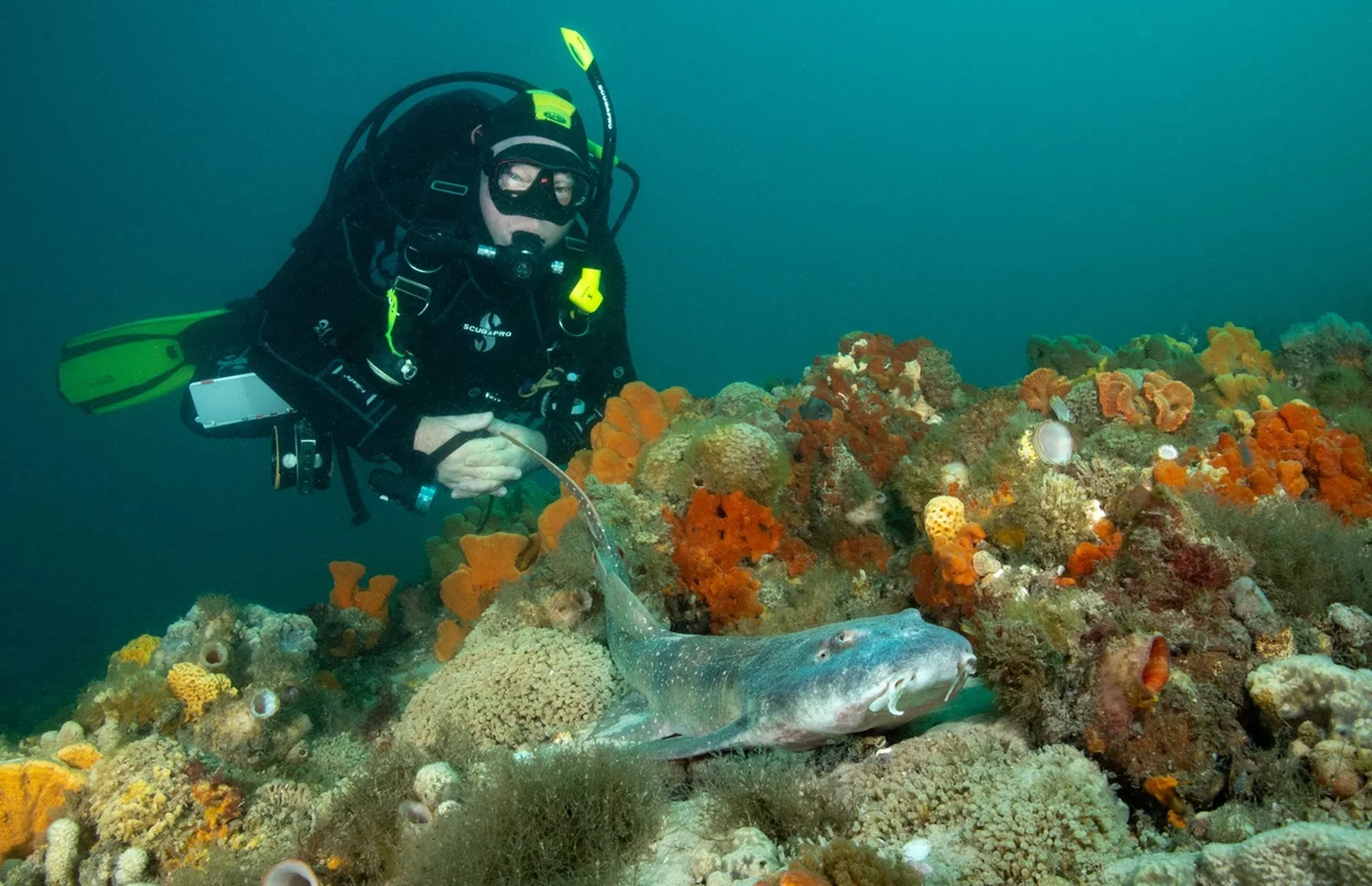
This drift is about the seabed more than the fish. Its headline is the soft coral, colourful and plentiful along the route, and sea pens in every colour. McFadyen notes the fish life is less prolific than on a dive wholly at Fly Point or Halifax Park, but there are some great bream, flathead and leatherjackets at the start, and small wobbegongs, Port Jackson sharks, large flathead and whiting can turn up along the way. NSW Marine Parks lists thorny seahorses, blue-ringed octopus and the elusive Nelson Bay anglerfish as often spotted at the Pipeline, and puts the best critter hunting between the old pipe and the breakwall, among sponges and soft corals at 7-9 m. Feet First Dive adds White's seahorses, ornate ghost pipefish, cuttlefish, pyjama squid and the striped nudibranch Polycera capensis. White's seahorse is endangered, and the Pipeline has a famous one: a female known as Dawn, tagged in 2014 and documented by Nelson Bay marine scientist David Harasti living at the site for more than seven years. Fish diversity across Nelson Bay peaks in late summer and early autumn, when the water is warmest.
Conditions turn on the tide. McFadyen's rule is that the drift can only be done on an incoming tide, preferably nearer high water, with the best start about an hour before high tide: enough margin to be a little late while still carrying the group to the exit at a good pace. General Nelson Bay advice warns divers off the rising tide because it sweeps them along the busy main channel; this drift takes that ride on purpose. On big spring tides, local estimates put the current beyond swimming speed once a diver is more than an hour from slack, so there is no swimming back to Fly Point. Smaller tides are gentler: around Fly Point, McFadyen finds 1.8-2.0 m tides very fast and 1.5 m tides easy to swim against. Many local divers plan from the Fort Denison (Sydney) predictions, with high water in the bay arriving roughly 20-30 minutes later.
Visibility follows the same rhythm. Around 7-8 m counts as good in Nelson Bay, 15 m happens on an exceptional day and under 1 m on a bad one. The incoming tide brings clean Tasman Sea water, especially with a southerly wind, while low tide fills the bay with Karuah River discharge, and heavy rain can spoil visibility for several days. Water temperature falls to about 16°C from July to September and climbs to around 23°C in February and March, so a 7 mm wetsuit with a hood suits winter and a 5 mm suit is comfortable in late summer. Sitting well inside the port, the route is rarely closed by swell; the tide and recent rain decide the day.
Boat traffic shapes everything else. The main boating channel from the marina runs past Fly Point and the drift passes beneath the marina entrance, so the firm local rule is never to surface mid-route, even if buddies separate: agree a lost-buddy plan before entering that keeps everyone below the boat traffic until the exit. Groups of two or three are the practical maximum. Careful macro work is better saved for a separate slack-water dive at the Pipeline, a long-standing favourite with night divers. The marina breakwall near the exit is a fish dive in its own right, with luderick, bream and sawtail surgeonfish massed along the rocks, though fishing line and tackle tangle the wall.
Most shore dives ask divers to explore; this one asks them to commit. Get the tide right, keep the group small and trust the clock, and the port does the swimming, carrying a few divers across a field of soft corals and sea pens, beneath the marina traffic and up into the critter-rich shallows of the Pipeline. Misjudge it, and the same water explains very quickly why Nelson Bay divers treat the tide table as their most important piece of kit.
Site Access and Logistics
The drift is a shore dive with separate entry and exit points in Nelson Bay, Port Stephens, about 2.5-3 hours' drive north of Sydney. Entry is at Fly Point: follow the beachfront past the roundabout to the small park where the main road turns right, gear up in the small car park, which fills early, and take the stairs to the cleared path into the water. The exit is at the Pipeline, past the main marina and the fishing co-op off Teramby Road, where concrete steps with a handrail sit about 25 m east of the old pipe. Leave a car at the co-op first.
The depth sits within Open Water limits, but the dive suits experienced divers only: Advanced Open Water with drift experience, or close supervision by someone who knows the route, is the sensible minimum. Enter only on an incoming tide, about an hour before high tide.
Feet First Dive, at 97 Stockton Street, Nelson Bay, offers guided dives, gear and tank hire, and advice on local tides.
Sources
- Michael McFadyen's Scuba Diving, Fly Point to The Pipeline Drift - Diving Nelson Bay, Tidal Currents - Indo Pacific Images, Diving Nelson Bay - NSW DPIRD, SCUBA diving and snorkelling in Port Stephens-Great Lakes Marine Park - Feet First Dive, The Pipeline - Diving Nelson Bay, Seahorse Gardens
Header photo: A splendid chromodoris nudibranch (Goniobranchus splendidus) at Fly Point, Port Stephens, by Sylke Rohrlach, CC BY-SA 2.0, via Wikimedia Commons.

Visibility at Fly Point to Pipeline Drift
Visibility at Fly Point to Pipeline Drift typically ranges from 3 to 10 metres, though it shifts with swell, wind and recent rainfall. Incoming tide only, enter about 1 hour before high tide generally offers the best conditions for diving here.
Right now: approximately 5 m, 98% confidence (updated 12:31 AEDT).
View the live forecast and 7-day outlook for Fly Point to Pipeline Drift →
Air, gear and guides near Fly Point to Pipeline Drift
Browse dive shops in Newcastle for fills, hire gear, servicing and guided dives at this site.