Shearwater Teric: Australian Diver Review
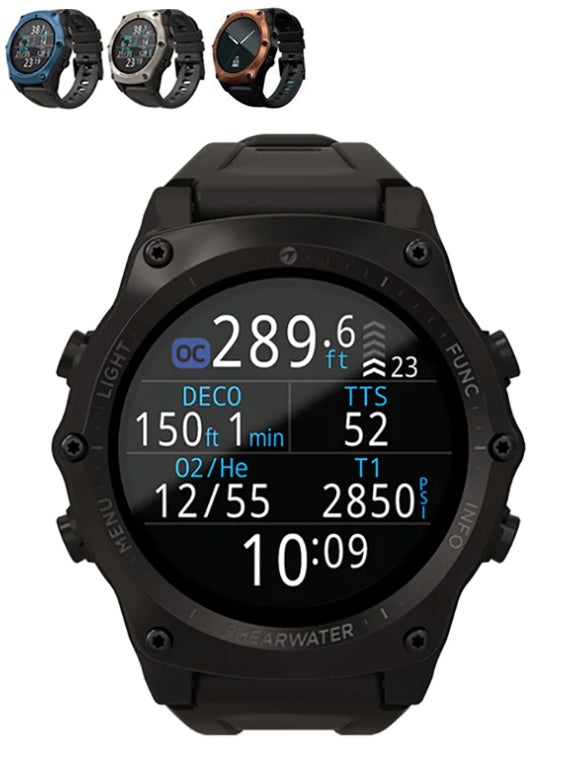
A full technical dive computer in a 120 gram watch case, with the brightest AMOLED display in the water and vibration alerts. Around $1,529 in Australia.
Where to Buy
Affiliate links — we may earn from qualified purchases
The Shearwater Teric is the best dive computer you can wear as a watch, and at around $1,529 in Australia it is priced accordingly. It packs genuine technical capability, five gases, trimix and closed circuit support, into a 120 gram watch-sized case with an AMOLED display that is the brightest thing in the water. For divers who want one computer that handles a Sunday shore dive at Shelly Beach and a decompression dive on the Yongala without compromise, this is the one to beat.
## Overview: Shearwater Teric
The Teric exists because Shearwater's earlier computers, brilliant as they were, looked like industrial instruments strapped to your arm. The Teric puts the same decompression engine into a 1.39 inch round case with a 316 stainless bezel, a sapphire crystal and a leather-or-rubber strap swap, so it passes as a watch topside and works as a full technical computer underwater.
The display is the headline. It is a full colour AMOLED at 400 x 400 resolution, and unlike the reflective MIP and LCD screens on most competitors, it emits its own light. That inverts the usual trade-off: where a MIP panel like the Mares Quad Ci gets better as ambient light increases, the Teric is at its most striking in exactly the conditions Australian divers complain about, green water off Melbourne, a dusk dive at Bare Island, or inside the Yongala's shadow. You read it at a glance without hunting for the backlight button.
Underneath, it runs Bühlmann ZHL-16C with Gradient Factors, the same algorithm Shearwater put in the Petrel and Perdix, so you set your own conservatism rather than accepting a manufacturer's fixed interpretation. It handles five open circuit and five closed circuit gases, supports up to four optional transmitters, and rates to 200 metres, which is well past anything a recreational or sport technical diver will do.
Against the Peregrine at roughly half the price, you are paying for the watch form factor, air integration and freediving mode. Against the Perdix 2, you are trading screen size and battery convenience for something you can actually wear to dinner.
## Key Features
- 3.5 cm full colour AMOLED display at 400 x 400 resolution behind a sapphire crystal - Bühlmann ZHL-16C algorithm with user-set Gradient Factors - 5 open circuit and 5 closed circuit gases, with trimix support in OC Tec mode - Optional wireless air integration for up to 4 transmitters - Dive modes: air, nitrox, 5 gas nitrox, OC technical trimix, closed circuit and bailout, gauge, freediving - 3 axis tilt compensated digital compass - Switchable vibration alerts alongside audible alarms - Rechargeable lithium ion battery, up to 30 hours dive time or 50 hours in watch mode, charged on an included wireless dock - Depth rated to 200 metres - 500 hours of dive logging at 10 second sampling, 120 grams on the wrist
## The Good
- **The AMOLED display genuinely changes how you read a computer.** On a night dive at Chowder Bay or in the tannin-stained water off Tasmania, an emissive screen is legible instantly where a reflective one needs a backlight press. Colour coding for deco status and gas warnings is immediate rather than something you interpret from a number. - **Vibration alerts are the underrated feature.** Audible alarms are easy to miss under a hood in a 7 mm suit, or in current with a regulator hissing. A wrist buzz for a missed ascent rate or a deco ceiling is impossible to ignore, and for divers with any hearing loss it is the difference between an alarm that works and one that does not. - **Gradient Factors put decompression in your hands.** Running 45/85 versus the default is a real, considered choice for repetitive multi-day diving on a Coral Sea liveaboard. Once you have dived a computer that lets you set conservatism deliberately, fixed-algorithm computers feel like guesswork. - **It works as a watch, which means you actually wear it.** Sounds trivial, but a computer on your wrist on the drive to the site is a computer you have not left on the kitchen bench. At 120 grams with a swappable strap it is comfortable for all-day wear. - **The technical headroom means you will not outgrow it.** Five gases, trimix and closed circuit support cover everything short of serious cave and CCR expedition work. Buy it as an advanced recreational diver and it will still be the right computer three certifications later.
## The Bad
- **The battery is not user-replaceable in the field.** It is an internal rechargeable cell with a typical five year service life, replaced by Shearwater rather than by you with a coin and a spare. On a remote trip to the Rowley Shoals, forgetting the charging dock is a genuine problem in a way that a spare AA never is. - **AMOLED costs you endurance.** Thirty hours of dive time is plenty for a normal trip, but it is well short of the sixty to one hundred hours a Perdix 2 gets from a single AA, and the screen is the reason. You will be charging weekly on a liveaboard. - **The screen is small for heavy decompression work.** A 3.5 cm round display is elegant, but if you are running multiple gases and a long deco schedule, the 2.2 inch Perdix 2 shows more at once and is easier to read with presbyopic eyes behind a mask. - **The price is real, and the transmitters are extra.** At around $1,529 before you add air integration, the Teric is a serious purchase. The Peregrine delivers the same core algorithm and display quality for roughly half, if you can live without the watch form and air integration.
## Verdict
The Teric is the most complete recreational and sport technical dive computer on the market, and the only one that seriously works as an everyday watch. The AMOLED screen, vibration alerts and Gradient Factor control are not spec sheet padding, they change how the computer behaves on real dives in the conditions Australians actually dive in. The compromises are the price, the sealed battery and a screen that is elegant rather than expansive.
Buy it if you want one computer for everything and you value the watch form factor enough to pay for it. Look at the Peregrine if you want Shearwater quality on a budget, or the Perdix 2 if you are heading into expedition or heavy decompression diving where a field-swappable AA battery matters more than looking good at the pub afterwards.
Star Rating: ⭐⭐⭐⭐½ (4.5/5)
Where to Buy
Get the Shearwater Teric: Australian Diver Review and experience the difference quality gear makes underwater.